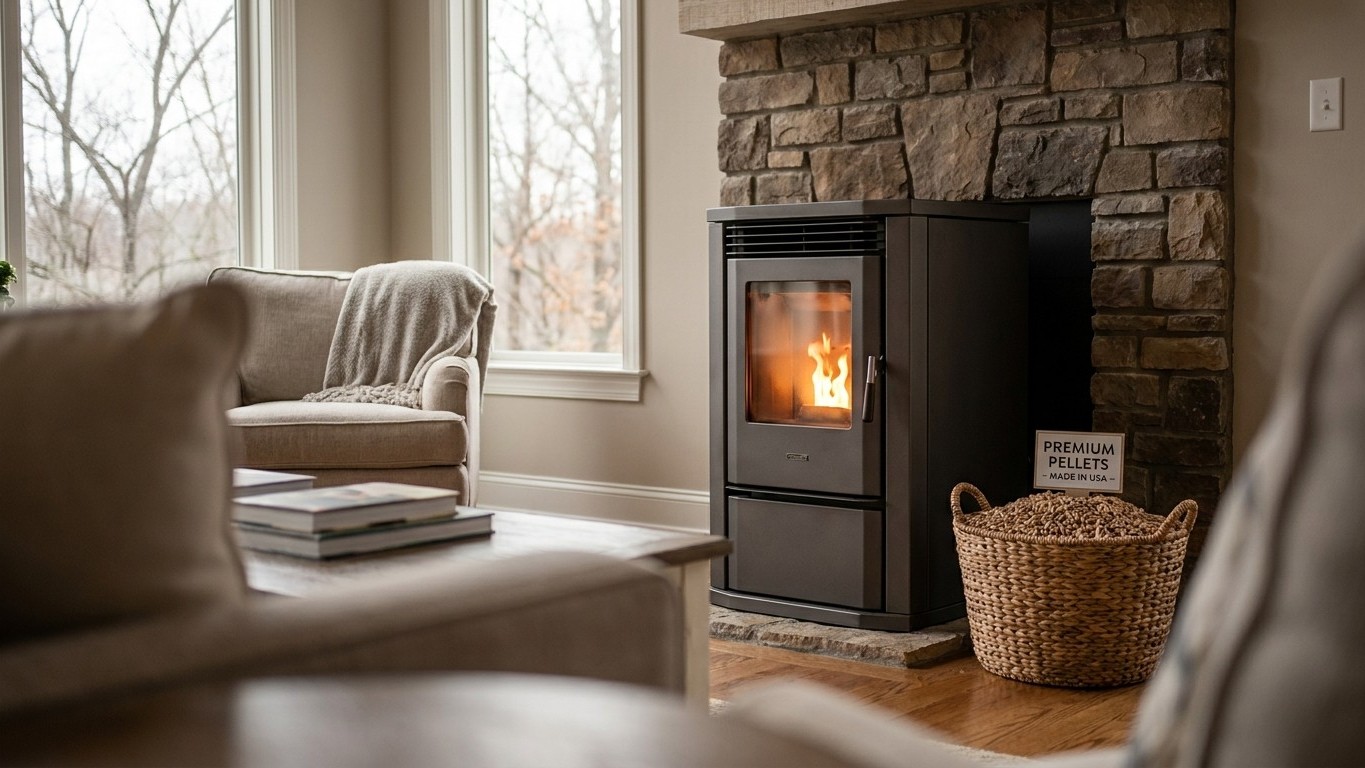

In and around Moncton, a pellet stove burns through roughly 2.5 to 4 tons of fuel over a typical winter for a house that leans on it as a main heat source, and less for one using it as a supplement. The reason sits in the region’s degree-day numbers, which run high and long. Whether your own number lands near the low or high end depends on your house, your thermostat habits, and how many other heat sources you’re running alongside it.
How hard the winter works here

Moncton A, the reference climate station for southeastern New Brunswick, averages about 4,696 heating degree days a year below 18°C, according to Environment and Climate Change Canada’s 1981-2010 Climate Normals. That single number is the whole story behind every ton of pellets a household burns: a house exposed to twice the degree days of another needs roughly twice the fuel to stay at the same indoor temperature, all else equal.
What makes this figure meaningful is that it’s not concentrated into three brutal months. The monthly breakdown shows demand starting in September, when the normal mean daily temperature (13.6°C) first drops below the 18°C baseline ECCC uses to count degree-days. It builds through the fall (322 degree-days in October, 484 in November), peaks hard in January at 832, and only tapers below the baseline again in July. That’s close to ten months a year where the house is losing heat to the outside, even if the losses in September or May are mild compared to January.
Depth and length are two different questions, and this station answers both at once. The depth tells you January will demand far more fuel per week than October. The length tells you the stove isn’t a three-month appliance here: it has a legitimate job from early fall through late spring, with only a brief true break in midsummer. For a homeowner deciding whether a pellet stove will function as a real heating system or as a supplemental comfort feature, a number like 4,696 degree-days points toward the former. This is a climate where the stove can carry meaningful load, not just take the chill off a few cold evenings.
One caution worth repeating: this is a single station’s data, drawn from Moncton. New Brunswick stretches from the Bay of Fundy coast to the Restigouche highlands in the north, and microclimates vary. A house in Edmundston or along the upper Saint John River valley likely sees a colder, longer season than Moncton’s numbers show; a coastal spot near Saint John may see a milder one. If you’re outside the Moncton area, treat this figure as a reasonable regional anchor, not a precise reading for your own address.
How many tons a winter takes here
Nobody can hand you a single trustworthy figure for “a winter’s worth of pellets in New Brunswick,” because no source publishes one at that level of precision, and two houses on the same street can differ by a factor of two depending on how they’re built and used. What you can do is work the math the same way pellet buyers everywhere do, then adjust for what you now know about this region’s degree-day load.
Start with the units. A standard bag weighs 40 pounds. Fifty bags make a ton. From there, consumption tracks the heat the house actually needs to replace, which is exactly what the degree-day figure above measures. A house that needs to replace more heat, because it’s colder outside for longer, burns more bags to do it.
Three variables move the final count more than anything else:
- How well the house holds heat — insulation, air sealing, window quality, and even how exposed the house is to wind can shift consumption by a large margin between two similarly sized homes.
- Whether the stove is the only heat source or a supplement — a stove carrying the full load through a Moncton-area January burns far more than one that only tops up a heat pump or electric baseboard system on the coldest days.
- The setting it runs at — a stove dialed down for background warmth uses a fraction of what the same appliance burns running at a high setting to hold a full house at 70°F through a January cold snap.
Given that spread, the most reliable number available to you isn’t a published estimate at all. It’s your own first winter. Buy a modest supply, track how many bags you actually burn from the September start of the season through the spring, and use that count as your baseline for every winter after. One measured season on your own thermostat and your own walls beats any regional estimate, including the range at the top of this page. For the general method behind that math, the site’s guide on how many pellets a winter takes walks through the calculation in more detail.
Buying and storing them in this climate
Timing matters more here than the calendar might suggest. With heating demand climbing back through October and hitting real weight by November, the smart window to buy is before September, while dealers are still stocked and prices haven’t reacted to the season’s first serious cold snap. Wait until a hard November arrives and you’re competing with every other household in the region for the same pallets, often at a worse price and with less choice over quality or brand.
Storage is where this region’s climate asks something specific of you. Wood pellets are compressed sawdust, held together by the natural lignin in the wood rather than any added glue, which means they have no tolerance for moisture. A humid Maritime summer, a damp basement, or a garage floor that sweats with temperature swings between a cool night and a warm afternoon can all be enough to swell and crumble a bag from the inside, long before you ever get it near the stove. New Brunswick’s coastal humidity and its wet shoulder seasons both work against pellets sitting exposed on a concrete floor or under a leaky tarp.
Elevate bags off any bare floor, keep them under a roof rather than under plastic sheeting alone, and check a sample bag partway through storage rather than assuming the whole stack is fine because the top one looks dry. When you’re comparing supply options, price only makes sense per ton, since bag sizes and pallet counts vary between sellers and a per-bag price hides the real cost difference. For the details on keeping pellets dry and judging fuel quality before you buy, the site’s dedicated guides on pellet storage and pellet quality cover both in full.
What a winter outage means here
A pellet stove is not a wood stove, and the difference shows up the moment the power goes out. Feeding pellets from the hopper into the firebox and moving warm air into the room both depend on small electric motors, an auger and a blower, that do nothing without an electrical supply. Cut the power and the stove goes cold no matter how full the hopper is.
Cross that constraint with the degree-day numbers from earlier and the stakes become clear. An outage during a mild stretch in October or a warm spell in April is an evening without the stove, mildly annoying and nothing more. An outage during a January cold snap, when the Moncton-area station is racking up 832 degree-days for the month alone, is a genuine heating emergency for any household counting on that stove for real warmth.
What households actually fall back on matters here too. Statistics Canada’s 2023 data on primary heating systems shows New Brunswick leaning heavily on electric heat already: 31% of households use electric baseboard heaters as their main system, and another 27% run a heat pump, with forced-air furnaces at 9%. The survey doesn’t publish a reliable figure for heating stoves as a primary system, which means that data point is suppressed for reliability, not zero. The practical takeaway is blunt: a wide power outage in this province doesn’t just take out the pellet stove. It takes out the baseboard heaters and the heat pump running most other households’ primary heat at the same time, since none of those systems run without grid power either.
That leaves the honest planning steps outside the scope of any general estimate. Check your specific stove’s electrical draw on its appliance label before assuming any backup power source will run it, and see the site’s guide to pellet stoves and power outages for how to size a response around your own equipment rather than a generic number.