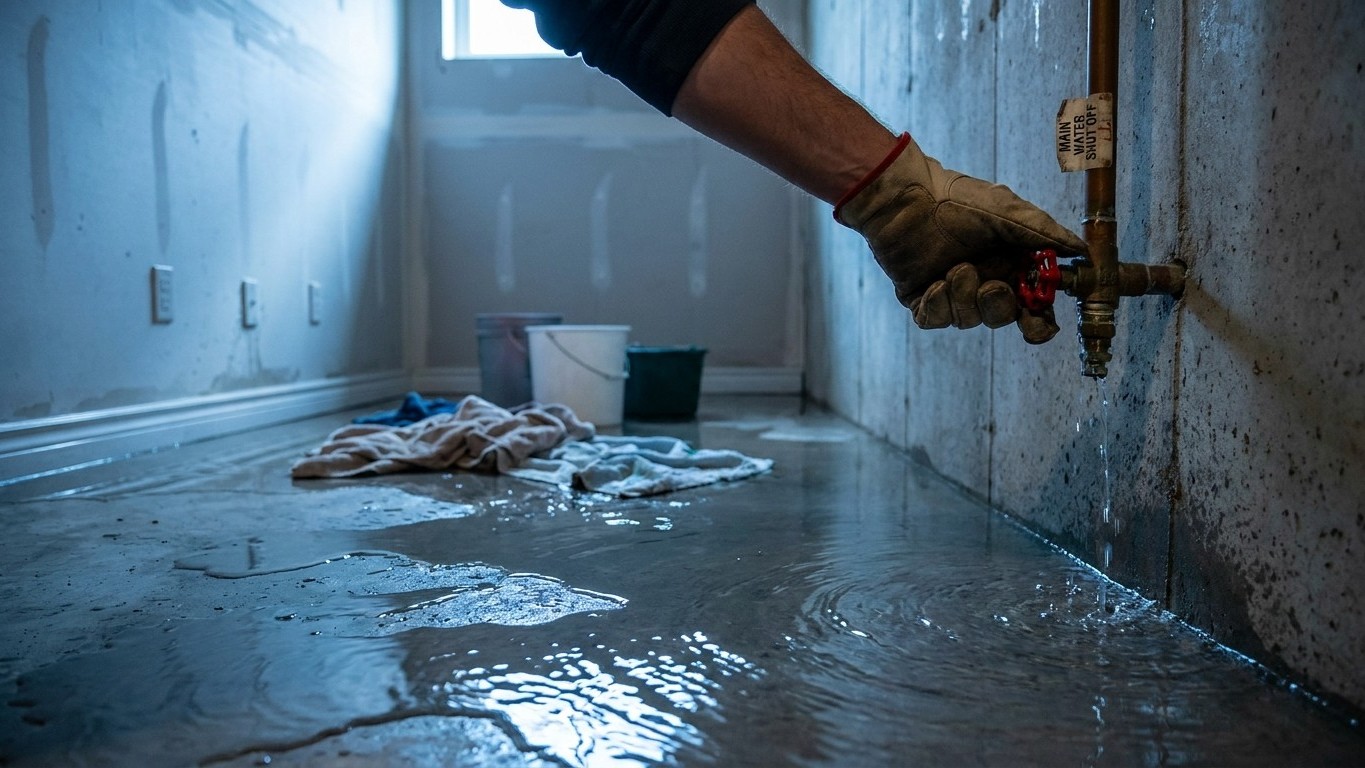

Water spreading across a floor in seconds means one thing matters more than any other: shutting off the supply before anything else. Find your main shut-off valve now, before you need it, because in a real burst you won’t have time to search. Turn it clockwise until it stops. If water is anywhere near outlets, switch panels, or a water heater, cut power at the breaker before you step into the flooded area. Everything else, towels, buckets, phone calls, comes after those two moves.
What is actually happening
A burst pipe isn’t a leak that got worse. It’s a failure point, usually from frozen water expanding, corroded metal thinning out, or a joint under stress finally giving way, and once it lets go, the water behind it is under constant pressure from your home’s supply line. That’s the part people underestimate. A dripping faucet loses water by the drop. A burst pipe loses it by the gallon per minute, nonstop, until something interrupts the pressure feeding it.
That’s why the order of operations isn’t a suggestion. Water off at the main comes first because it’s the only action that actually stops the flow. Everything downstream of that valve, every fitting, every branch line, is still pressurized until you turn it. Power off comes second, and only when water is near electrical components, because standing water and live circuits are a shock and fire risk that outranks the flooding itself.
Why the sequence matters
Skipping ahead to grabbing towels while the main is still open just means you’re mopping a puddle that keeps refilling. Cutting power before checking whether water is even near an outlet can leave you fumbling in the dark for no reason if the leak is confined to, say, a laundry room with no wiring nearby. The mechanism decides the order: stop the source, then remove the hazard, then deal with the damage. Once the main is off, the flow doesn’t stop instantly, there’s still water in the pipes between the valve and the break, but it tapers off within a minute or two instead of continuing indefinitely.
Only after both of those are handled does it make sense to move furniture, soak up standing water, or start photographing damage for an insurance claim. A homeowner who understands this sequence can adapt it to their own layout, whether the main valve is in a basement, a crawlspace, or a utility closet, because the logic (stop the source, remove the hazard, then manage the mess) holds regardless of where the actual valve sits in your house.
What to check, in order
Once the water and, if needed, the power are off, work through these checks from cheapest and fastest to more involved. Each one tells you something specific about what you’re dealing with.
- Confirm the main valve actually stopped the flow. Watch the break point for thirty seconds. If water is still running, either that valve doesn’t control the affected line, or there’s a second source (an appliance supply line, an outdoor spigot) still feeding it.
- Check the water meter. With the main off and no fixtures running, the meter’s leak indicator (often a small triangle or dial) should sit still. If it’s still spinning, water is moving somewhere in the system that your main shut-off doesn’t reach.
- Look at where the water is pooling. Water tracking along a floor toward a wall or down through a ceiling tells you it’s already migrating into structure, which changes how urgent professional help becomes.
- Check nearby outlets and switches for moisture before touching them, even after cutting power. A damp cover plate means the water traveled further than the visible puddle suggests.
- Assess the pipe material and location of the break. A break you can see and reach, on an exposed section of copper or PEX in a basement, is a very different situation than one you can only hear, behind drywall or under a slab.
Each result narrows down what you’re actually facing. A meter that stops spinning and a break you can see and access are the best-case combination. A meter still moving, or a break hidden behind a wall, both point toward calling in a professional rather than continuing to troubleshoot on your own.
What it costs to leave it
It’s tempting to think a burst pipe is a one-time event: it happens, you shut it off, it’s done. But the water that got out before you reached the valve, and any that continues seeping from a break that wasn’t fully isolated, adds up faster than most people expect. The U.S. EPA WaterSense program notes that “household leaks can waste nearly 1 trillion gallons of water annually nationwide”, and that “the average household’s leaks can account for more than 9,300 gallons of water wasted every year.” Those numbers describe the country as a whole, not your specific pipe, but they establish something worth sitting with: leaks are rarely small in total, even when they look minor moment to moment.
The same EPA data notes that “nine percent of homes have leaks that waste 50 gallons or more per day.” A burst pipe, even a small one that’s mostly stopped, can push a household into that category quickly if the break isn’t fully sealed and the line stays pressurized in the meantime. Compare that to a slow drip: EPA figures show “a leaky faucet that drips at the rate of one drip per second can waste more than 3,000 gallons per year,” and “a showerhead leaking at 10 drips per minute wastes more than 500 gallons per year.” A burst pipe operates on a different scale entirely, which is exactly why the shut-off has to happen in minutes, not after you’ve finished assessing the damage.
None of these national figures tell you what your specific leak cost you. Your water meter does that, and reading it correctly after an incident like this is worth doing properly rather than guessing. Fixing leaks generally, per WaterSense, can help “save homeowners about 10 percent on their water bills,” which gives a sense of the financial upside of catching problems early rather than letting them run. For the actual method of checking your own meter and tracking your own usage, see this site’s page on finding a hidden leak.
When to stop and call a plumber
Some situations are within reach of a confident homeowner. Others aren’t, and pretending otherwise is how a bad afternoon turns into a much worse week. Water damage moves fast and quietly, soaking into drywall, subfloor, and framing long before it becomes visible as a stain or a sag, so the line between “handle it yourself” and “call now” needs to be clear rather than a judgment call made under stress.
Call a licensed plumber, and do it before attempting further fixes, in these situations:
- The break is behind a wall, under a floor, or anywhere you can hear or see water damage but can’t reach the pipe itself.
- The failure involves the main supply line itself, rather than a branch line feeding a single fixture or appliance.
- A gas water heater is involved in any way, whether it’s leaking, sitting in standing water, or its supply line is the source of the break.
- Water has already soaked into drywall, subfloor, insulation, or framing, even if the active leak has stopped.
Any one of these means the problem has moved past a simple shut-off-and-mop situation. A pipe behind a wall might look contained, but you have no way of knowing how far the water traveled before it reached a spot where it became visible. A gas water heater near water is a hazard that combines flooding with a fire or carbon monoxide risk, not something to troubleshoot casually. And wetted structure, drywall, subfloor, framing, starts a mold clock that runs whether or not anyone is watching it.
Before that call, though, the shut-off still comes first. A plumber arriving to find the main already off and the area already assessed can move straight to repair instead of starting with damage control. For the specifics of locating and operating your home’s shut-off valves, this site’s dedicated shut-off page walks through the process for different valve types and locations.
Common questions
How fast can a burst pipe flood a room?
It depends on pipe size and water pressure, both of which vary by home and aren’t things this page can estimate generically. What’s consistent is that the flow doesn’t slow down on its own. It continues at full pressure until the main valve is shut, which is why finding that valve ahead of time matters more than any other single preparation step.
Should I try to patch the pipe myself before calling a plumber?
If the break is exposed, accessible, and clearly isolated from structure, a temporary patch can buy time. If it’s behind a wall, involves the main line, or has already wetted drywall or framing, skip the patch attempt and call a licensed plumber instead, per the boundaries above.
Does homeowners insurance typically cover burst pipe damage?
Coverage varies by policy and by cause (sudden failure versus long-term neglect are often treated differently), so this is a question for your specific insurer rather than a general rule. Photograph the damage and the shut-off area before cleanup starts, regardless of what the policy says.
How do I know if my main shut-off valve is even working?
Turn it off during a moment with no emergency, then check a faucet on the lowest floor of the house. If water still flows, or flows for more than a minute or two, the valve may be partially seized or not controlling the line you expect. Testing it now, rather than during a burst, is the whole point.