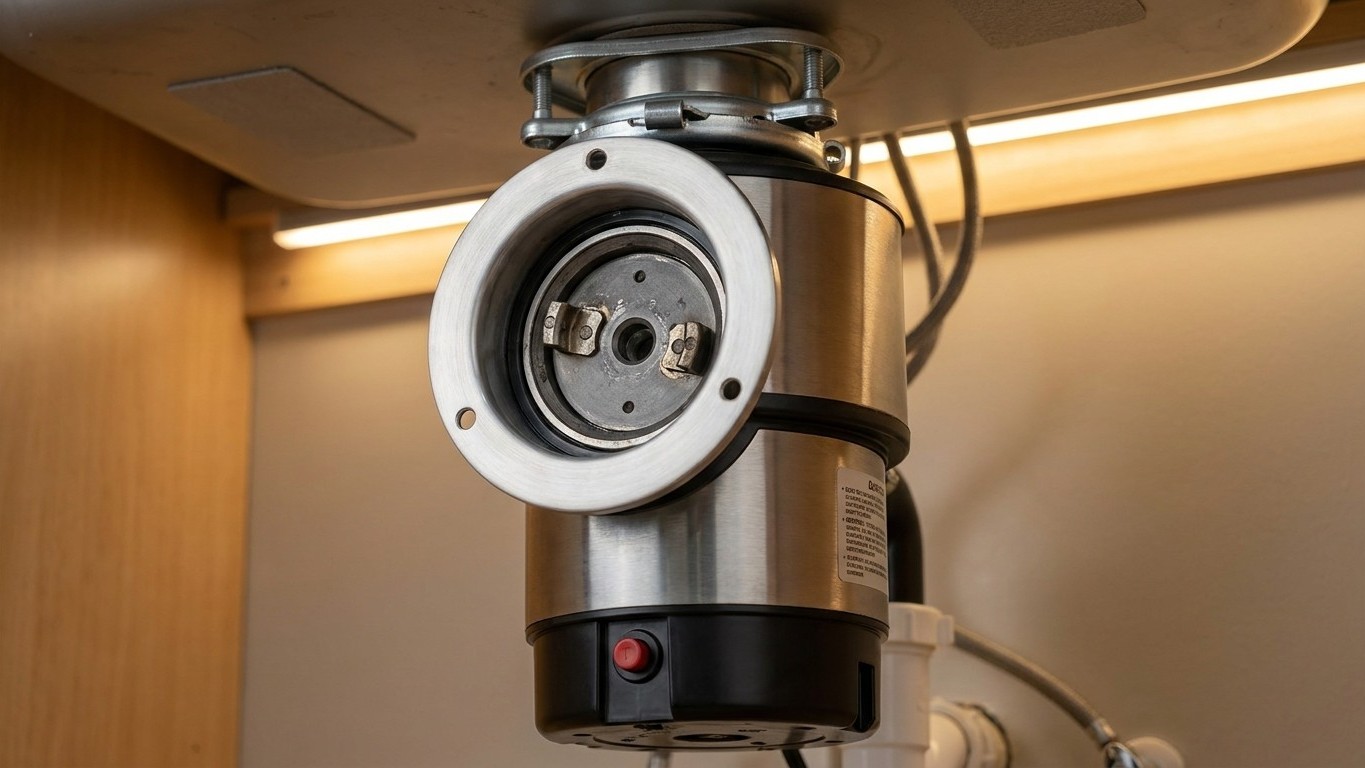

A garbage disposal that hums without spinning has a jam, not a dead motor. Power is reaching the unit and the motor is trying to turn, but something inside the grinding chamber is stopping the plate from rotating. A disposal that smells is a separate problem entirely: trapped food, not electrical failure. Both faults are usually fixable in under 15 minutes with one household tool, once you understand the two features built into almost every disposal that most owners never notice.
What is actually happening
A disposal motor doesn’t stop and start with each use the way a drill does. When you flip the switch, the motor spins at full speed almost instantly, turning a flat plate at the bottom of the grinding chamber. That plate isn’t lined with blades. It carries two blunt metal lugs that fling food scraps outward against a stationary grind ring, which is what actually breaks the material down. This matters because it explains the hum: if a bone fragment, fruit pit, or piece of glass wedges between the plate and the ring, the motor still has power and still tries to spin. It just can’t. The result is a steady electrical hum with zero rotation, and within a few seconds an internal thermal overload switch often trips to keep the motor from burning out.
That thermal switch is the first thing worth understanding, because it’s not a repair part, it’s a safety feature you reset yourself. Look at the underside of the unit, near the bottom of the housing. On most models there’s a small red or black button, roughly the size of a pencil eraser. When the motor overheats from trying to push through an obstruction, that button pops outward automatically, cutting power before anything melts. Pushing it back in restores power, but only after the jam itself is cleared. Reset it first and the disposal will just hum and trip again.
The hex socket most owners never use
The second feature is the one that actually solves the jam. Centered on the bottom of the disposal housing, underneath the sink, there’s a hexagonal opening built into the motor shaft itself. It’s designed to accept a standard 1/4-inch hex wrench, inserted from below and turned by hand. Because that opening connects directly to the same shaft that spins the grinding plate, rotating it manually forces the plate to move back and forth from outside the unit, without ever putting a hand or utensil into the grinding chamber. A few firm turns in either direction usually frees whatever is wedged against the ring. This is the mechanism every disposal repair depends on. Once you understand that the hex socket physically turns the same plate the motor turns, you can adapt the process to any brand or model, because the socket location and size are standardized across nearly all residential units, even when the housing shape differs.
Smell is a different mechanism altogether and has nothing to do with the motor or the plate. A rubber baffle, sometimes called a splash guard, sits just inside the drain opening to stop water from splashing back up. Small scraps of food regularly get caught in its folds instead of washing down, and because that space stays damp and dark, trapped organic matter starts to break down anaerobically within a day or two. That’s the source of nearly every disposal odor, and it has no connection to a jam or a hum.
What to check, in order
Work through these checks from cheapest and most likely to more involved. Each result tells you something specific about where the fault actually sits.
- Listen first. Flip the switch for no more than two seconds. A steady hum with no motion means a mechanical jam, as described above. Complete silence with no hum at all points to an electrical problem instead, such as a tripped reset button, a tripped circuit breaker, or a loose connection, and no amount of turning the hex socket will fix that.
- Check the reset button. Push it in. If it stays in and doesn’t pop back out within a few seconds, the thermal switch has reset successfully and you can move to clearing the jam. If it pops right back out, the motor is still overheated or still under load, and needs a few minutes to cool before trying again.
- Turn the hex socket by hand. With power switched off at the wall or unplugged under the sink, insert a hex wrench into the bottom socket and work it firmly in both directions. Resistance that suddenly gives way, followed by the wrench turning freely, means the obstruction has broken loose. Resistance that never gives means something larger or harder is wedged in, and you’ll need to look inside from the top with a flashlight before going further.
- Look inside the chamber. With power off, shine a light down the drain opening and use tongs, never fingers, to remove anything visible: bone chips, fruit pits, bottle caps, or utensils that fell in. Finding an obvious object explains the entire jam and usually means the unit runs normally the moment it’s out.
- Check for smell separately. If odor is the complaint rather than a jam, pull back the rubber baffle at the drain opening and look for trapped scraps clinging to its underside. A buildup here, rather than anywhere deeper in the unit, accounts for the vast majority of persistent disposal smells and needs nothing more than removal and a rinse.
- Check the outlet and breaker last. If there’s no hum and the reset button holds, test the outlet with another small appliance and check the breaker panel. A tripped breaker or dead outlet points to wiring, not to the disposal itself, and is worth ruling out before assuming the unit has failed.
What it costs to leave it
A jammed disposal that keeps tripping its reset switch isn’t typically a water-wasting problem, it’s a nuisance and an electrical safety one. But once you’re under the sink working on a disposal, you’re looking at exactly the kind of fitting, hose connections and drain seals, where household leaks quietly start. That’s worth taking seriously, because the numbers behind hidden household leaks nationally are larger than most people expect.
According to the U.S. EPA WaterSense program, “household leaks can waste nearly 1 trillion gallons of water annually nationwide,” and “the average household’s leaks can account for more than 9,300 gallons of water wasted every year.” The program also notes that “nine percent of homes have leaks that waste 50 gallons or more per day.” Those figures come from faucets, toilets, and showerheads across millions of homes, not from disposal units specifically, and they describe a national pattern, not any single household’s bill.
Still, the scale is worth sitting with. EPA WaterSense points out that “a leaky faucet that drips at the rate of one drip per second can waste more than 3,000 gallons per year,” and “a showerhead leaking at 10 drips per minute wastes more than 500 gallons per year.” An old or worn toilet flapper, the program adds, “can cause your toilet to flush on its own or silently leak thousands of gallons a year.” None of that is caused by a disposal jam. But it illustrates how a slow drip under a cabinet, easy to ignore while you’re focused on freeing a grinding plate, can add up over months without anyone noticing.
The upside is that “fixing easily corrected household water leaks can save homeowners about 10 percent on their water bills,” per the same source. That figure is a national average, not a prediction for any one home. The only number that actually applies to your house is the one on your own water meter. If you suspect a slow leak anywhere near the disposal connections, a simple meter check, described on our page about finding a hidden leak, will tell you far more than any national statistic can.
When to stop and call a plumber
Most disposal jams and smells are things you can safely handle from under the sink with a hex wrench and a flashlight. The line to stop at is a physical one, not a matter of confidence or patience.
Anything happening inside a wall, rather than at the visible connections under the sink, is past the point of a DIY fix. If water is showing up on a wall or floor near the kitchen and you can’t trace it to the disposal’s own fittings, that points to a supply or drain line running through the structure itself, and opening a wall to chase it is a plumber’s job, not a weekend project. The same goes for anything touching the home’s main water supply line rather than the isolated shutoff for the sink. A disposal repair never requires touching the main; if you find yourself there, you’ve gone further than the problem required.
Gas water heaters deserve their own mention, even though they seem unrelated to a kitchen disposal. Under-sink plumbing work sometimes runs a homeowner into nearby gas lines or venting for a water heater in a tight utility space, and gas connections are never a place to guess. If a repair path brings you anywhere near a gas line or appliance, stop and call a licensed plumber.
Last, any leak that has already soaked into a cabinet floor, subfloor, or drywall has moved past a plumbing issue into a moisture and mold issue. Wet wood and wet drywall don’t dry evenly on their own, and papering over a soaked cabinet base without addressing what’s underneath just delays a bigger repair. Before doing any work near the disposal’s water connections, it’s worth knowing exactly where your fixture shutoff is, which our shut-off valve page walks through, so you can isolate water to that one line without cutting off the whole house while you work.
Common questions
Why does my disposal hum but not spin even after I reset it?
The reset button restores electrical power, but it doesn’t clear a jam. If the plate is still physically obstructed, the motor will hum, try to turn, and trip the reset switch again within seconds. Clear the obstruction with the hex socket first, then reset.
Is it safe to reach into the disposal to remove a stuck object?
No. Always cut power at the wall switch or unplug the unit under the sink before reaching in, and use tongs rather than fingers even then. The lugs on the grinding plate can move unexpectedly if the motor is still connected to power.
Why does my disposal smell bad even though it runs fine?
A working motor has nothing to do with odor. Smell almost always comes from food trapped against the rubber baffle at the drain opening, where it sits and decomposes out of the water stream.
How often should I run water while using the disposal?
Running cold water before, during, and for a short time after grinding helps flush scraps fully down the drain line instead of leaving them to settle near the baffle, which is one of the simplest ways to prevent both smell and future jams.