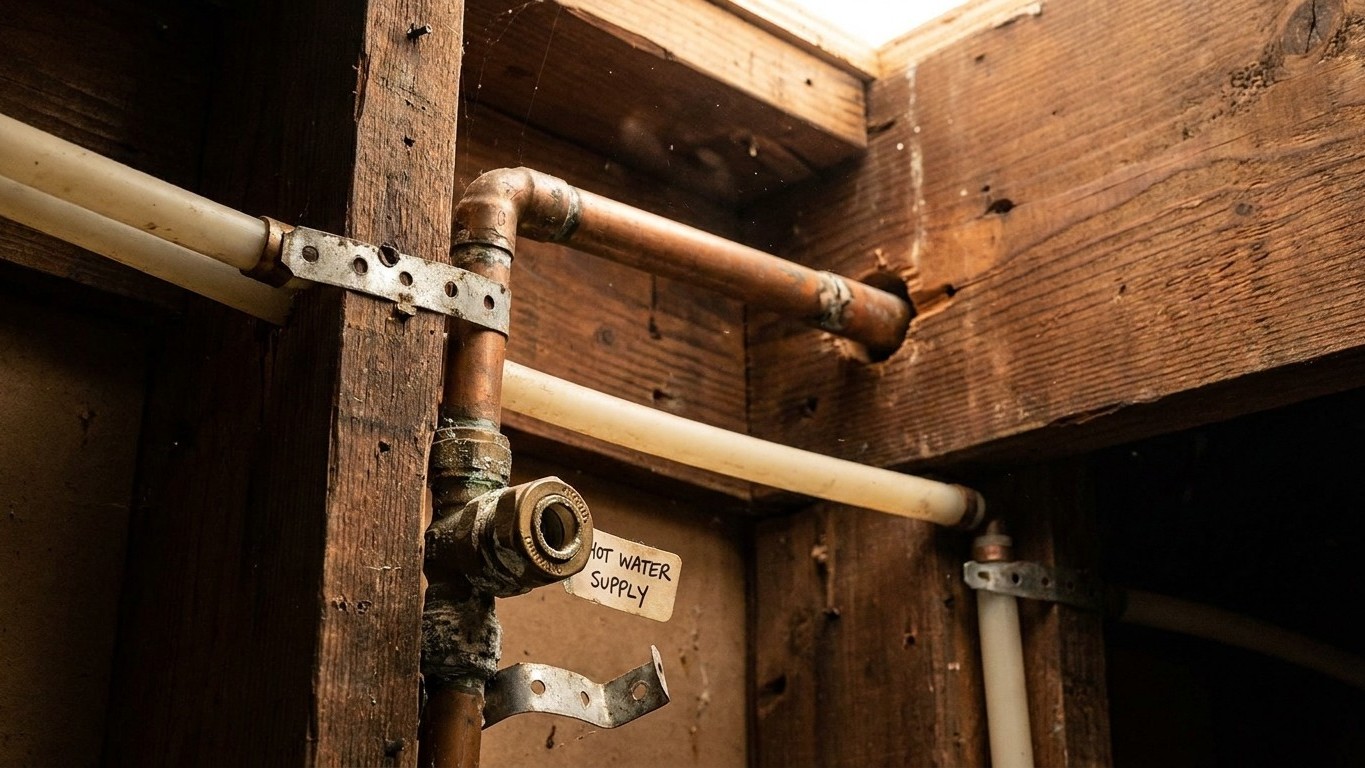

Noisy pipes almost always trace back to one of three mechanisms: a restriction squeezing water through a narrow gap, a temperature swing flexing metal against wood or metal against metal, or a pipe that’s lost its grip on the framing and now slaps a stud every time water moves. The fix depends on which one you’ve got. A whistle points to a valve or fixture. A tick points to a hot-water line. A rattle points to a loose strap. None of the three require opening a wall to diagnose.
What is actually happening

A whistle is air or water being forced through an opening that’s too small for the flow trying to get through it. Think of it like wind through a cracked window, but with water pressure doing the pushing. The usual suspects are a valve that isn’t fully open, a worn washer inside an old-style compression valve, or mineral scale that’s built up inside a supply line or fixture and narrowed the passage. The sound is highest-pitched right at the restriction, which is why it often seems to come from one specific faucet or toilet fill valve rather than the wall generally.
A tick is a different animal entirely. Copper and PEX both change length as they heat and cool, expanding a small but measurable amount every time hot water runs through them and contracting again as they cool back down. If a pipe passes through a framing hole or rests against a joist without any cushioning, that tiny movement turns into a scrape or a tick as the metal slides against wood. It’s most noticeable right after you turn on a hot tap, or a few minutes after the water heater cycles, because that’s exactly when the pipe is moving through its expansion range.
A rattle means something has come loose. A strap that used to hold a pipe snug against a joist has loosened over the years, or a plastic clamp has cracked, and now the pipe has just enough play to bounce when water starts or stops moving through it. Rattles tend to show up right when you shut a valve fast, like A Washing Machine solenoid valve or an ice maker line, because the sudden stop sends a small shock down the pipe and an unsecured length has nothing to absorb it.
Why the sound itself is the diagnostic tool
Before touching anything, it’s worth just listening for a minute. A whistle that only happens at one fixture is almost never a whole-house problem. A tick that only happens with hot water is an expansion issue, not a pressure issue. A rattle that only happens on shutoff is a support issue, not a valve issue. Matching the sound to the mechanism saves a lot of wasted effort chasing the wrong fix.
What to check, in order
Work through these from cheapest and most likely to more involved. Each result tells you something different about which mechanism is at play.
- Run one fixture at a time and listen. If the noise only happens at a single faucet, showerhead, or toilet, the problem is local to that fixture, not the supply line feeding the house.
- Check that supply valves are fully open. Angle stops under sinks and toilets, and the main shutoff, sometimes get left partially closed after past repairs. A valve that’s most of the way open still passes water, but it creates the exact restriction that produces a whistle. Opening it fully and having the sound disappear confirms the cause.
- Clean the aerator or showerhead. Mineral deposits build up inside these small screens over time, especially in areas with hard water, and a partially clogged aerator narrows the opening enough to whistle. Removing and rinsing it is a five-minute test.
- Look at pipe supports in any accessible basement, crawlspace, or utility closet. A pipe resting directly against a joist with no strap, or a strap that’s cracked or loose, is the source of most rattles. Tightening or re-securing it, with something to cushion the contact, usually resolves the noise immediately.
- Note whether ticking only happens with hot water. If cold-only lines are silent and hot lines tick, that confirms thermal expansion rather than a loose fitting. The fix there is about giving the pipe room to move, not tightening it down harder.
- Pay attention to noise right when a valve shuts, like a washing machine or ice maker. A bang or rattle that happens only at shutoff points toward a fast-closing valve shaking an unsecured length of pipe, rather than a steady-flow restriction.
Most homeowners find the answer somewhere in the first three checks. The last three matter more when the noise is intermittent or tied to a specific appliance rather than general water use.
What it costs to leave it
Noisy pipes are usually a nuisance rather than an emergency, but they’re also a signal, and signals worth ignoring aren’t free. The U.S. EPA’s WaterSense program has tracked what unaddressed household leaks and worn fixtures add up to nationally, and the scale is worth knowing even though none of it tells you what your own house is losing.
According to WaterSense, “household leaks can waste nearly 1 trillion gallons of water annually nationwide,” and “the average household’s leaks can account for more than 9,300 gallons of water wasted every year.” The program also notes that “nine percent of homes have leaks that waste 50 gallons or more per day,” which is the kind of loss that starts showing up as a noticeably higher water bill rather than just a background noise.
Some of the specific figures line up directly with the kind of worn fixtures that cause whistling in the first place. WaterSense reports that “a leaky faucet that drips at the rate of one drip per second can waste more than 3,000 gallons per year,” and “a showerhead leaking at 10 drips per minute wastes more than 500 gallons per year.” A worn valve washer that’s causing a whistle is often the same worn part that’s letting water drip past when the fixture is supposedly off. Toilets carry their own version of this: “an old or worn flapper can cause your toilet to flush on its own or silently leak thousands of gallons a year,” often with no sound at all.
The upside is that these are, per WaterSense, generally cheap problems to fix relative to what they waste: “fixing easily corrected household water leaks can save homeowners about 10 percent on their water bills.” But every one of these numbers is a national aggregate from a conservation campaign, not a measurement of your plumbing. The only number that actually applies to your house is the one on your own water meter, and this site has a separate page walking through how to read it for a hidden leak.
When to stop and call a plumber
Everything above assumes the pipe in question is somewhere you can see, reach, and check by hand. That covers a lot of noisy-pipe cases, but not all of them, and it’s worth being honest about where the line sits.
If the noise is coming from inside a finished wall or ceiling with no access panel, stop there. Chasing a rattle or tick behind drywall means opening up finished surfaces, and a licensed plumber can often confirm the cause with a stethoscope or moisture meter before anything gets cut.
Anything involving the main water supply line, meaning the pipe between the street or well connection and your first shutoff valve, is not a do-it-yourself repair. That line is under constant pressure whether or not any fixture in the house is running, and a mistake there can flood a basement fast.
A gas water heater is its own category entirely. Ticking or popping that seems to come from the tank itself, especially combined with any smell of gas, rust-colored water, or a pilot light that won’t stay lit, calls for a professional rather than a DIY fix. Sediment buildup inside a gas tank can produce a rumbling or ticking sound as water boils under the sediment layer, and that’s a maintenance and safety issue, not a strap-and-cushion fix.
Finally, any noise that’s accompanied by actual water, meaning a damp spot on a wall, a soft patch of drywall, warped flooring, or a musty smell that wasn’t there before, means the leak has already reached structure. At that point the priority isn’t quieting the pipe, it’s stopping active water damage, and that’s worth a same-day call rather than a weekend project.
Common questions
Why do my pipes only whistle when I run the dishwasher or washing machine?
Appliances that fill through a solenoid valve create a sudden, narrow restriction each time they open, which is exactly the condition that produces a whistle. If the sound stops when the appliance finishes filling, the valve or its supply line is almost certainly the source rather than the house plumbing generally.
Is a ticking pipe a sign that something is about to fail?
Not usually. Ticking from thermal expansion is normal pipe behavior and, on its own, isn’t a sign of impending failure. It becomes worth attention only if it’s new, has gotten noticeably louder, or is paired with any sign of moisture nearby.
Can high water pressure cause pipes to rattle?
Yes, higher-than-typical pressure can make loose pipes bounce more when valves open and close, since there’s more force behind each surge. Securing loose supports helps regardless of pressure, but if rattling is happening throughout the house rather than at one or two points, it’s worth having pressure checked as part of the diagnosis.
Do noisy pipes always mean I’m losing water?
No. A rattle from a loose strap or a tick from thermal expansion doesn’t waste any water at all, it’s purely a mechanical noise. A whistle is the one most likely to be tied to an actual leak, since it often comes from the same worn valve or washer that lets water drip past when a fixture is off.