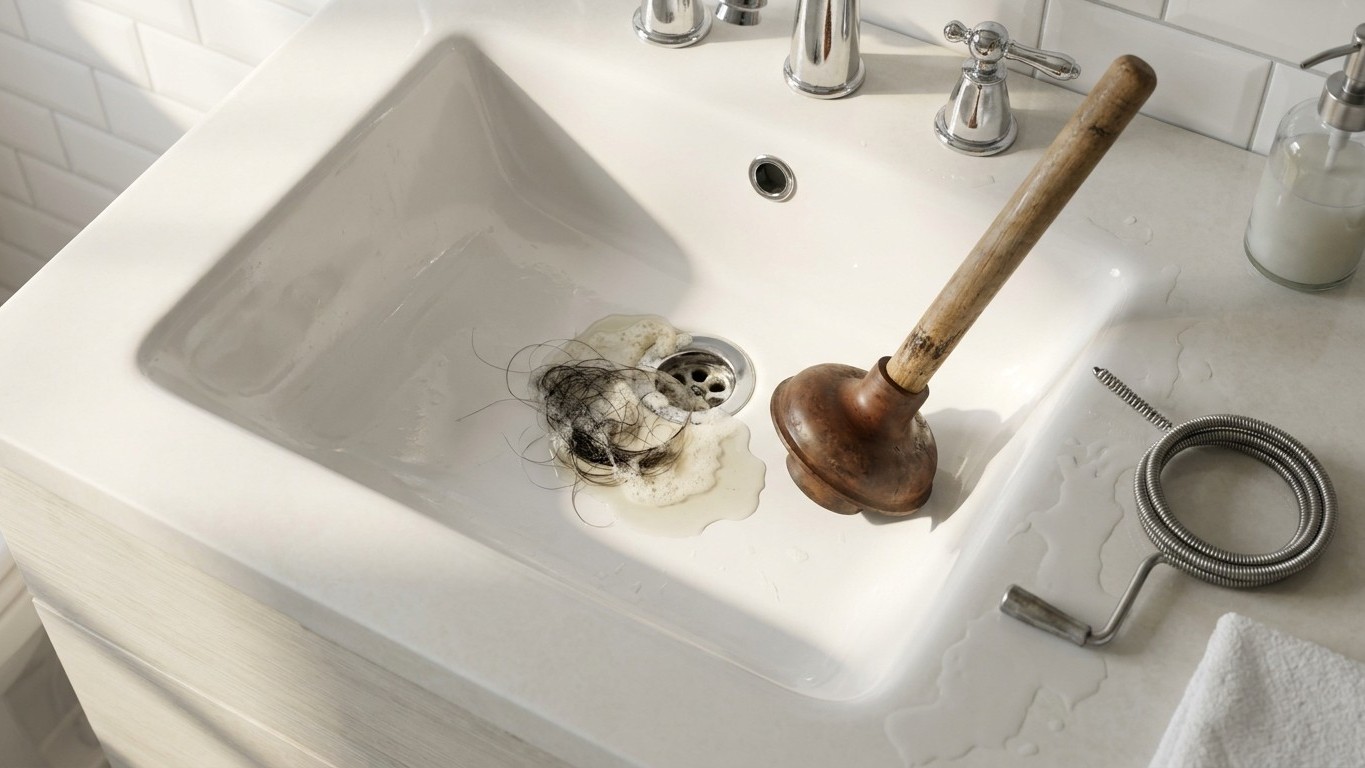

Most clogged drains come down to one of three things sitting in one of three places: hair and soap scum in a bathroom trap, grease and food scraps in a kitchen line, or scale and root intrusion further down the main. A plunger, hot water, and a hand auger clear the majority of them safely. Chemical drain cleaners often make things worse, since they can soften plastic pipe, corrode old metal fittings, and splash caustic liquid back at whoever is standing over the sink.
What is actually happening

A drain clog is a mechanical problem before it’s a chemical one, and where it sits changes everything about how to reach it. Water leaving a sink or tub passes first through the trap, that curved section of pipe under every fixture. The curve holds standing water to block sewer gas, but it also catches hair, soap scum, and small debris, which is why traps clog first and most often. Past the trap, the branch line carries waste toward the vertical stack, picking up flow from other fixtures along the way. Past that is the main line, the pipe that leaves the house and connects to the municipal sewer or a septic system.
Each of those three sections fails for a different reason. Bathroom traps clog with hair bound together by soap scum, forming a mat that thickens over weeks. Kitchen lines clog with grease that goes down warm and liquid, then hardens as it cools against the pipe wall, narrowing the channel until it closes. Main lines clog less often but more seriously, usually from years of scale buildup in older galvanized pipe, or from tree roots finding their way into a joint in a clay or cast-iron sewer line. A slow bathroom sink and a backed-up main line look similar at the fixture, but they are not the same problem, and treating one like the other wastes time.
This is where chemical drain cleaners run into trouble. Most work through an exothermic reaction, generating heat as they break down organic material. That heat can be enough to soften PVC joints or warp older plastic fittings, and the reaction itself can corrode metal pipe over repeated use. If the clog does not fully clear, the caustic liquid sits in the trap, and the next person who runs the plunger, or a plumber who has to pull the trap apart by hand, is working with pipe full of chemical residue. None of that touches a clog sitting further down the branch or in the main, where the liquid never even reaches.
| Location | Typical cause | What you’ll notice | Reasonable first step |
|---|---|---|---|
| Trap | Hair, soap scum | Slow drain at one fixture only | Plunge, or remove and clean the trap |
| Branch line | Grease, food, buildup | Gurgling, slow drain that gets worse | Hot water flush, hand auger |
| Main line | Scale, root intrusion | Multiple fixtures back up together | Professional auger or camera inspection |
What to check, in order
- Is it one fixture or several? Run water in a nearby sink or flush a toilet on the same floor. If only the original fixture is slow, the clog is local, in the trap or the branch line right behind it. If water backs up somewhere else too, or a toilet gurgles when you run the washing machine, the problem is further down, likely the main line, and it’s worth reading further before reaching for any tool.
- Look at the trap itself. Under most sinks, the trap is the curved pipe held on with two slip nuts you can loosen by hand or with pliers. A trap packed with a gray, greasy mat is holding the clog right there, an easy fix. A trap that looks clear means the blockage is further along the branch line.
- Flush with hot water. Not boiling, just as hot as the tap runs, for a minute or two. If drainage speeds up afterward and slows again within a day, you’re dealing with grease or soap buildup coating the pipe rather than a solid obstruction.
- Plunge it properly. A flat-bottomed sink plunger, not the flanged toilet kind, seals better over a drain opening. Block any overflow opening with a wet rag first, so the pressure goes down the pipe instead of out the overflow. A clog that clears with plunging was sitting in the trap or just past it.
- Listen for gurgling from other fixtures. A gurgle when water drains often points to a venting issue, air trying to equalize through the wrong path, rather than a blockage. That’s a different repair than a clog and usually needs a plumber to trace the vent stack.
- Feed in a hand auger. If plunging and hot water don’t work, a hand-crank auger fed slowly into the drain will meet resistance at the clog. How much cable goes in before you feel resistance tells you roughly how far away the blockage sits, useful information even if you end up calling someone.
- Find the cleanout, if there is one. Many homes have a capped fitting on the branch or main line, often in a basement, crawlspace, or outside near the foundation. Opening it (carefully, over a bucket) gives direct access to clear a stubborn clog without pulling apart fixture plumbing.
What it costs to leave it
A clogged drain by itself doesn’t run up a water bill the way a dripping faucet does. But a slow drain that gets ignored puts pressure on the same seals, gaskets, and joints that develop the leaks water utilities actually track, and it’s worth knowing the scale of that separate problem. The U.S. EPA WaterSense program states that “household leaks can waste nearly 1 trillion gallons of water annually nationwide,” and that “the average household’s leaks can account for more than 9,300 gallons of water wasted every year.” That’s a national aggregate across millions of homes, not a prediction about any single house, but it shows how much slips away through fittings nobody’s watching.
Some of those leaks are dramatic and some are nearly silent. WaterSense notes that “nine percent of homes have leaks that waste 50 gallons or more per day,” while smaller sources add up too: “a leaky faucet that drips at the rate of one drip per second can waste more than 3,000 gallons per year,” and “a showerhead leaking at 10 drips per minute wastes more than 500 gallons per year.” A worn trap seal or a slip nut loosened by repeated plunging can start exactly that kind of slow drip, easy to miss under a sink that’s rarely opened. Toilets carry their own risk here too, since “an old or worn flapper can cause your toilet to flush on its own or silently leak thousands of gallons a year,” a fault that has nothing to do with a clog but often gets discovered while someone’s down there checking one.
The reason any of this matters for a clogged drain specifically: repeated plunging, auguring, or pulling a trap apart puts wear on connections that were never meant to be disturbed often. WaterSense estimates that “fixing easily corrected household water leaks can save homeowners about 10 percent on their water bills,” which is a fair reason to check those same fittings once the clog is cleared. None of these national figures say what your household is losing. Your water meter does that. If a slow drain has you wondering whether something nearby is also leaking, a look at the meter with everything shut off is the only measurement that’s actually yours.
When to stop and call a plumber
Most clogs end at the trap or the branch line, and most of that is reasonable to handle with a plunger, hot water, and a hand auger. The line to stop is clear once you know where it is. Anything behind a wall, meaning you’d need to cut drywall or tile to reach the pipe, is a job for a licensed plumber, not because the pipe is different but because opening a wall wrong creates a second repair on top of the first.
Anything involving the main water supply line is the same story. A clogged drain is a wastewater problem, but if working on it means touching the shut-off valve or the supply side of the plumbing, that’s worth knowing how to do safely before you start, and this site has a page walking through exactly where that valve is and how it works.
A gas water heater raises the stakes further. If a drain issue is anywhere near the water heater, or you’re tempted to disconnect a line to get better access, that’s a stop point. Gas connections and combustion venting are not something to work around while chasing a clog.
Last, any leak that has already wetted structure, meaning a subfloor, a ceiling below a bathroom, or wall framing feels damp or shows staining, needs a plumber now rather than after another attempt at clearing the clog yourself. Water sitting inside a wall or floor cavity causes damage quietly, and by the time it’s visible, it has usually been there a while.
Common questions
Is it safe to use a plunger after a chemical drain cleaner didn’t work?
Wait at least the time listed for the product to sit before plunging, and wear gloves and eye protection, since agitating the standing chemical can splash. If the product has already sat for hours without clearing the clog, further plunging rarely helps and mostly stirs up caustic liquid.
Why does my drain gurgle even when it’s not clogged?
Gurgling usually means air is struggling to move through the vent system rather than the drain being blocked. It can point to a partially blocked vent stack on the roof or a venting issue in the branch line, both of which are worth a plumber’s look if the sound continues.
Can a clogged drain cause a leak somewhere else?
Not directly, but repeated force from plunging or auguring, or standing water sitting against an old seal, can loosen a slip nut or wear a gasket over time. It’s a reasonable moment to check nearby connections once the clog itself is cleared.
How do I know if the clog is in my line or the city’s?
If every fixture in the house backs up at once, especially the lowest drain like a basement floor drain, the blockage is likely past your property line. That’s typically a call to the municipal utility or a plumber with a sewer camera, not a job for a hand auger.