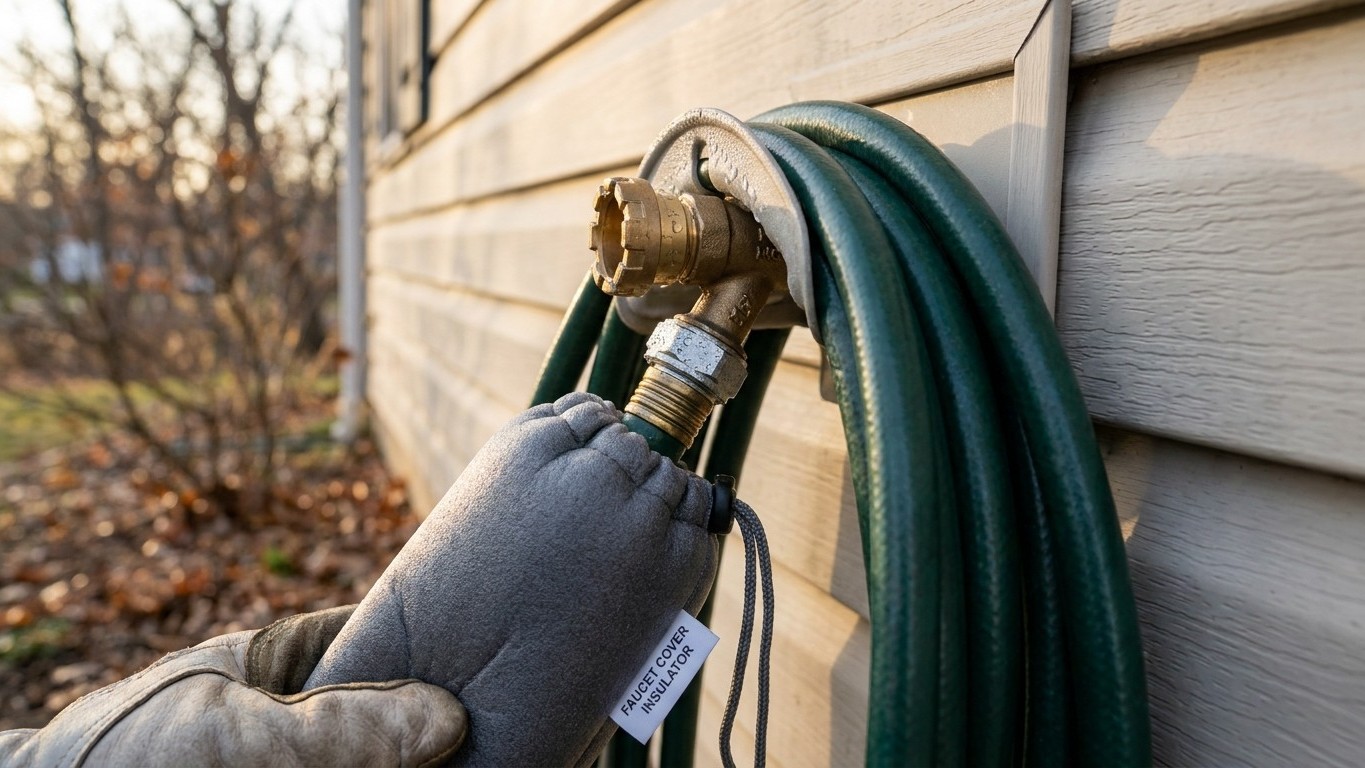

Winterizing outdoor faucets means shutting off the water supply feeding the spigot, opening the valve to drain the line completely, disconnecting any hose, and covering the exposed fixture before the first hard freeze hits. Skip any one of those steps and the pipe behind the wall is the part that pays for it. The job takes about ten minutes per faucet and costs nothing beyond the insulated cover. Do it in late fall, not the night a freeze warning goes out, because a frozen line often cracks quietly and only reveals itself weeks later when the weather warms up.
What is actually happening
A garden hose left attached to an outdoor spigot all winter is the single most common cause of a burst pipe inside the house. That sounds backwards, since the hose is outside, but the mechanism explains it. Most outdoor faucets installed since the 1990s are “frost-free” or “freeze-proof” sillcocks, meaning the actual shutoff valve sits well back inside the wall, in the warmer air of the house, not out at the spout where you turn the handle. When you close that valve, the several inches of pipe between the valve and the spout are supposed to drain out by gravity, leaving the vulnerable section empty and air-filled through the cold months.
A hose screwed onto the spout blocks that drainage path. Water has nowhere to go, so it sits trapped in the pipe between the valve and the hose bib. When temperatures drop, that trapped water freezes and expands, and the expansion pressure travels backward through the fitting, not forward out the spout where the hose is blocking it. The pipe usually splits somewhere inside the wall cavity, in a section you can’t see and won’t notice until the ice thaws.
Why the damage shows up late
This is the part that catches people off guard. A pipe that cracks in January often doesn’t leak in January. Ice has plugged the crack. The failure becomes obvious only when the weather warms enough to melt that ice plug, at which point water starts running inside the wall, sometimes for days before it’s visible on a ceiling or baseboard. A homeowner who checks their outdoor faucet in March and finds it “working fine” may just be a week away from finding a soaked drywall patch. That lag is exactly why draining the line properly in November matters more than any product you buy to wrap the spigot.
Faucets without a frost-free design, meaning simple hose bibs where the shutoff is right at the wall exterior, are even more exposed, because there’s no interior length of pipe protected by house heat at all. Older homes, additions, and detached garages often have this simpler fixture, and it needs a separate interior shutoff valve, plus draining, to be safe.
What to check, in order
Work through these checks before the first freeze, starting with the ones that cost nothing and take the least time. Each result tells you.
- Is a hose still attached? Disconnect every hose from every outdoor spigot, coil it up, and store it. This alone prevents the majority of frost-free faucet failures, and it costs zero dollars.
- Is there an interior shutoff valve for this faucet? Look in the basement, crawlspace, or utility area near where the pipe exits toward that spigot. If you find a dedicated valve, that’s good news: this faucet can be isolated from the rest of the house’s water system for winter.
- Does the valve actually stop the flow? Close it, then open the outdoor spigot. If water stops coming out fairly quickly, the valve is doing its job. If water keeps trickling, the valve itself may be worn and not sealing, which means it can’t be trusted to protect the line this winter.
- Does the outdoor spigot drain on its own once the interior valve is shut? Leave the spigot open after closing the interior valve. A properly sloped, frost-free line will empty by gravity within a minute or two. If water sits and won’t drain, there may be a low spot, a bent line, or a valve that isn’t a true frost-free type, and that changes what protection this fixture actually needs.
- Is there a bleeder cap or small drain plug near the interior valve? Some setups include one specifically so trapped water between the valve and the wall doesn’t sit and freeze. If yours has one, open it briefly to release any remaining water after the main valve is shut.
- Is the exposed spigot covered? Once the line is drained, an insulated cover over the spigot itself adds a buffer against direct cold on the fitting, though it does nothing to protect a line that wasn’t drained first.
If every check passes, the faucet is winterized. If the valve won’t fully stop the flow or the line won’t drain, that’s a signal the fixture needs attention now, while it’s dry outside and easy to work on, rather than in January.
What it costs to leave it
A cracked outdoor faucet line is one entry in a much bigger national picture of water that leaves a house unnoticed. According to the U.S. EPA WaterSense program, “household leaks can waste nearly 1 trillion gallons of water annually nationwide,” and “the average household’s leaks can account for more than 9,300 gallons of water wasted every year.” Those are aggregate figures across the entire country, not a prediction of what one faucet will cost one household, but they establish something worth sitting with: leaks are common, and they’re rarely dramatic enough to notice on their own.
WaterSense also notes that “nine percent of homes have leaks that waste 50 gallons or more per day,” which is the scale of leak a split outdoor faucet line can produce once the ice plug thaws and water starts running behind a wall. By comparison, “a leaky faucet that drips at the rate of one drip per second can waste more than 3,000 gallons per year,” and “a showerhead leaking at 10 drips per minute wastes more than 500 gallons per year.” Those smaller numbers put the outdoor-faucet scenario in perspective: a slow drip is a nuisance on the water bill, while a frozen and split supply line is a structural repair.
None of these national figures tell you what your own faucet, if left unwinterized, would actually cost you. They can’t. Only your water meter can measure that, and a rising bill with no obvious explanation is usually the first real signal something is leaking somewhere in the house. If that’s the situation you’re in right now, checking for a hidden water leak using your meter is the next concrete step, not a national average. WaterSense does note that “fixing easily corrected household water leaks can save homeowners about 10 percent on their water bills,” which is at least a reason to treat a suspicious meter reading as worth investigating rather than ignoring.
When to stop and call a plumber
Winterizing an outdoor faucet is a job most homeowners can do themselves with no tools beyond maybe a screwdriver and an insulated cover. But there’s a clear line where this stops being a weekend task and becomes something to hand to a licensed plumber, and it’s worth knowing that line before you’re standing in a wet basement trying to figure it out under pressure.
If the interior shutoff valve for the faucet is behind a finished wall, inside a ceiling, or somewhere you’d need to cut into drywall to reach, don’t start opening things up. That’s a plumber’s job, both for the repair and for putting the wall back together correctly. If you can’t find any dedicated interior valve at all and the only way to stop water to that faucet is shutting off the main supply to the entire house, treat that as a sign the plumbing for this fixture needs proper diagnosis rather than a seasonal workaround. Our main water shutoff guide walks through locating and testing that valve safely, which is the right first move before anyone touches pipework near it.
Anything involving a gas water heater is also outside DIY territory the moment water and gas lines are anywhere near each other. And if you’ve already found water damage, a soft spot in drywall, a stain spreading on a ceiling, or standing water where there shouldn’t be any, that means structure has already gotten wet. At that point the priority isn’t winterizing anything; it’s stopping the water immediately and calling a plumber, because saturated framing and drywall only get more expensive to fix the longer they stay wet. Water damage moves fast and quietly, and the honest move is to treat any sign of it as urgent rather than something to monitor for a few days.
Common questions
Do I need to winterize a frost-free faucet if I never use a hose on it?
Yes. Even without a hose, the interior valve still needs to be checked and closed, and the line still needs to be confirmed as fully drained. The frost-free design reduces risk but doesn’t eliminate the need to shut off water to it for winter.
What temperature triggers the need to winterize?
There’s no single number that applies everywhere, since exposure, wind, and how deep the pipe sits in the wall all vary. The safer approach is timing: winterize before the first hard freeze is forecast in your area, rather than waiting for a specific temperature reading.
Can an insulated faucet cover replace draining the line?
No. A cover adds a layer of protection to the exposed spigot itself, but it does nothing for water trapped inside the line if the interior valve wasn’t closed and the pipe wasn’t drained first. Draining the line is the step that actually prevents a burst pipe.
How do I know if my outdoor faucet is frost-free or a basic hose bib?
Frost-free sillcocks typically have a longer body, often several inches, extending back through the wall, with the handle at the outer end. A basic hose bib sits flush against the exterior wall with little to no visible extension. If you’re unsure, the interior shutoff valve check described above will tell you what you’re dealing with regardless of the fixture’s outward appearance.