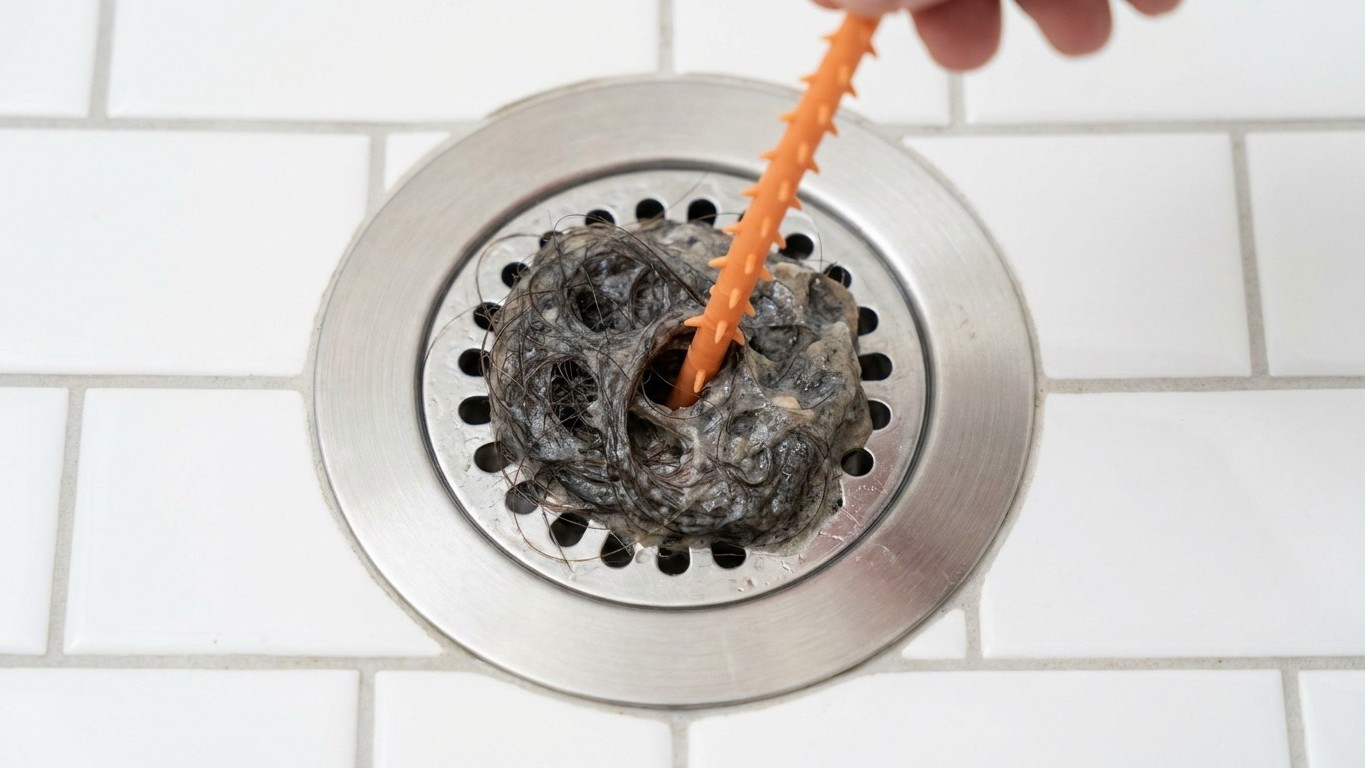

A slow shower drain is almost never a mystery. In the overwhelming majority of homes, it’s hair that has caught on a stopper, a crossbar, or the rough wall of the trap, and soap scum has bonded to it until the strands form a mat that water can barely push past. The fix sits within the first foot of pipe, no snake truck required. What follows is how to confirm that, check the few other causes that mimic it, and know the dollar difference between fixing it this weekend and letting it ride.
What is actually happening
The thing to understand here is that a shower drain isn’t a straight tube. Just below the strainer or stopper, most residential drains have a shallow trap or a narrowed fitting designed to slow water just enough to catch debris before it reaches the branch line. That design works exactly as intended, and that’s the problem: hair snags on the first rough edge it meets, then acts like a net. Every shower after that adds a few more strands, plus the fatty residue in soap and shampoo, which hardens as it cools and glues the mat together. Within a few weeks, what started as a few loose hairs becomes a rubbery plug the width of a pencil.
This is why the right tool for the first attempt is short and simple: a plastic drain-cleaning tool with barbed teeth, or a bent length of stiff wire with a small hook on the end, pushed down through the strainer opening. You’re not trying to reach the main line. You’re trying to reach the first 10 to 12 inches, which is where over 90 percent of shower clogs actually live. Pull, don’t push, once you feel resistance; pushing a hair mat deeper just relocates the problem to a spot you can’t reach by hand.
Soap scum complicates this because it isn’t just cosmetic residue, it’s a binder. Bar soap in particular leaves behind fatty-acid salts that stay soft in warm water and set hard as the pipe cools between showers. That’s why a drain that ran slow on Monday can be nearly sealed shut by Friday, even though nobody added anything to it: the same hair has simply had four more days to bond. Homes with harder water see this happen faster, since minerals in the water react with soap to form more of that scummy residue in the first place.
A smaller but real contributor is the overflow or crossbar assembly on older stoppers, a horizontal bar just below the drain opening that hair loves to wrap around. If you pull a strainer and see a metal bar instead of open pipe, that bar needs to be checked and cleared separately from the trap below it, because it holds hair in place even after you think you’ve pulled the clog free.
What to check, in order
Work from the cheapest and most likely cause down to the ones that actually require tools or outside help. Each step tells you something even when it doesn’t fix the problem, which narrows down what’s next.
- Pull the stopper or strainer and look. If you see a visible hair mat sitting right at the opening, that’s very likely the entire problem, and removing it by hand often restores full drainage immediately.
- Run water for 30 seconds and watch the behavior. A drain that gurgles or bubbles as it empties usually means a partial clog is trapping air, not that the pipe is fully blocked. A drain that backs up and rises before draining suggests the blockage is farther down, past where a hand tool reaches.
- Use a flexible drain-cleaning tool through the strainer opening. If it comes back with hair and gunk and the water starts draining faster afterward, you’ve confirmed the clog was in the trap, the most common location by far.
- Remove the stopper assembly entirely and inspect the crossbar or linkage. If hair is wrapped around a horizontal bar rather than sitting loose in the pipe, this is a different fix, you need to physically unwind it rather than pull it out with a hook tool.
- Check whether other fixtures in the house are slow too. If the kitchen sink, bathroom sink, or a toilet also drains sluggishly, the problem likely isn’t isolated to the shower trap at all. That points toward a shared branch line or main drain issue, which is a different scope of job.
- Note whether the slow drainage came on suddenly or gradually. Gradual slowing over weeks fits a growing hair-and-soap mat. Sudden, total blockage after normal use fits a foreign object or a deeper obstruction, and it’s a signal to stop trying the small tools and reassess.
None of these checks require pouring anything down the drain. A drain-cleaning chemical can react badly with whatever’s already partially blocking the pipe, and it does nothing to tell you which of the causes above you’re actually dealing with, so it’s worth skipping until you know what you’re treating.
What it costs to leave it
A slow shower drain rarely floods anything, so it’s easy to let it slide for months. But it sits inside a much bigger pattern of household water waste that’s worth putting in perspective. According to the U.S. EPA WaterSense program, “Household leaks can waste nearly 1 trillion gallons of water annually nationwide,” and “The average household’s leaks can account for more than 9,300 gallons of water wasted every year.” Those are national totals, not a forecast for your bathroom, but they show how much of this waste happens quietly, fixture by fixture, in homes that otherwise look fine.
A partially clogged shower drain isn’t a leak in the classic dripping-faucet sense, but the same EPA program notes that “nine percent of homes have leaks that waste 50 gallons or more per day,” and that scale of loss usually comes from several small, ignored problems stacking up rather than one dramatic pipe burst. A shower that runs longer than it should, because water is pooling and draining slowly, plus a leaky showerhead or a worn toilet flapper elsewhere in the same bathroom, adds up faster than most homeowners expect. EPA notes separately that “A showerhead leaking at 10 drips per minute wastes more than 500 gallons per year,” and that “An old or worn flapper can cause your toilet to flush on its own or silently leak thousands of gallons a year.”
None of these figures tell you what your own household is losing, and that’s the point: national aggregates give you scale, not your bill. Your water meter is the only measurement that actually belongs to you, and reading it before and after a repair is the only way to know what a specific fix was worth in your house. If you suspect there’s more going on behind the walls or under the slab than a slow shower drain explains, this site’s guide to finding a hidden water leak walks through how to read your meter for exactly that purpose.
The financial upside of catching these small problems is real, though general: EPA states that “Fixing easily corrected household water leaks can save homeowners about 10 percent on their water bills,” and a slow drain, while not a leak itself, is often the first sign that a bathroom’s fixtures haven’t been checked in a while.
When to stop and call a plumber
Everything above assumes the problem is a shower trap you can reach with your hands and a simple tool. That covers most slow-draining showers. It stops covering the problem the moment any of the following show up.
If pulling the stopper, clearing the crossbar, and running a flexible tool through the first foot of pipe hasn’t restored normal drainage, the blockage is likely past the trap and inside the wall or under the floor. At that point you’re no longer clearing a surface clog, you’re dealing with the home’s actual drain line, and that’s a job for a licensed plumber with the right equipment to clear it without damaging the pipe.
Any sign of water reaching the main supply line, rather than staying contained to the drain side, is also outside the scope of a DIY fix. Drain problems and supply problems are different systems entirely, and mixing up which one you’re troubleshooting wastes time and can make a small problem worse.
A gas water heater anywhere near the affected bathroom changes the calculation too. If a slow drain is accompanied by any smell of gas, any pilot light behaving strangely, or any water pooling near the unit itself, that’s not a drain-clearing job at all, it’s a safety call, and it should go to a licensed plumber or your gas utility immediately rather than being treated as a weekend project.
Finally, stop and call a professional the moment you see water that has already reached structure, meaning it’s soaked into drywall, subfloor, or framing rather than just sitting in the tub or pooling briefly before draining. Water damage is expensive precisely because it’s quiet: it spreads inside materials well before it’s visible on the surface, and by the time a stain or soft spot appears, the damage behind it is usually already done. A licensed plumber can trace the actual source, which matters because a slow shower drain and a hidden leak upstream can look identical from where you’re standing.
Common questions
Why does my shower drain slowly even though I just cleared visible hair?
Hair can also wrap around a crossbar or linkage hidden below the strainer, out of sight even after the opening looks clear. Pull the whole stopper assembly, not just the surface strainer, to check for that.
Is it normal for a shower drain to gurgle before it clears?
Gurgling usually means trapped air escaping around a partial clog, not a fully blocked pipe. It’s a sign to keep checking the trap area rather than a sign of a deeper problem on its own.
Can hard water make shower drain clogs worse?
Minerals in hard water react with soap to form more scum, which binds hair together faster and makes the resulting mat harder to pull loose. Homes on well water or in known hard-water regions tend to see this build up quicker.
Should I try a chemical drain cleaner before checking the trap myself?
Checking the trap by hand first costs nothing and tells you exactly what’s blocking the pipe. A chemical product can’t tell you that, and it can react unpredictably with whatever hair and residue is already sitting there.