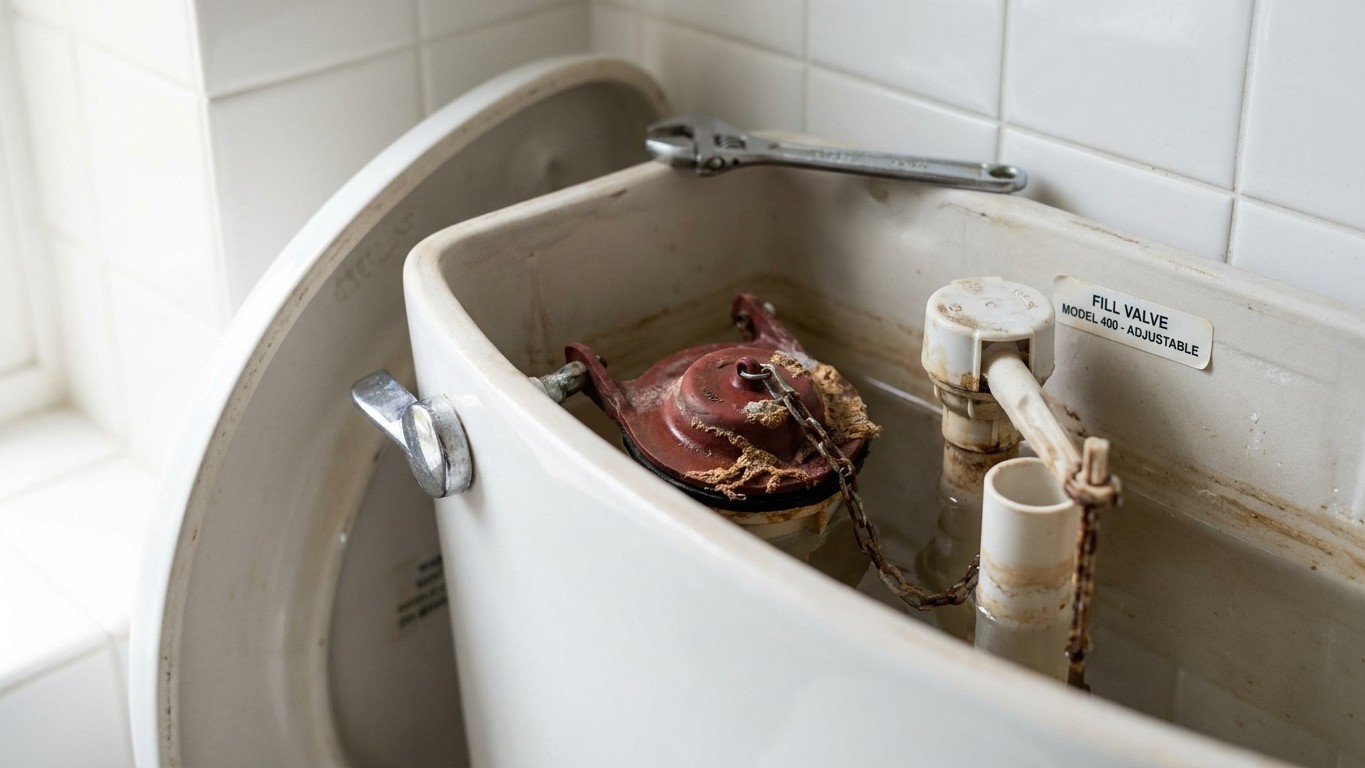

A toilet keeps running because the flapper, the water level, or the fill valve isn’t doing its job — most often a worn flapper that no longer seals the tank drain. The fix is usually a five-minute check, not a plumber visit. But which part is at fault changes what you do next, and guessing wrong means you keep paying for water you never used.
What is actually happening
Take the lid off the tank and watch what happens after a flush, because the whole problem is visible if you know where to look. At the bottom of the tank sits a rubber or silicone seal called the flapper. When you press the handle, it lifts, water rushes down into the bowl, and then it’s supposed to drop back down and seal the opening so the tank can refill and stop. That’s the entire job: open, flush, close, seal.
Flappers don’t fail suddenly. They fail the way a rubber gasket in any appliance fails, by slowly losing its shape. Constant contact with water and, in some households, with in-tank cleaning tablets, makes the rubber stiffen, warp, or grow a thin coating of mineral scale along the edge. A warped flapper doesn’t seat evenly anymore. Water finds the gap and trickles into the bowl continuously, so the tank’s fill valve senses the drop and keeps topping it off. That’s the classic ghost-flush: the tank refills every few minutes with no one touching the handle.
A second, less obvious point of failure is the chain connecting the flush handle to the flapper. Too much slack and the flapper doesn’t lift fully on flush, so you get a weak flush and sometimes it doesn’t seal right when it drops back, catching on itself. Too little slack and the chain holds the flapper slightly open all the time, which produces the same nonstop trickle as a worn seal, even with a brand-new flapper.
The third mechanism worth understanding is the fill valve, the taller assembly usually to the left of the flapper. It controls how high the tank fills before shutting off, using either a float ball on an arm or a float cup that rides up the fill valve shaft. If that shut-off point is set too high, water rises until it spills into the overflow tube, a narrow pipe standing in the middle of the tank, and drains continuously into the bowl. This looks and sounds identical to a bad flapper from across the room, but the cause and the fix are completely different. Understanding which of these three parts is misbehaving, rather than just knowing “the toilet runs,” is what lets you fix your specific toilet instead of following generic steps that assume a fitting you don’t have.
What to check, in order
Work through these checks from cheapest to most involved. Each one tells you something specific, so don’t skip ahead even if you’re fairly sure you know the cause.
- Look at the water level against the overflow tube. Take the tank lid off and flush once. If the water settles at or above the top of the overflow tube, water is constantly spilling into that tube and down into the bowl. That points to the fill valve’s shut-off height, not the flapper.
- Check the chain slack between handle and flapper. There should be a small amount of give, roughly half an inch, when the flapper is fully seated. A taut chain that holds the flapper open even slightly will cause a continuous trickle you can usually hear if you put your ear near the tank.
- Inspect the flapper itself. Feel the edge that contacts the tank’s drain opening. If it feels stiff, cracked, or gritty rather than smooth and pliable, or if you can see it’s warped and sitting unevenly, it’s no longer sealing. This is the single most common cause of a running toilet.
- Run the dye test. Add a few drops of food coloring to the tank water and wait ten minutes without flushing. Color appearing in the bowl confirms water is leaking past the flapper seal, even if the running sound is faint or intermittent.
- Listen after the tank has clearly finished filling. A faint hiss that continues after the fill sound stops usually means the fill valve itself isn’t shutting off completely, which is a different repair than a flapper and often means the whole valve assembly needs replacing rather than adjusting.
Each of these takes under a minute and needs no tools beyond your eyes and ears. The point of doing them in order is that the first two rule out the easy adjustments before you conclude a part needs replacing.
What it costs to leave it
It’s tempting to let a running toilet slide because the sound is easy to tune out. The numbers behind that habit, though, come from one of the more sobering pieces of federal water research. The U.S. EPA’s WaterSense program has found that “household leaks can waste nearly 1 trillion gallons of water annually nationwide”, and that “the average household’s leaks can account for more than 9,300 gallons of water wasted every year”. That’s a national aggregate, not a prediction for your bathroom specifically, but it shows the scale of what “just a running toilet” adds up to across millions of homes.
The toilet flapper gets its own specific mention in that research: “an old or worn flapper can cause your toilet to flush on its own or silently leak thousands of gallons a year”. That single sentence is worth sitting with, because a silent leak, one you can’t hear and might never notice, is exactly what a stiffened flapper produces once it’s warped just slightly rather than dramatically. WaterSense also notes that “nine percent of homes have leaks that waste 50 gallons or more per day”, a category that a badly sealing flapper falls into more easily than most people assume.
None of these figures tell you what your specific toilet is wasting, and they shouldn’t be used that way. They’re drawn from a national conservation campaign designed to show the scale of the problem across the country, not to estimate any one household’s water bill. The only number that actually applies to you sits on your water meter. If you want to measure your own leak rather than guess from a national average, our page on finding a hidden water leak walks through reading the meter before and after a period with no water use in the house. WaterSense does offer one reassuring, general figure worth keeping in mind once repairs are made: “fixing easily corrected household water leaks can save homeowners about 10 percent on their water bills”, which is as close as this research gets to a promise that the fix pays for itself.
When to stop and call a plumber
Everything described above happens inside the tank, in full view, with parts you can touch by hand. That’s the boundary. Once a leak or a running sound involves anything you can’t see, the calculation changes.
Call a licensed plumber if the problem is behind a wall, where you can hear water but can’t inspect the source. Call one if it involves the main water supply line coming into the house, rather than the toilet’s own shut-off. Call one immediately if a gas water heater is anywhere near the water, since combining electrical or gas components with standing water isn’t a DIY situation under any circumstance. And call one the moment you see a leak that has already wetted drywall, subfloor, or ceiling material below a bathroom, because water damage spreads through building materials far faster than it shows on the surface, and what looks like a small stain is often already a soaked stud or joist behind it.
None of this is meant to be alarming, but it deserves to be said plainly rather than softened: a running toilet is mostly a nuisance, while a hidden or structural leak is a repair bill that grows every hour it’s ignored. If you’re ever unsure whether what you’re looking at is a simple tank fix or something bigger, the safest first move is the same either way, find and turn off the water supply so nothing gets worse while you sort it out. Our page on locating and using the shut-off valve covers exactly where to look for the toilet’s own valve as well as the home’s main shut-off, so you’re not searching for it for the first time in an emergency.
Common questions
Why does my toilet run for a few seconds every hour even if I never use it?
That intermittent, unprompted refill almost always means water is slowly leaking past the flapper into the bowl. Once enough water has dripped out to lower the tank level slightly, the fill valve kicks in to top it back off, then shuts off again. It repeats on a cycle you can time, which is a strong sign the flapper needs replacing.
Can hard water cause a toilet to keep running?
Mineral buildup from hard water can coat the flapper’s sealing edge or the inside of the overflow tube, preventing a clean seal even on a flapper that isn’t otherwise worn. Wiping the flapper and the seat it sits on clean is worth trying before assuming the part itself has failed.
Is a running toilet dangerous, or just wasteful?
On its own, it’s a water-waste and cost problem rather than a safety one. It becomes a bigger concern only if water starts overflowing the tank or bowl, or if a related fitting elsewhere in the supply line begins to leak, at which point it moves into the territory covered above.
How much does it typically cost to fix the parts involved?
This varies by fitting and by region, and no reliable national price was verified for this page, so it isn’t listed here. What can be said is that the parts involved, the flapper and the fill valve, are among the least expensive components in the entire plumbing system, which is part of why letting one fail silently for months is such a poor trade against the water it wastes.