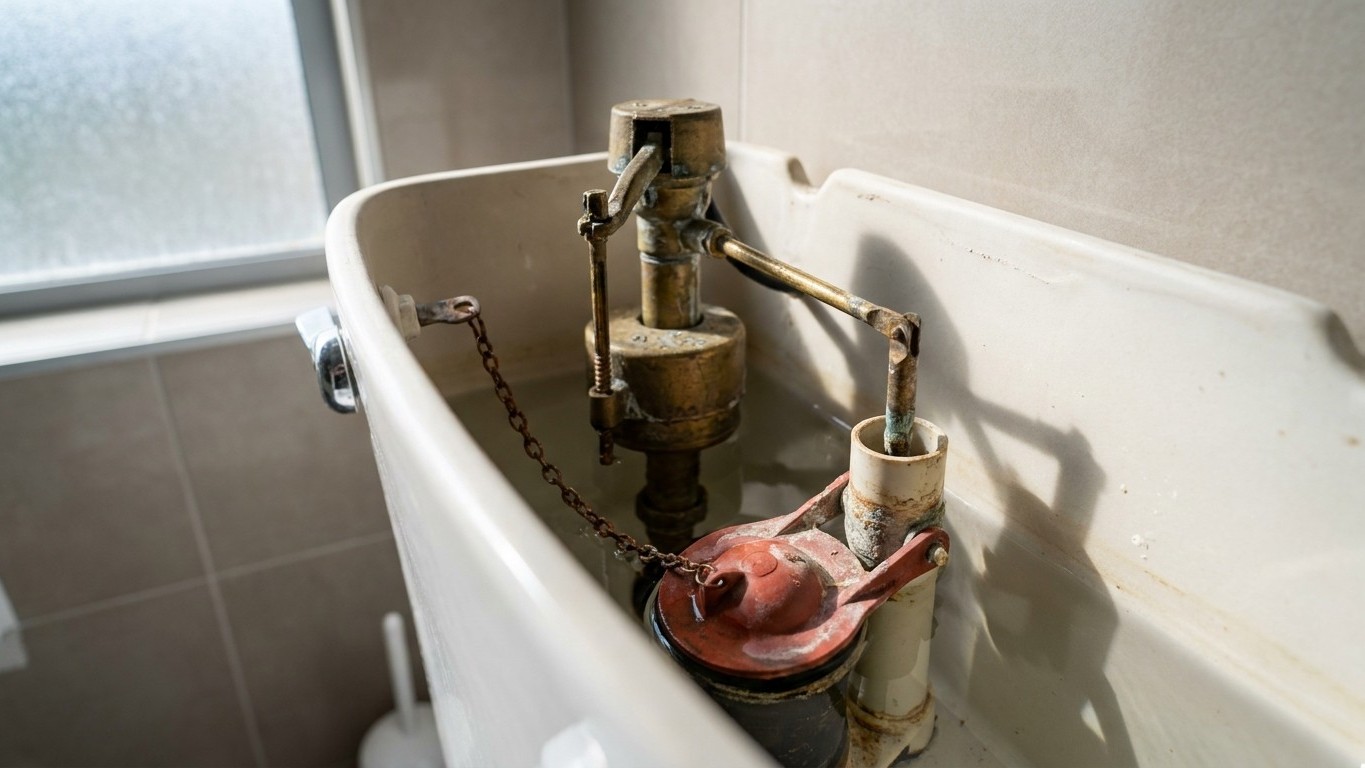

A toilet that won’t flush is telling you one of two things: the bowl isn’t getting enough water to create a siphon, or something between the bowl and the branch drain is blocking the water’s path. The first is almost always a five-minute fix inside the tank. The second can mean anything from a wad of paper in the trap to a problem much further down the line. Knowing which one you’re dealing with changes everything about how you respond.
What is actually happening
A flush is a physics trick, not just a button push. When you press the handle, the flapper lifts and the water stored in the tank drops fast into the bowl through the rim holes and the larger siphon jet at the bottom. That sudden rush fills the trapway (the curved passage built into the base of the toilet) faster than it can drain, and for a second or two the trapway runs completely full of water. That full column is what creates suction, pulling the bowl’s contents up and over the trap and down into the drain line. Cut that water volume short, and the siphon never forms. The bowl just sort of gurgles and settles back to where it started.
That’s the tank-side version of the problem, and it looks almost identical to a real blockage from where you’re sitting. A worn flapper that doesn’t stay open long enough, a fill valve that stops filling the tank before it reaches the fill line, or a float set too low all starve the bowl of the water volume it needs. The flush looks weak, sluggish, incomplete, and the bowl often refills to a lower level than usual because there simply wasn’t enough water pushed through in the first place.
The drain-side version
A blocked trap or drain behaves differently once you look closely. Water enters the bowl fine, rises, and either drains slowly over several minutes or doesn’t drain at all no matter how much water goes in. This is a physical obstruction, not a water-supply problem, and it sits somewhere between the base of the toilet and the point where the branch line joins the main drain. Mineral buildup inside the rim holes can also choke off flow gradually, over months, until one day the flush that used to work fine just doesn’t clear the bowl anymore.
The distinction matters because the fixes don’t overlap. Adjusting a float or replacing a flapper does nothing for an actual clog, and no amount of plunging fixes a tank that isn’t delivering water. Figuring out which side of the problem you’re on is the entire first step, and it takes about two minutes with the tank lid off.
What to check, in order
Work through these from cheapest and most likely to more involved. Each one tells you something specific, and most people never get past step three.
- Lift the tank lid and check the water level. There should be a fill line marked inside the tank, and the water should sit right at or just below it. If the water level is noticeably low, that’s your answer: the bowl isn’t getting enough volume to siphon. This points to the fill valve or the float, not a clog.
- Watch the flapper during a flush. Trip the handle and look at the flapper at the tank’s bottom. It should lift fully and stay up for the whole flush cycle, then drop and seal completely. If it falls too early, or if the chain connecting it to the handle is tangled, slack, or too short, the tank is dumping only part of its water before the flapper reseals.
- Check whether the fill valve shuts off properly. After a flush, the tank should stop filling once it hits the line. If water keeps trickling or the fill valve runs continuously, it may be working against the float, keeping the tank from ever reaching full volume between flushes.
- Look at the rim holes and the siphon jet. Hard water leaves mineral deposits that narrow these openings over time. If you can see white or rust-colored crust around the rim, restricted flow through those holes could be reducing flush force even when the tank itself is filling correctly.
- Run a plunger test. If the tank checks out (correct water level, flapper sealing, fill valve shutting off) but the bowl still won’t clear, the problem has moved to the drain side. A firm, steady plunge that either clears the blockage or makes no difference at all tells you.
- Note how the water behaves when it doesn’t drain. Slow but steady drainage over several minutes suggests a partial obstruction. A bowl that fills and simply stops, with water level rising toward the rim, suggests a more complete blockage or an issue further along the branch drain that’s beyond what a plunger or a homeowner can safely diagnose.
What it costs to leave it
A toilet that flushes poorly rarely stays a minor annoyance. A flapper that’s failing to seal doesn’t just weaken the flush, it also lets water seep continuously from tank to bowl, and that’s a leak you’re paying for around the clock. The U.S. EPA WaterSense program notes that “an old or worn flapper can cause your toilet to flush on its own or silently leak thousands of gallons a year.” That’s not a hypothetical. It’s the most common hidden leak in an American home, and it often starts as exactly the kind of weak-flush symptom described above.
Zoom out and the scale gets harder to ignore. WaterSense reports that “household leaks can waste nearly 1 trillion gallons of water annually nationwide,” and that “the average household’s leaks can account for more than 9,300 gallons of water wasted every year.” The program also found that “nine percent of homes have leaks that waste 50 gallons or more per day.” Those are national aggregates, useful for understanding how widespread this problem is, not a prediction of what your own toilet is doing. Every home’s plumbing, water pressure, and fixture age are different.
The only number that actually matters is the one on your own water meter. WaterSense estimates that “fixing easily corrected household water leaks can save homeowners about 10 percent on their water bills,” which is a real incentive to chase down a flapper or fill valve issue rather than live with it. If you want to know whether your specific toilet is part of that leak statistic, the most reliable method is a simple meter check before and after a period of no water use in the house, a method covered in detail on this site’s hidden-leak page. That test, not a national average, is what tells you what this problem is actually costing you.
When to stop and call a plumber
Most weak-flush and mild-clog situations are within reach of a homeowner willing to take the tank lid off and watch a flush cycle. There’s a clear line past which the smart move is to stop and bring in a licensed plumber, and it’s worth knowing where that line sits before you’re standing in an inch of water figuring it out.
Anything happening behind a wall is past that line. If a blockage seems to be further down the branch line than the trap itself, opening up plumbing inside a wall or under a slab isn’t a DIY afternoon, it’s a job that requires the right tools and, in many areas, a permit. The same goes for anything touching the main water supply to the house. Shutting off and working on a single toilet’s supply valve is routine; working on the main line that feeds every fixture in the house is not, and a mistake there affects far more than one bathroom.
A gas water heater sitting nearby changes the calculation too. Even if the toilet problem seems unrelated, any work that requires disturbing plumbing near a gas appliance, or any sign that a slow leak has been running long enough to reach a water heater’s area, is a moment to call a professional rather than improvise. Gas and water don’t mix well, and neither does guesswork.
Finally, treat any leak that has already wetted structure, meaning drywall, subfloor, ceiling below a bathroom, or framing, as a plumber call, not a weekend project. Water damage is expensive precisely because it’s quiet. By the time you can see a stain or feel softness in a floor, the leak has usually been running longer than you’d guess, and what looks like a simple flush problem may have already become a structural one. When in doubt, a licensed plumber’s inspection costs far less than the repair you’d be guessing at otherwise.
Common questions
Why does my toilet fill up but not flush?
This usually points to a drain-side blockage rather than a tank problem. If the bowl fills with water when you flush but the water doesn’t recede, or recedes very slowly, something is obstructing the trap or the line beyond it. Check the tank first to rule out a water-volume issue, then move to a plunger test.
Can a toilet flush weakly without being clogged?
Yes, and it’s one of the most common causes of a weak flush. A low tank water level, a flapper that closes too early, or mineral buildup restricting the rim holes can all weaken a flush even when there’s nothing blocking the drain at all.
How do I know if the problem is the flapper or the fill valve?
Watch the tank during a full flush cycle. If the flapper drops and seals before the tank empties, that’s a flapper issue. If the tank never refills to the marked line afterward, or keeps running continuously, the fill valve or float is the more likely culprit.
Is a weak flush a sign of a bigger plumbing problem?
Not usually, but it’s worth checking early rather than living with it. A failing flapper can silently waste a significant amount of water, and a gradually worsening flush can be the first visible sign of mineral buildup or a slow blockage that’s easier to address before it becomes a full clog.