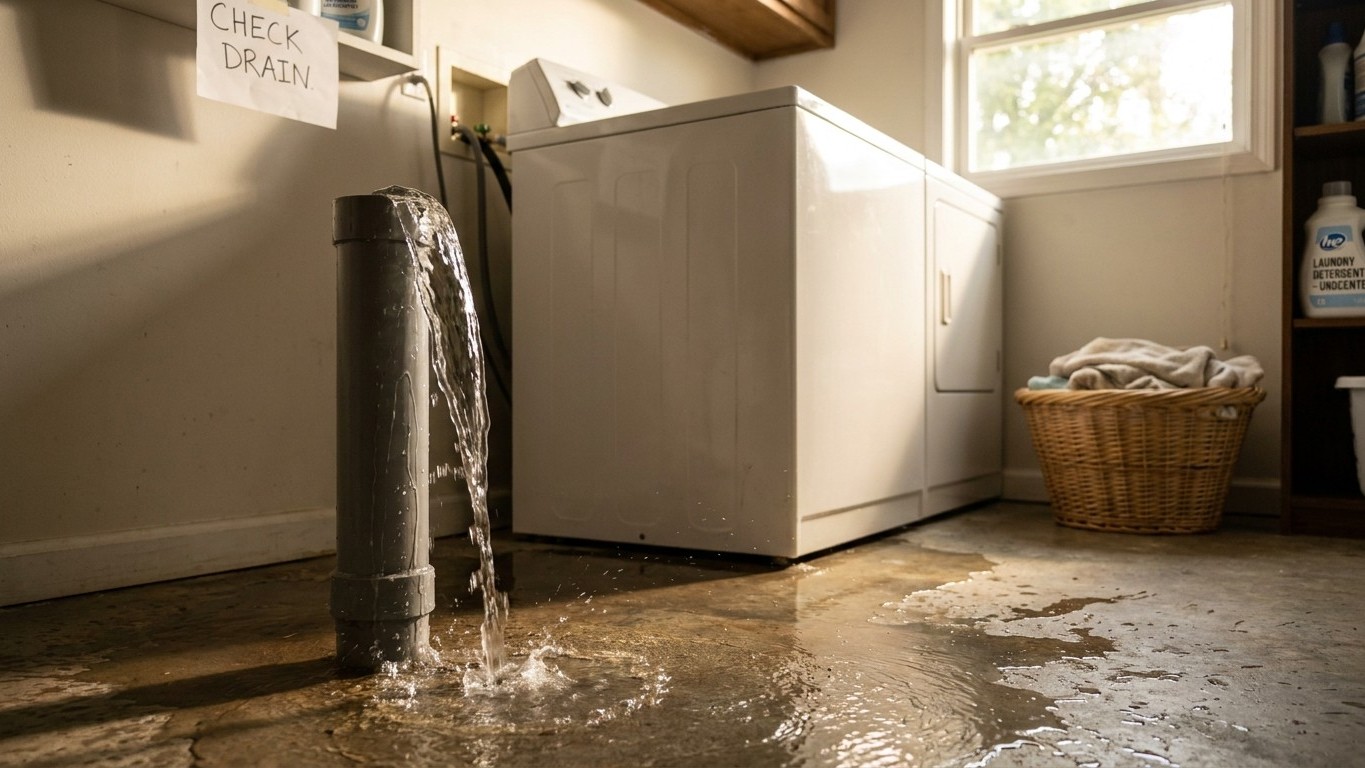

A washing machine that backs up is rarely a defect in the machine itself. It’s the drain trying to accept more water, faster, than it was built for. During the spin-and-drain cycle, a washer’s pump can push 15 to 20 gallons out in under two minutes, a burst no other household fixture demands. That surge hits a standpipe and trap sized for ordinary flow, not a flood. When water rises back into the tub or spills onto the floor, the fix usually starts with the standpipe, not the appliance.
What is actually happening
Every washing machine drains into a vertical pipe called a standpipe, usually about two inches across, that stands open behind or beside the machine. The drain hose from the washer simply hangs into the top of it, no direct connection, no seal. Below that standpipe sits a trap, a U-shaped bend that holds a small amount of water at all times. That trapped water is what keeps sewer gas out of your laundry room. It has nothing to do with capacity; it’s there for odor control, not flow.
The problem is timing, not pipe size. A bathroom sink might send out half a gallon over thirty seconds. A washing machine dumps several gallons in a single, violent push, more like emptying a bucket than running a tap. The standpipe and trap have to accept that whole surge at once, then let it settle before the next rinse cycle sends another wave. If anything downstream slows that water, even slightly, the surge has nowhere to go but back up and out the top of the standpipe.
Why lint matters more than people expect
Lint doesn’t stay in the lint trap. A good portion rides the wash water straight into the drain hose, and because that water moves fast, lint tends to settle where the flow slows down, right at the bends in the trap and in the branch line beyond it. Over months, a coating builds up on the inside of the pipe. The opening shrinks. The washer’s fast, heavy discharge no longer matches what the narrowed pipe can pass, and the backup that used to happen “once in a while” starts happening every load.
There’s also a venting piece that often gets missed. Every trap needs a vent, a separate pipe that lets air in so water can flow past the trap without sucking it dry through siphoning. If that vent is blocked, undersized, or was never routed correctly during a remodel, the washer’s fast discharge can pull the trap’s water seal right out from under it, which shows up as gurgling, slow draining, or water pushed back up the standpipe even when the pipe itself is perfectly clear.
What to check, in order
Work through these from cheapest and quickest to more involved. Each one tells you something different about where the problem sits.
- Check the hose insertion depth in the standpipe. The drain hose should hang loosely, inserted only a few inches, never pushed down near the trap or taped airtight. If it’s jammed in deep or sealed, that alone can trigger siphoning. Pulling it back to a shallow, loose position and testing again isolates this instantly, if the backup stops, that was the whole issue.
- Pour a bucket of plain water into the standpipe when the washer is idle. Watch how fast it clears. A quick, quiet drain means the pipe is open. A slow drain, or water that lingers and gurgles, points to a partial clog somewhere close by rather than a venting problem.
- Listen for gurgling during the wash cycle. Gurgling as the washer drains, especially from a nearby sink or floor drain, usually means air isn’t reaching the trap properly. That’s a venting symptom, not a simple clog, and it tends to need a plumber’s inspection of the vent stack rather than a home fix.
- Check whether other fixtures on the same branch line back up too. Run a utility sink or floor drain nearby right after the washer drains. If they act up together, the blockage sits downstream of both, in the shared branch line, not inside the washer’s own connection.
- Test with a drain auger if the standpipe itself is slow. A hand-cranked or powered auger fed into the standpipe can clear lint and soap buildup sitting in the trap or the first few feet of pipe. If the auger meets resistance and pulls back debris, that confirms the clog’s location and size.
- If none of the above changes anything, suspect the main line. A backup that shows up in multiple fixtures across the house, not just the laundry area, points to a blockage further down the drain system, which is a job for a plumber with proper line-clearing equipment.
What it costs to leave it
A washing machine that backs up once, gets ignored, and then does it again isn’t a one-time inconvenience. It’s a recurring water loss, plus a growing risk of water damage to flooring, subfloor, and whatever sits below the laundry room. The scale of household water waste nationally is worth knowing, even though it doesn’t tell you what your own backup is costing you.
The U.S. EPA WaterSense program notes that “household leaks can waste nearly 1 trillion gallons of water annually nationwide,” and that “the average household’s leaks can account for more than 9,300 gallons of water wasted every year.” The program also found that “nine percent of homes have leaks that waste 50 gallons or more per day,” a scale that a repeated washing machine backup, spilling water onto the floor load after load, can easily reach or exceed.
None of those figures are yours. They’re national aggregates from a conservation campaign, useful for understanding that this kind of waste is common and often invisible, not for estimating what a specific backup is doing to your water bill. Your water meter is the only instrument that measures your actual loss, and this site’s guide to checking for a hidden water leak walks through how to read it before and after a load to see the real number.
What EPA WaterSense does confirm is the payoff for fixing these problems: “fixing easily corrected household water leaks can save homeowners about 10 percent on their water bills.” A washing machine backup, once traced to a lint-clogged trap or a bad vent, usually falls squarely into that “easily corrected” category, which makes tracking it down worth the hour it takes.
When to stop and call a plumber
Some of the checks above are safe to do on your own with basic tools and no risk beyond a wet floor. Others cross a line where the wrong move causes real damage, fast, and quietly enough that you might not notice until the drywall is already soft.
Stop and call a licensed plumber if the clog or backup sits behind a wall, meaning you can hear or see water problems but can’t reach the actual pipe without opening finished surfaces. Stop if the issue seems to involve the main water supply line rather than just the drain side, since misdiagnosing supply and drain problems can lead to working on the wrong system entirely. Stop if a gas water heater sits anywhere near the affected area, because water and gas lines close together raise the stakes on any repair mistake. And stop immediately, no exceptions, if a leak or backup has already wetted structural material, subfloor, framing, or drywall, since trapped moisture behind a wall becomes a mold problem within days, not weeks.
Before any of that, if standing water is spreading toward outlets, appliances, or a finished area you can’t easily protect, find and use your main shut-off valve first. This site’s guide to locating and operating your main shut-off valve covers where to look and how to test it before you actually need it in an emergency, which is not the moment to be reading instructions for the first time.
A plumber called early, before water has traveled into a wall cavity, is usually a straightforward, contained visit. A plumber called after the fact, once subfloor or drywall has absorbed water, turns into a repair job that has nothing to do with the original drain problem anymore.
Common questions
Why does my washing machine only back up during the spin cycle?
Spin cycles push out the largest, fastest volume of water in the whole wash. If the trap or branch line has any partial restriction, that’s the moment it gets overwhelmed, while smaller discharges earlier in the cycle pass through without any visible problem.
Is it normal for a washing machine standpipe to gurgle sometimes?
Occasional gurgling can happen with normal air movement in the vent system, but gurgling that occurs every time the washer drains, especially alongside a slow-draining nearby sink, usually signals a venting issue worth checking rather than ignoring.
Can I just move the washer to fix a backup?
Moving the washer doesn’t change the standpipe, trap, or branch line behind it, so a backup will follow the plumbing, not the appliance. The fix has to happen at the drain, not by relocating the machine.
How often should the standpipe and trap be cleared as preventive maintenance?
There’s no fixed local code interval for this, since it depends on household laundry volume and what’s shared on that branch line. As a practical habit, a quick bucket-of-water test every few months catches slowdowns before they turn into a spill on laundry day.