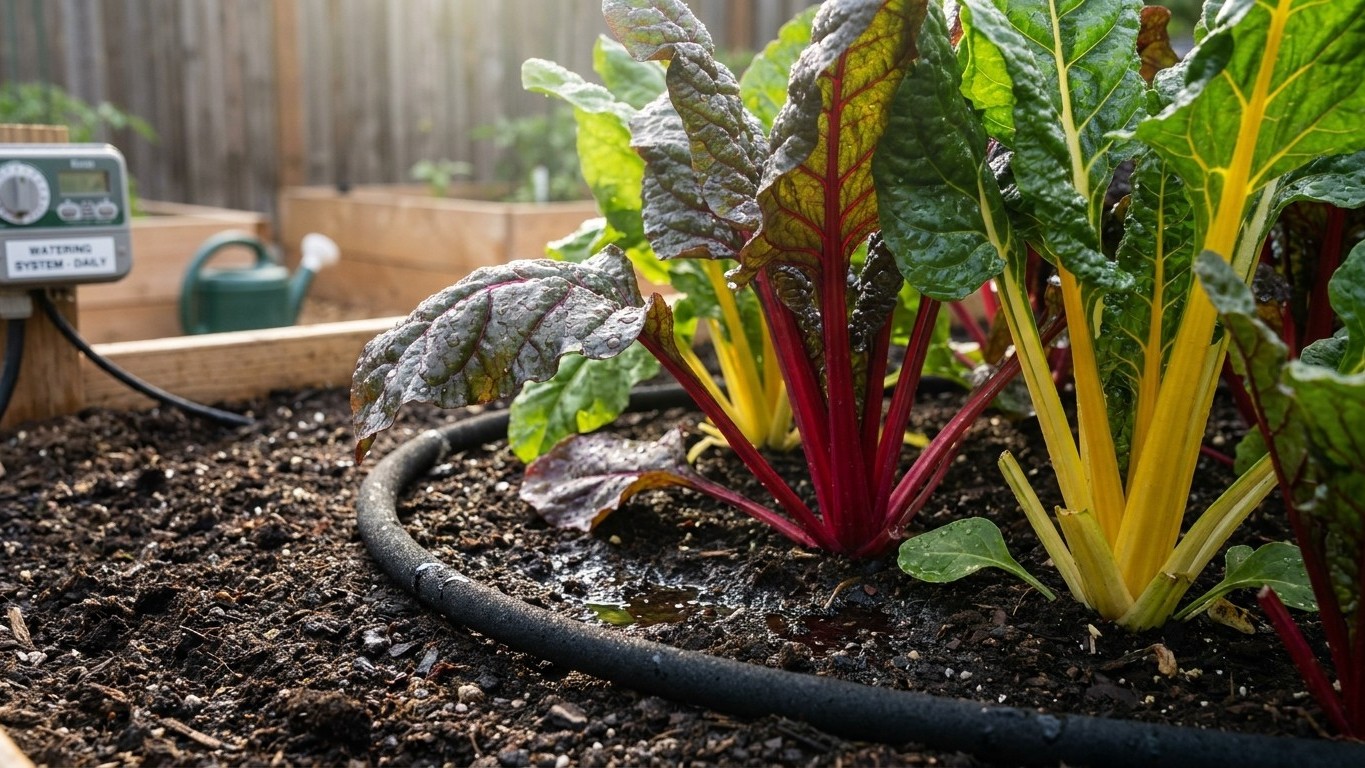

Swiss chard turns tough and bitter when its soil moisture swings between soggy and dry, not when it simply misses a deep soaking. Utah State University Extension is blunt about this: irrigation needs to be “frequent and uniform,” delivering 1 to 2 inches of water per week, because “moisture fluctuations will cause leaves to become tough, slow leaf development and contribute to off-flavors.” That single line changes how you should be watering this crop compared to almost everything else in the garden.
The short answer
Chard wants small, steady drinks, not the occasional flood. Utah State University Extension recommends supplying 1 to 2 inches of water per week, and it stresses that the delivery method matters as much as the total: irrigation should be “frequent and uniform.” That phrasing is deliberate. Most root vegetables and many fruiting crops respond well to deep, infrequent watering that trains roots to reach downward and builds drought tolerance between soakings. Chard is the exception on this list. Its shallow, fibrous root system sits close to the surface, where soil moisture rises and falls fastest, and the leaves respond to every one of those swings.
When the soil dries out between waterings and then gets soaked again, the plant reacts by pulling water rapidly into leaf tissue after a dry stretch, then slowing growth during the dry period itself. That stop-and-start pattern is exactly what produces the tough, stringy texture and bitter edge that show up on a dinner plate. Utah State University Extension ties this directly to flavor and quality, not just texture: high summer temperatures already “reduce growth, decrease quality, and may cause bitter or off-flavors to develop,” and inconsistent watering compounds the problem instead of offsetting it.
The practical target is straightforward. Aim for that 1 to 2 inch weekly total, but split it into more frequent, smaller applications rather than one long soak. In sandy soil that might mean watering every couple of days; in heavier clay soil that holds moisture longer, less frequent but still regular watering can hit the same weekly total without letting the root zone dry out completely in between. The number itself doesn’t change. What changes is how you divide it up to keep the moisture curve flat instead of jagged.
This also explains why chard can taste noticeably better in spring and fall than in the middle of summer. Utah State University Extension notes that chard “tastes best when plants grow rapidly and mature before the summer heat,” largely because cooler weather makes it easier to keep soil moisture consistent. Once daytime highs push past that 75 F comfort zone the source names, water demand spikes, evaporation accelerates, and any lapse in watering shows up in the leaf almost immediately.
What actually decides it

Three separate mechanisms are stacked on top of each other here, and each one has its own trigger condition.
Root architecture and moisture access
Chard’s root system stays relatively shallow compared to deep-rooted vegetables, so it draws most of its water from the top layer of soil, the same layer that dries out fastest under sun and wind. A crop with deep roots can ride out a few dry days by pulling moisture from lower soil layers. Chard doesn’t have that buffer, which is precisely why the frequent-and-uniform approach exists as a workaround for a root system that can’t reach for water on its own.
Temperature as an amplifier, not a separate factor
Utah State University Extension sets 75 F as the threshold where growth quality starts to suffer, and notes that temperatures down to 32 F don’t seriously harm young plants. That asymmetry matters for watering strategy: cold snaps are rarely the problem, but a hot stretch above 75 F increases the plant’s water use at the same time it increases the soil’s rate of drying. If your watering schedule doesn’t tighten up as temperatures climb, the gap between what the plant needs and what the soil can supply widens fast, and that gap is where bitterness and toughness start.
Mulch as a moisture stabilizer, conditionally
The source recommends organic mulch specifically “to cool the soil when temperatures increase, reduce water stress, and help control weeds.” The condition embedded in that sentence is worth noticing: mulch is framed as a response to rising temperatures, not a year-round default. Its job is to slow evaporation and buffer the soil against the same fluctuations that irregular watering causes. A 2 to 3 inch layer of straw, shredded leaves, or similar organic material around established plants extends the interval between waterings without letting the soil swing to dry, effectively doing part of the frequent-watering job for you during the hottest weeks.
How to do it
- Choose your route first: direct seeding or transplants. According to Utah State University Extension, transplants go into the garden near your last frost date, while direct-seeded chard goes in 3 to 4 weeks earlier than that same frost date. These are two different starting points, not two versions of the same date, so decide which method you’re using before counting backward on your own calendar.
- Prepare soil that drains but doesn’t dry out instantly. Chard’s shallow roots do better in soil that holds moisture evenly, so working in organic matter ahead of planting helps smooth out the fluctuations the plant is sensitive to later on.
- Water newly seeded or newly transplanted chard gently and often while roots are establishing. Young seedlings have even less capacity to buffer against dry spells than mature plants, so consistency matters most in these first few weeks.
- Once plants are established, settle into the 1 to 2 inch per week target, delivered in frequent, evenly spaced applications rather than one heavy soak. Adjust the frequency, not the weekly total, as weather warms.
- Apply organic mulch around the base of the plants as temperatures start climbing toward and past 75 F. This is the point where Utah State University Extension flags mulch as most useful, since it’s cooling soil and reducing water stress exactly when both are hardest to manage.
- Keep monitoring through the season. As heat increases, check soil moisture more often rather than assuming the existing schedule still matches plant demand, since the same watering routine that worked in cooler weeks can fall short once daytime highs push past that 75 F threshold.
What goes wrong

- Deep, infrequent soakings instead of frequent ones. Treating chard like a crop that wants to dry out between waterings triggers the exact moisture fluctuation Utah State University Extension warns against. Fix it by switching to smaller, more frequent applications that still add up to 1 to 2 inches per week.
- Letting soil dry out completely during hot stretches. Once temperatures push past 75 F, water demand rises and the same watering interval that worked in cooler weather leaves the root zone dry for longer stretches. Check soil moisture more often during hot weeks and tighten the schedule instead of waiting for visible wilting.
- Skipping mulch during the hottest part of the season. Bare soil heats up and loses moisture faster, undercutting even a good watering schedule. Apply organic mulch around plants as heat increases; it’s specifically recommended to cool the soil, reduce water stress, and control weeds at the same time.
- Confusing the seed and transplant timelines. Because direct-seeded chard goes in 3 to 4 weeks before the last frost date while transplants go in near that same date, using one timeline for the other either delays seeding or pushes transplants out too early. Match the method to its own starting point.
- Assuming cold is the main threat and ignoring heat. Young plants tolerate temperatures down to 32 F without serious damage, so growers sometimes focus watering and protection efforts on cold snaps while summer heat, the actual driver of bitterness and toughness, goes unmanaged.
Common questions
Does chard need more water in containers than in garden beds? Utah State University Extension doesn’t break out a separate figure for containers, but the same 1 to 2 inch weekly target and the frequent, uniform approach apply. Containers dry out faster, so meeting that target usually means more frequent checks, not a different total.
Can I switch to deep watering once chard is established? The source doesn’t draw a distinction between young and established plants on this point. The guidance to keep irrigation frequent and uniform is presented as the standard approach for chard generally, tied to preventing moisture fluctuation rather than to plant age.
Which chard variety handles heat best? Utah State University Extension names four varieties, Rhubarb, Bright Lights, Lucullus, and Fordhook Giant, but doesn’t rate any of them for heat tolerance or attach performance figures to any name. Variety choice isn’t presented as a substitute for consistent watering.
Is bitterness always caused by watering problems? Not exclusively. The source lists high summer temperatures as a separate contributor to bitter or off-flavors, alongside moisture fluctuation. The two often occur together since hot weather also makes consistent watering harder to maintain.