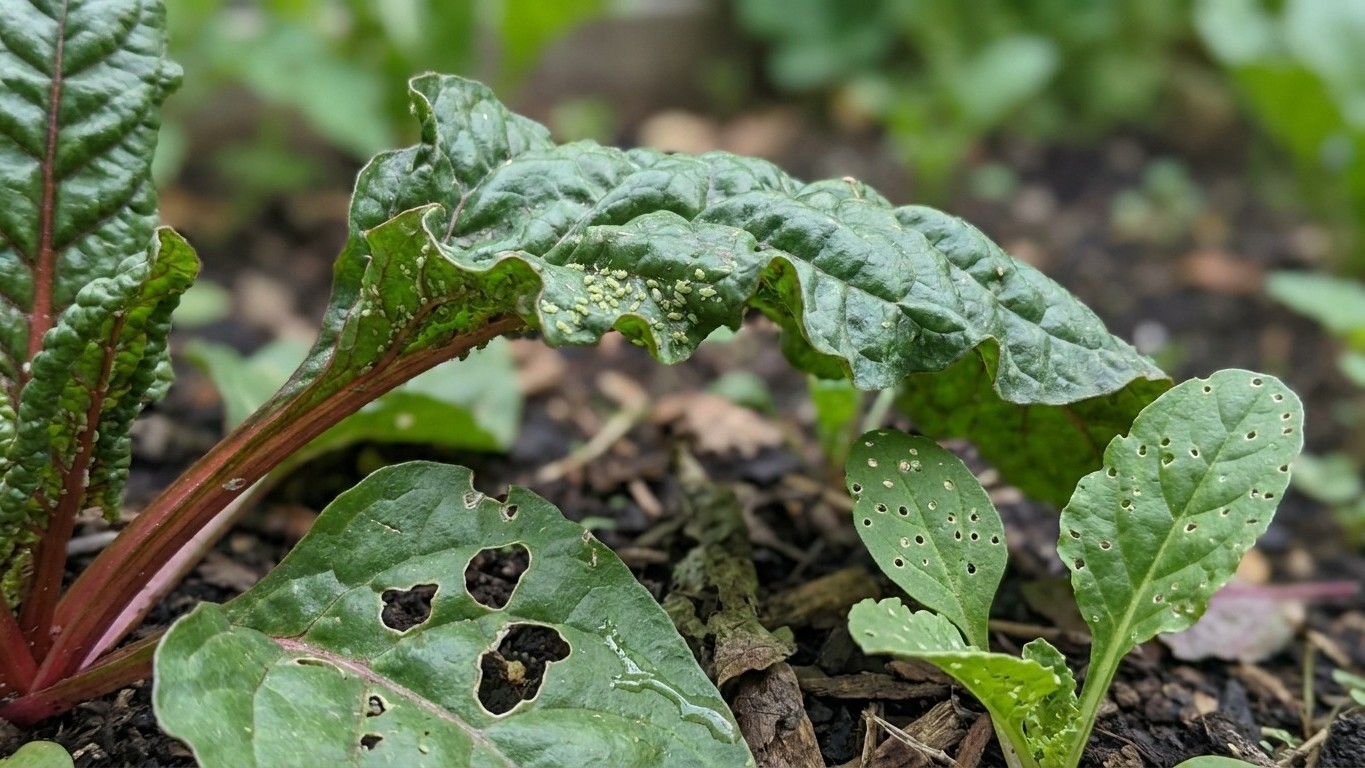

Swiss chard picks up three recurring pests: aphids that curl and crinkle the leaves, slugs that chew ragged holes overnight, and flea beetles that riddle young seedlings with pinholes or wipe out a stand entirely. None of them calls for the same fix. Aphids respond to soap or a hard water spray, slugs need drier soil, flea beetles need a physical barrier before they arrive. Treating all three the same way wastes effort on a crop that’s otherwise easy to grow.
The short answer
According to Utah State University Extension’s fact sheet Swiss Chard in the Garden, the plant itself is a fairly forgiving one to grow. The Extension notes that “most Swiss chard is fast growing and is not susceptible to many disease problems,” and that rotating where you plant it from year to year handles most of the disease pressure that does show up. Insects are a separate story, and the fact sheet treats each one on its own terms rather than offering a single spray-and-forget answer.
Aphids show up as clusters on the undersides of leaves, and the tell is cosmetic before it’s serious: “leaves become crinkled and curled.” Utah State University Extension recommends insecticidal soap or simply knocking the colony off with a strong stream of water. That’s it, no systemic treatment, no schedule to follow. It’s a mechanical and low-toxicity fix, which matters if you’re growing chard to eat within days of noticing the problem.
Slugs leave a different signature. They “chew holes in leaves,” usually irregular and ragged rather than the clean punctures flea beetles leave. The Extension’s guidance here isn’t a product at all, it’s a condition: avoid moist soil conditions that favor slugs in the first place. That shifts the whole conversation from treatment to prevention, which changes how you water and mulch long before slugs ever show up.
Flea beetles are the pest most likely to end a planting before it starts. The fact sheet is direct about the stakes: they “can reduce plant stands or may kill seedlings.” Because young chard seedlings have almost no size or leaf mass to spare, a flea beetle population that would just look scruffy on a mature plant can flatten a newly emerged row. The Extension’s answer is floating row cover, used to exclude the beetles from ever reaching the plants, rather than any spray applied after damage appears.
Three pests, three different response types: a contact treatment, a soil-moisture habit, and a physical barrier. That’s the short answer, and it’s the reason a single “pest control” plan for chard usually underperforms.
What actually decides it

The instructions in the fact sheet aren’t unconditional. Each one depends on a circumstance that determines whether it works at all, and skipping that condition is where most of the frustration with these three pests comes from.
Why soil moisture decides the slug outcome
Slugs aren’t repelled by a product, they’re excluded by an environment. The Extension’s phrasing, “avoid moist soil conditions that favor slugs,” puts the entire mechanism on moisture management rather than on the slugs themselves. A garden bed that stays consistently damp, whether from heavy mulch, low drainage, or frequent shallow watering, creates the exact surface conditions slugs need to move and feed at night. Change the watering pattern toward deeper, less frequent irrigation and you change the population pressure, without ever touching a slug directly.
Why timing decides whether row cover works against flea beetles
Floating row cover only works as exclusion if it’s in place before the beetles find the seedlings. The Extension notes fabric covers are also used “to protect seedlings and Transplants from frost,” which means the same material doing double duty for cold protection is the one that has to go down early enough to matter for flea beetles too. Cover installed after beetles are already established in a bed does nothing, because the insects are sealed in with the plants rather than kept out. The condition isn’t the fabric, it’s the sequence.
Why contact matters for aphid treatments
Insecticidal soap and a water stream both work only where they actually touch the insect. Aphids cluster on leaf undersides, which is exactly where a light or careless spray misses. The mechanism behind both recommended fixes is physical contact with the soft-bodied insect, not a residual chemical effect that keeps working after the leaf dries. That’s why a single treatment often needs to be repeated once new aphids move in from nearby plants, rather than treated as a one-time fix.
Disease resistance follows a different mechanism entirely. Since the Extension attributes most disease control to crop rotation rather than variety choice, moving chard to a new bed section each year does more for long-term plant health than any pest response listed above.
How to do it
- Decide whether you’re starting from seed or from transplants, since the fact sheet gives each a different point in the season. Seed goes into the ground 3 to 4 weeks Before the Last Frost date. Transplants go out near the last frost date itself, later than direct-seeded chard.
- If frost risk remains after seeding or transplanting, use a fabric row cover for its intended purpose first: protecting seedlings and transplants from frost.
- Leave that same row cover in place, or install one at seedling emergence, specifically to exclude flea beetles before they locate the planting. This is the single Extension-recommended defense against flea beetle damage.
- Manage irrigation toward less frequent, deeper watering rather than light frequent watering, to avoid the moist soil conditions that favor slugs.
- Inspect leaf undersides regularly through the growing season. If leaves start to crinkle and curl, treat the affected plants with insecticidal soap or a strong stream of water to dislodge the aphid colony.
- Rotate the chard planting location the following year, since the Extension credits rotation with controlling most of the disease pressure the crop faces.
What goes wrong

- Row cover goes down too late. Once flea beetles are already present in the bed, cover traps them with the seedlings instead of excluding them. The fix is installing cover at or before seedling emergence, not after the first pinholes appear.
- Watering habits keep soil consistently damp. Frequent shallow irrigation or heavy mulch against the stems creates exactly the moist surface slugs need. Shift to deeper, less frequent watering to remove the condition the Extension identifies as the driver of slug damage.
- Aphid spray only hits the top of the leaf. Because aphids cluster on leaf undersides, a spray aimed only at the top surface misses the colony entirely and the crinkling continues. Turn leaves over, or use a water stream angled upward, to reach the insects directly.
- Seed and transplant dates get treated as interchangeable. Seeding 3 to 4 weeks before the last frost and setting out transplants at the frost date are two different points in the calendar. Using one date for both routes either exposes seedlings to unnecessary cold or delays the crop for no reason.
- Chard goes back into the same bed year after year. Since the Extension attributes most disease control to location rotation rather than pest management, skipping rotation undercuts disease resistance no amount of insect control can make up for.
Common questions
Do aphids, slugs, and flea beetles require the same treatment?
No. Utah State University Extension recommends a different response for each: insecticidal soap or a strong water stream for aphids, drier soil conditions for slugs, and floating row cover for flea beetles.
Can row cover protect chard from both frost and flea beetles?
Yes, according to the fact sheet, fabric covers serve both purposes: protecting seedlings and transplants from frost, and excluding flea beetles from reaching the plants, provided the cover is installed before either threat arrives.
Is Swiss chard prone to disease as well as insect damage?
Not particularly. The Extension states that most Swiss chard is fast growing and not susceptible to many disease problems, and that rotating planting locations from year to year controls most of what disease pressure does occur.
Should seed and transplants go in on the same date?
No. The fact sheet’s guidance places seed sowing 3 to 4 weeks before the last frost date, while transplants go into the ground near the last frost date itself, a later point in the season.