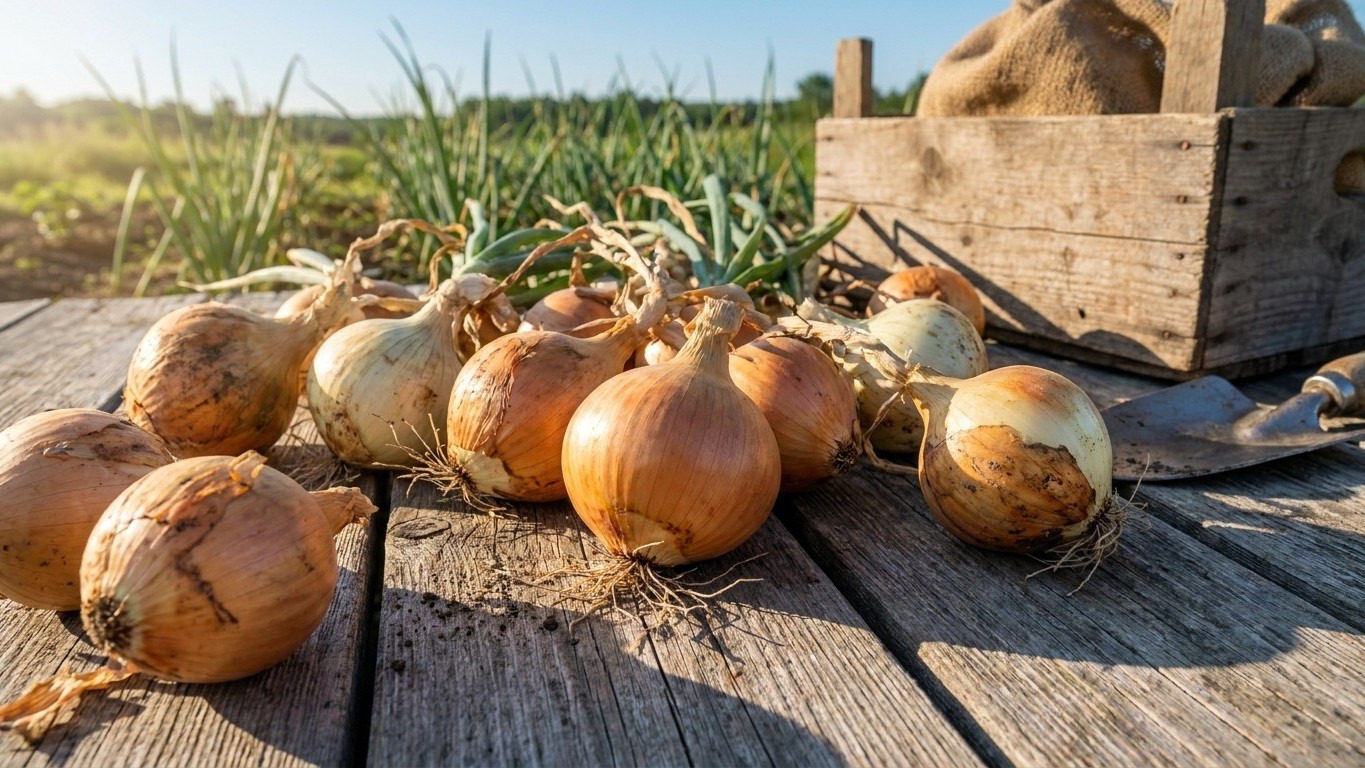

University of Arizona Cooperative Extension documents seven insects that actually feed on onion here, out of a longer list of garden pests it tracks statewide. Thrips do the most consistent damage to the leaves; aphids, false chinch bugs, grasshoppers, spider mites and whiteflies follow at different points in the season; and the beet leafhopper matters less for what it eats than for the virus it carries into the plant.
Which pests attack onion in Arizona

University of Arizona Cooperative Extension documents ten pests that recur in Arizona vegetable plantings: Aphids, Beet leafhopper (vector of curly top virus), False chinch bug (Nysius raphanus), Grasshoppers, Green fruit beetle (Cotinis mutabilis), Spider mites, Squash bug (Anasa tristis), Thrips, Tomato hornworm (Manduca quinquemaculata), and Whiteflies. That’s the full list for the territory. It isn’t longer than that, and nothing outside it belongs on this page.
Three of the ten have no business on an onion bed. Squash bug (Anasa tristis) feeds on cucurbit vines, squash, pumpkin, melon, piercing leaves and stems that an onion plant simply doesn’t grow. Tomato hornworm (Manduca quinquemaculata) needs solanaceous foliage, tomato, pepper, eggplant, to complete its life cycle, and an onion row gives it nothing to chew. Green fruit beetle (Cotinis mutabilis) goes after ripening or damaged fruit, figs and stone fruit especially, not the below-ground bulb an onion is built around. Seeing any of those three near a struggling onion patch means something else is going on, not this insect.
That leaves seven worth watching once transplants go in: Aphids, Beet leafhopper, False chinch bug, Grasshoppers, Spider mites, Thrips, and Whiteflies. Thrips do more direct damage to onion bulb size in Arizona than any other insect on this list, because they rasp the leaf surface and feed on the sap that leaks out, and a heavy population can shrink the bulb before harvest without ever spreading a disease. The beet leafhopper works differently. Its own feeding is minor, but it injects curly top virus while it does it, and that virus can stunt or kill a young plant within weeks of the bite. False chinch bugs are the ones that surprise gardeners most, since they don’t build up on the onion itself; they mass on nearby weeds and only pour into the row once those weeds dry down, arriving in numbers that look like an infestation started overnight.
Aphids, spider mites, grasshoppers and whiteflies round out the list, and each one behaves closer to how it acts on any other vegetable crop, no onion-specific twist. What changes from one Arizona county to the next is which of the seven actually shows up in a given year, not whether the species exists here at all.
When each one shows up, and what it does first
Onion timing in Arizona doesn’t run on the calendar the way it does farther north. Onions grown near latitude 33.43 degrees north sit at a spot where the longest day of the year brings 14 hours and 13 minutes of daylight, and a short-day onion starts shifting from leaf growth to bulb growth once daylight crosses roughly 12 hours. That threshold, not the month on the wall, is what decides when a plant stops making leaves and starts making a bulb, so it’s a more reliable marker for pest timing too.
In the weeks right after transplanting, aphids and thrips are the first to show up, clustering down in the folded new leaves where they’re hard to see. The first sign isn’t the insect itself; it’s a silvery, slightly mottled sheen on the leaf blade that looks more like sun damage than a bug problem at first glance.
False chinch bugs arrive on a different trigger entirely: they move once the winter annual weeds nearby, mustards especially, dry down and stop offering green tissue. When that happens, whatever green plant is still standing gets the overflow, onions included, and the first sign is leaf tips turning white and then brown in patches that look out of proportion to how few actual bugs you can find on the plant.
Grasshoppers tend to show up later, once rangeland or roadside vegetation has dried out and they move into anything irrigated. Their damage is easy to place: ragged notches chewed inward from the leaf edge, unlike the smooth cuts a tool or a hailstorm would leave.
Spider mites build during the hottest, driest stretch of the season, often overlapping with the days closest to that 14-hour daylight peak. Fine stippling on the leaf and a faint webbing between blades are the earliest clues. Bulbing itself runs on a light switch, not a thermometer, so any leaf-feeding pest active right as day length crosses that 12-hour mark has an outsized effect on how big the bulb ends up. Beet leafhopper activity often lands in that same window, and its bite can go unnoticed while the virus it delivers starts twisting new growth from the inside. Whiteflies close out the season, building up on foliage that’s already worn down by heat.
Telling the damage apart from everything else
Onion leaves show stress the same way no matter what caused it, which is exactly why misdiagnosis happens so often. A few side-by-side comparisons narrow it down faster than staring at one leaf.
| Symptom | Also caused by | What distinguishes it |
|---|---|---|
| Silvery streaks or mottling on leaves | Sunscald, spray drift | Thrips streaks run parallel to the leaf vein and carry tiny dark flecks of droppings; sunscald and drift are blotchy with no directional pattern |
| Leaf tips whitening then browning | Underwatering, drought stress | Check soil moisture first; browning that continues after a recent, adequate watering points to an insect, not the root zone |
| Stippled, bronzed leaves with fine webbing | Nitrogen deficiency | Webbing and stipple together are specific to mites; a deficiency yellows the leaf evenly with no webbing |
| Ragged notches chewed from the leaf edge | Hail, tool or mower damage | Chewed edges show an irregular, gnawed pattern; mechanical damage leaves a cleaner, straighter cut |
| Twisted, stunted new growth | Herbicide drift | Curly top damage often shows yellowing veins first; drift damage tends to be worse on the side of the row facing the wind |
| Sticky residue with sooty mold | Fungal disease | Wipe the leaf; a sticky film underneath points to aphids or whiteflies, not a fungus |
Any symptom that’s worse on one side of a row, matching the direction the wind usually blows, points to chemical drift, not an insect. None of this replaces a look from someone trained to tell them apart. A local county extension office can confirm what a photo or a sample actually shows, and that step matters more than guessing off a symptom list, however detailed.
What actually works here, and what is a waste of time
Timing beats treatment in a growing season this compressed, and a physical barrier put on early does more than most sprays put on late. A row cover set down the day transplants go into the ground keeps thrips and aphids from ever finding the crop; the same cover put on two weeks later, after the first insects are already inside, does nothing but trap them there. Covers can stay on through the leaf-growth stage since onions don’t need pollinators to form a bulb, which gives a longer protection window than most vegetable crops allow.
Clearing out drying weeds, mustards especially, before false chinch bugs are forced to move removes their launch pad before it becomes a problem. Keeping soil moisture even through the hottest stretch of the season reduces the stress that invites spider mites in the first place; letting the bed dry out and rewetting it hard tends to make an outbreak worse, not better.
What doesn’t work is reaching for a broad-spectrum treatment at the first sign of damage. Wiping out the insects that eat aphids and mites tends to trigger a bigger secondary outbreak of the very pests being treated for, since predators take longer to rebuild their numbers than the pests do. Any decision about what’s labeled for use on onion in Arizona belongs with the county extension office, not a generic product label.
One more thing shapes the stakes here: short-day onions grown in the low desert run sweeter because they carry fewer of the volatile sulfur compounds that make an onion pungent, and those same compounds are what protect a bulb in storage. That trade-off means Arizona onions don’t hold for months the way a northern, long-day onion does, so pest damage to the bulb surface matters more in the short window before use than it would for a crop meant to sit in storage all winter.
Where to check this for your own county
University of Arizona Cooperative Extension is the source for everything in this piece, and it keeps offices at the county level across the state. That local office is the right next step for anything more specific than what’s written here, whether that’s a photo of an unfamiliar insect or a leaf sample worth a second look.
A pest documented statewide by University of Arizona Cooperative Extension doesn’t mean it’s active in every county in the same year. Low desert counties like Yuma and Maricopa run on a different pest calendar than the higher, cooler counties around Flagstaff, and a species common in one can be a non-issue a few hundred miles away. Latitude shifts across the state too; a garden well north of the reference point near Phoenix gets more summer daylight, which changes not just the pest calendar but which onion varieties will even bulb properly.
The next move is straightforward: bring a leaf sample or a clear photo to the county extension office before treating anything. What’s published at the state level is a starting list, not a diagnosis for one particular garden.