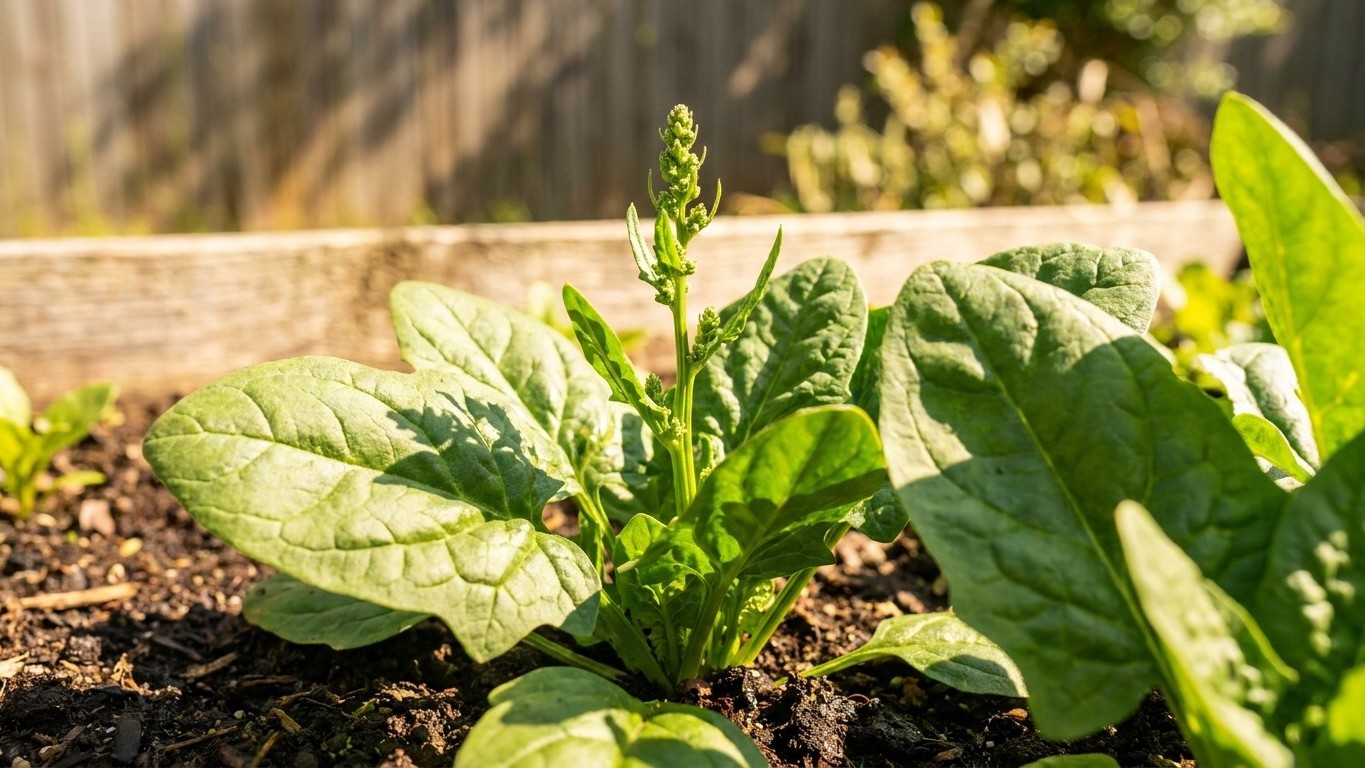

In Arizona, the University of Arizona Cooperative Extension documents seven pests that actually feed on spinach: aphids, whiteflies, thrips, spider mites, grasshoppers, the false chinch bug, and the beet leafhopper, which spreads curly top virus. Most of them show up as a fall-sown crop pushes through winter and into spring, and pressure builds right as the same stretch of longer days and rising heat pushes the plant itself toward bolting.
Which pests attack spinach in Arizona

The University of Arizona Cooperative Extension documents ten garden pests for this territory: aphids, beet leafhopper (vector of curly top virus), false chinch bug (Nysius raphanus), grasshoppers, green fruit beetle (Cotinis mutabilis), spider mites, squash bug (Anasa tristis), thrips, tomato hornworm (Manduca quinquemaculata), and whiteflies. That’s the full documented list for this region, and not every name on it belongs on a spinach bed.
Three of the ten have no business near a row of spinach. The green fruit beetle chews on ripening, soft fruit, think overripe peaches or figs, and gets nothing from a leaf that never produces fruit. The squash bug is a cucurbit specialist that targets squash, pumpkin, and melon vines, and won’t cross over to a spinach leaf even sitting in the next row. The tomato hornworm needs a solanaceous host, tomato, pepper, eggplant, to complete its life cycle, and spinach isn’t one of those either.
That leaves seven species that actually feed on spinach here. Aphids and whiteflies are sap feeders that cluster on the undersides of young leaves and multiply fast on tender new growth. Thrips rasp the leaf surface, leaving a silvery scarring that spreads across a planting before it’s obvious. Spider mites are technically arachnids rather than insects, but the extension service groups them with the pests that matter for this crop, and they thrive in dusty, dry conditions. Grasshoppers are generalist chewers that will strip a spinach leaf to its ribs given enough time and enough of them. The false chinch bug tends to arrive in large numbers rather than as isolated insects, often moving onto garden beds once nearby weeds or wild grasses dry out. The beet leafhopper matters less for what it eats directly and more for what it carries: it’s the vector for curly top virus, which can stunt or kill a planting even though the leafhopper’s own feeding damage is minor.
Seven pests isn’t a long list, and the extension service doesn’t document more than that for spinach in this territory. Most of the insect traffic in an Arizona garden is aimed at squash, tomatoes, and fruit, not at the leafy greens tucked into a fall bed.
When each one shows up, and what it does first
Spinach here goes into the ground once soil temperature drops out of the danger zone, since germination falls off sharply once soil holds above 80°F, according to Utah State University Extension. That soil threshold, not a frost date, decides the fall sowing window in this territory. Once seed is in, the only scheduling guidance available is to count backward: plant 50 to 75 days before the date a harvest is wanted.
Aphids and whiteflies are usually first to appear, often within the first few weeks after seedlings emerge. Aphids show up as small clusters on the undersides of the youngest leaves, and the first sign is rarely the insect itself, it’s a sticky film on the leaf or a faint curl at the margin. Whiteflies announce themselves when a disturbed plant sends up a small cloud of tiny white insects, with yellowing showing up on the leaves underneath soon after.
Thrips and spider mites tend to build through the season rather than arrive all at once. Thrips leave a silvery, papery stippling that spreads outward from the first damaged spots. Spider mites produce a similar dusty stippling, but fine webbing at the leaf joints, especially during stretches of dry heat, is the tell that separates them from thrips.
Grasshoppers, the false chinch bug, and the beet leafhopper are tied most closely to the surrounding landscape drying out. Grasshopper pressure climbs as the season warms and nearby vegetation gets picked over. The false chinch bug tends to arrive in a sudden wave once weeds or wild grasses nearby have dried down and stopped offering food. The beet leafhopper itself is small and mobile and hard to catch directly; the tell is usually the plant’s reaction, leaves that curl, yellow, and stop growing normally, pointing to curly top virus rather than to feeding damage.
All of this activity accelerates on the same clock that eventually ends the crop. As days lengthen toward this region’s 14 hours and 13 minutes of daylight on the longest day, and temperatures climb toward the 75°F ceiling spinach tolerates before turning bitter and bolting, pest pressure and plant stress rise together. That’s why a bed that looks fine in late winter can decline fast once spring really gets moving.
Telling the damage apart from everything else
Not everything that looks like pest damage on a spinach leaf is a pest. Arizona’s growing conditions produce plenty of look-alikes, and the wrong diagnosis usually means treating an insect that isn’t there while the real problem, heat, water, or soil, keeps working.
| What you see | Possible insect cause | Possible non-insect cause | What tells them apart |
|---|---|---|---|
| Yellowing leaves | Aphid or whitefly honeydew, sooty mold | Nitrogen deficiency, uneven watering | Sticky residue or visible insects underneath points to pests; even, whole-plant yellowing without residue points elsewhere |
| Ragged holes, chewed edges | Grasshoppers | Hail, wind abrasion, foot traffic | Chewed edges follow leaf veins irregularly; mechanical damage is more uniform, torn straight through |
| Fine stippling, dusty look | Spider mites or thrips | Sunscald, dust accumulation | Webbing at leaf joints confirms mites; scarring under a hand lens, rather than surface dust, confirms thrips |
| Curling, stunted growth | Curly top virus (beet leafhopper) | Underwatering, transplant shock | Virus symptoms persist and worsen even with consistent watering; stress symptoms improve once water is corrected |
| Bitter taste, flower stalk | Not insect-related | Heat and long days | A plant sending up a seed stalk once temperatures push past the 75°F ceiling is bolting, not being eaten |
That last row matters more than it looks. A planting that turns bitter and starts flowering in spring is responding to day length and heat, the same two factors that make the crop grow well in the first place, not to an insect at all. Spraying or hunting for pests at that point wastes time the plant doesn’t have left anyway.
None of this replaces an actual look at the plant. A county extension office can confirm what’s happening far more reliably than a written description, and that’s especially true for curly top virus, which is sometimes confused with simple heat stress until the two are compared side by side.
What actually works here, and what is a waste of time
Timing beats treatment on a crop this short. Floating row cover installed at seeding, before any pest has found the bed, keeps aphids, whiteflies, thrips, and grasshoppers off young plants during the weeks they’re most vulnerable, with the side benefit of moderating soil temperature while seed germinates below that 80°F threshold. Waiting to cover a planting until damage is already visible defeats the purpose, since whatever showed up is already inside the cover with the plant.
Clearing dried weeds and wild grasses from around a bed before they fully dry down reduces the sudden influx of false chinch bugs, since that insect moves onto garden plants specifically when its usual food source disappears nearby. Keeping the surrounding area watered or mowed, rather than letting it dry out untouched, removes the trigger.
Handpicking works for grasshoppers on a small planting, and it’s genuinely effective when done early and often rather than as a one-time cleanup. Reflective mulch under the row can reduce aphid and whitefly landings, since both orient partly by light reflected off bare soil.
What doesn’t work: treating a spinach bed for squash bugs, tomato hornworms, or the green fruit beetle. None of the three feeds on spinach, so any time or product spent on them is spent on the wrong crop entirely. Spraying broadly once a plant has already bolted is another dead end, since a bitter, flowering plant is responding to heat and day length, not to anything a treatment can reverse.
This site doesn’t recommend specific products or active ingredients, and for good reason: what’s legally labeled for use on spinach changes, and only the University of Arizona Cooperative Extension can say what’s currently approved for a home garden in this state.
Where to check this for your own county
The seven pests above are documented at the state level by the University of Arizona Cooperative Extension, and state-level documentation is a starting point, not a guarantee of what’s present in any one garden. Arizona spans low desert around Phoenix and Tucson, where the frost-free season runs essentially all year, and high country around Flagstaff, where hard freezes are routine. A pest that’s a constant problem in a low desert garden may barely register at higher elevation, and the reverse holds too.
The single most useful next step is a call or visit to the county extension office, not a general search for a treatment. County offices track what’s actually showing up locally, in real time, which state-level documentation can’t do. They can also confirm a diagnosis from a photo or a sample, which matters most for curly top virus, where symptoms are easily confused with heat stress from a distance.
It’s also worth asking the county office about the four spinach varieties named in the source documentation, Bloomsdale, Melody, Teton, and Olympia, since no performance data for any of them is published there. A local office may have observations about how the four hold up against specific pest pressure in that county, even where the state-level source stays silent.
A garden three miles away, on different soil, with different nearby crops and different weed pressure, can have a completely different pest picture. That’s not a reason to skip the general list above, it’s a reason to treat it as the first question rather than the last one.
Common questions
Do squash bugs or tomato hornworms ever attack spinach in Arizona?
Not according to the University of Arizona Cooperative Extension’s documentation for this territory. Both are host-specific, squash bugs to cucurbits and tomato hornworms to solanaceous crops, and neither is listed as a spinach pest here.
Why does spinach bolt in Arizona even in a mild spring?
Bolting is triggered by long days as well as heat. As daylight climbs toward this region’s 14 hours and 13 minutes on the longest day, and temperatures push past the 75°F ceiling spinach tolerates, the plant shifts to flowering regardless of how mild the air still feels.
Does planting in fall instead of spring help avoid pests?
Fall sowing sidesteps the worst of the day-length and heat pressure that triggers bolting, and pressure from grasshoppers and the false chinch bug tends to ease as surrounding vegetation cools rather than dries out. The only timing guidance published is to count 50 to 75 days back from the target harvest date once soil temperature has dropped below 80°F.
Is curly top virus common in Arizona spinach?
The beet leafhopper, which spreads curly top virus, is documented for this territory by the University of Arizona Cooperative Extension. How common the virus actually is in any one garden isn’t something a state-level list can answer, that’s a question for the county extension office.