
No. Alabama’s 67 counties sit in IECC Climate Zones 2A and 3A, and the 2021 International Residential Code exempts Zones 1, 2 and 3 from the interior vapor retarder requirement entirely. That covers every county in the state, from Mobile to Madison. “Not required” isn’t the same as “forbidden,” though, and local amendments can shift the answer for a specific jurisdiction.
What the code asks for in Alabama

The 2021 IRC, Section R702.7, states the baseline rule plainly: a vapor retarder of the class listed in Table R702.7(2) “shall be provided on the interior side of frame walls.” The code then lists four exceptions, and the one that decides Alabama’s answer reads: “A vapor retarder shall not be required in Climate Zones 1, 2 and 3.”
Alabama’s 67 counties split across two of those zones: 58 counties fall in Zone 3A, and 9 counties fall in Zone 2A, a group that includes Mobile and Baldwin. Both numbers matter here for a reason that doesn’t apply to every state in this series: Zone 2 and Zone 3 are both inside the exempt bracket. So while the state does span two climate zones, the interior vapor retarder question resolves the same way in both, county by county. No jurisdiction in Alabama carries the model-code mandate for an interior Class I retarder on above-grade frame walls.
That’s the baseline, not the final word. The IRC is a model code, and states and municipalities adopt, and sometimes amend, their own version of it. A county building department can require something the base 2021 text doesn’t, or clarify how the exception applies to a particular assembly. The rule that actually governs a given wall is the one printed in the code edition that jurisdiction has adopted, not the sentence quoted above.
None of this means a vapor retarder is barred from an Alabama wall. The exception removes an obligation; it doesn’t prohibit the material. A builder can still choose to install one, though the reasoning for doing so in a warm-humid climate runs in the opposite direction from a cold one, which is the subject of the next section. What the exception does mean is that a homeowner shouldn’t assume a northern-climate detail (poly sheeting behind the drywall, for instance) is automatically correct just because it shows up in a framing manual written for a colder region. A wall built with the wrong vapor control for its climate doesn’t fail on move-in day. It rots from the inside, quietly, and the owner usually finds out years later, when the drywall is already stained.
Why the answer is the opposite in a warm climate
In a cold climate, the moisture problem starts indoors. Heated air inside a house in January carries water vapor from cooking, showers, breathing, and that vapor pushes outward through the wall toward the cold sheathing. An interior vapor retarder stops it before it reaches that cold surface and condenses. That’s the logic behind requiring one in the northern climate zones.
Flip the climate, and the moisture starts outdoors instead. Along the Gulf Coast and through much of the Southeast, hot humid outdoor air pushes inward toward the air-conditioned interior of the house. Now the cool surface inside the wall cavity isn’t the exterior sheathing, it’s whatever impermeable layer sits closest to the conditioned space. If that layer is a Class I vapor retarder, it becomes the very surface the incoming moisture condenses against. The U.S. Department of Energy’s Building America program describes exactly this outcome: “If the wall contains a vapor retarder on the interior side of the insulation, the water vapor will condense on this cool, impermeable surface,” resulting in “ruined insulation, mold, and structural rot of framing members.”
That’s not a minor caveat. It’s the reason the code writes different rules for different climate zones in the first place, and it has nothing to do with bureaucratic inconsistency. The code is tracking the direction the water is traveling. In a cold zone, keeping vapor from moving outward through the wall protects the structure. In a warm-humid zone, blocking the wall’s ability to dry inward can create the very damage a retarder is meant to prevent. Two houses built to the same instructions, one in Minnesota and one in Mobile, would not get the same outcome, and that’s exactly why the exception for Zones 1, 2 and 3 exists.
The three classes, and why the word matters
“Vapor barrier” gets used loosely, but the code doesn’t work in absolutes. It defines three classes by how much moisture they let through, measured in perms, and the class, not the presence or absence of a retarder, is where climates actually disagree.
| Class | Example materials | Perm rating |
|---|---|---|
| Class I | Sheet polyethylene, nonperforated aluminum foil | 0.1 perm or less |
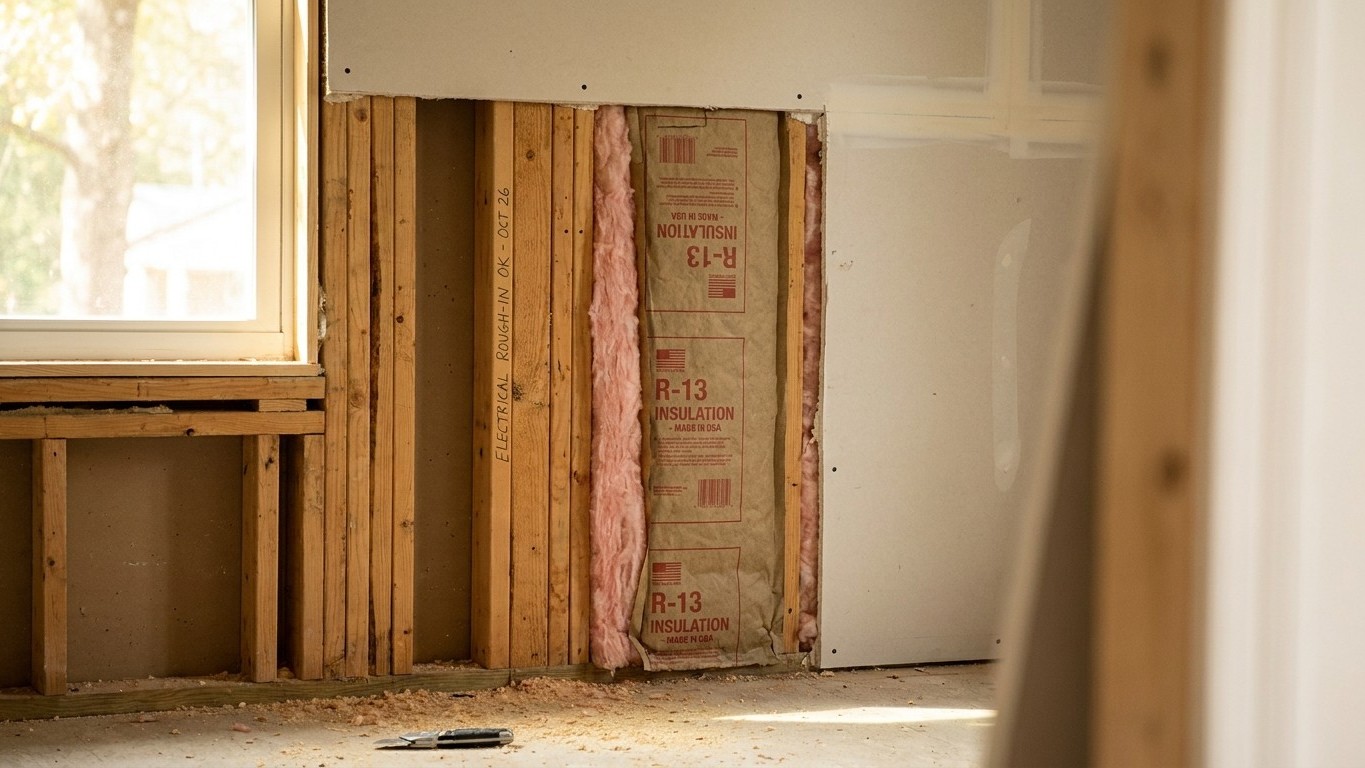
| Class II | Kraft-faced fiberglass batts, vapor retarder paint | above 0.1 up to 1.0 perm |
| Class III | Latex or enamel paint | above 1.0 up to 10.0 perm |
Sheet polyethylene is a vapor barrier only in the sense that it’s a Class I vapor retarder, the tightest of the three categories. Calling it “a vapor barrier” without naming the class is where a lot of the confusion between a cold-climate builder and a warm-climate builder starts; the disagreement is rarely about whether a wall needs any vapor control at all, it’s about which class belongs in which climate.
One detail surprises most homeowners: ordinary latex or enamel paint qualifies as a Class III vapor retarder. If the walls have a couple of coats of interior latex, there’s already a retarder on them, whether or not it was ever labeled that way.
Worth separating out: a vapor retarder and an air barrier do different jobs, even though the same sheet of material sometimes does both. A vapor retarder slows the diffusion of water vapor through a material. An air barrier stops bulk air movement, which carries far more moisture than diffusion ever does. A wall can have one without the other.
Where the rule stops
Section R702.7 lists exceptions beyond the climate-zone exemption already covered. Three apply regardless of zone:
- Basement walls
- The below-grade portion of any wall
- Construction where accumulation, condensation or freezing of moisture will not damage the materials
The basement exception is the one most homeowners actually run into. A poured concrete foundation wall holds groundwater and releases it slowly, for years, long after the concrete has technically “cured.” That assembly needs a path to dry inward, into the conditioned basement space, or moisture builds up behind whatever’s covering the wall with nowhere to go. Sealing an impermeable interior sheet against that concrete traps the moisture instead of letting it dissipate, which is the opposite of what a retarder is supposed to accomplish. For the fuller version of that mechanism and how it applies to finishing a basement, this site’s basement wall vapor barrier guide covers it in more detail.
The third exception, moisture that won’t damage the materials, is deliberately broad and depends on the specific assembly, not a blanket climate designation. It’s the kind of judgment call a local building official or a licensed designer makes for a particular wall, not something a general guide can settle in advance.
Who actually decides, in Alabama
The 2021 IRC text is a model code. Alabama, like every state, adopts its own version through the state building commission, and individual jurisdictions can amend or interpret it further. The code in force on a given lot is whichever edition and amendment set that county or city has actually adopted, not the national model discussed here. That gap, between the model code and the locally adopted one, is exactly why the local building department is the only source that can answer for a specific address.
Winter demand gives some sense of why this question carries real weight in Alabama rather than being purely academic. The Huntsville station averages about 2,831 heating degree days a year (base 65°F), against roughly 2,107 cooling degree days, a reading that measures how much heating demand the climate generates over a season, not a single temperature. That’s a real heating load, not a token one, alongside a cooling load that runs nearly as high, which is part of why the wall assembly question in Alabama isn’t as simple as “it’s the South, skip it.”
None of that changes who has the final say. This page describes the rule and what it depends on; it doesn’t tell any individual reader what belongs in their own wall. That decision, and the code edition that governs it, sits with the local building department. A wall built with the wrong vapor control for its climate rarely announces the mistake right away. It rots quietly, inside the cavity, and the damage usually surfaces years after the drywall went up.