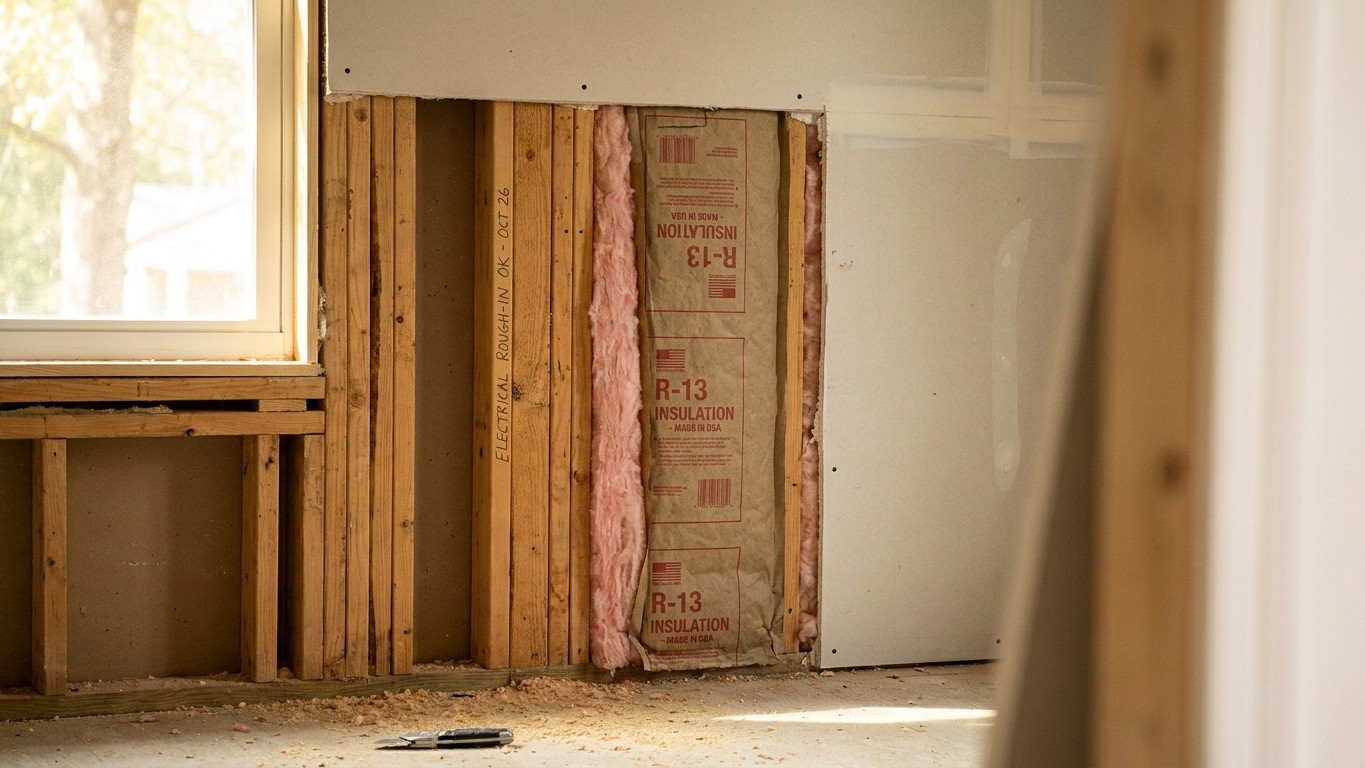

Illinois frame walls need an interior vapor retarder under the 2021 International Residential Code, and that answer holds whether a house sits in the state’s northern counties or its southern ones. The reason has nothing to do with local preference and everything to do with which climate zone the county falls into, and Illinois’s two zones both land on the same side of the code’s dividing line.
What the code asks for in Illinois

Section R702.7 of the 2021 IRC states it plainly: a vapor retarder of the class given by Table R702.7(2) shall be provided on the interior side of frame walls. The code then carves out four exceptions, and the one that decides most of the country reads: “A vapor retarder shall not be required in Climate Zones 1, 2 and 3.” Illinois never reaches that exception, because none of its 102 counties fall into zones 1, 2 or 3.
The state splits between two zones instead. Fifty-eight counties sit in zone 5A, and forty-four counties sit in zone 4A, according to the IECC’s Table R301.1 climate zone assignments by county. That’s a real split, and it matters for plenty of code questions, insulation R-values among them. But for the vapor retarder rule specifically, the split doesn’t change the outcome. Zone 4A and zone 5A are both outside the 1-2-3 exemption, so the base requirement in R702.7 applies to frame walls across the entire state, from the collar counties near Chicago down through the southern tip near Cairo.
That’s worth sitting with for a second, because it’s not how every state works. Some states straddle an exempt zone and a required zone at the same time, which means a builder two counties apart can face genuinely different obligations. Illinois isn’t one of those states. The requirement doesn’t get lighter or heavier depending on which of the two zones a given wall sits in; it’s present either way. What can differ, county to county and project to project, is which class of retarder a local building department expects to see specified, and that’s a detail the state-level fact set doesn’t settle.
None of this means a reader should treat R702.7 as the final word for their own wall. “Not required” is not the same as “forbidden,” and the reverse is also true: “required” here doesn’t specify which of the three classes applies to a particular assembly, insulation type, or cladding. A wall built with the wrong vapor control doesn’t announce the mistake with a leak or a stain. It rots quietly, inside the cavity, and an owner typically finds out years later, when a wall is opened for a renovation or a repair. That gap between “looks fine” and “is fine” is exactly why this is a building-department question, not a guesswork question, and the last section of this piece points to where that answer actually lives.
Why the answer is the opposite in a warm climate
Illinois’s answer only makes sense once you know why some states get the opposite one. In a cold climate, the moisture problem starts inside the house. Heated, humid indoor air pushes toward the colder outer wall all winter, and if that vapor reaches cold sheathing, it condenses there. A Class I retarder on the interior side stops that migration before it starts, which is exactly what R702.7 asks for in a state like Illinois, where the heating season runs long.
Flip the climate, and the physics flips with it. In a warm, humid state, the dominant moisture load doesn’t come from inside the house. It arrives from outside, driven by humid exterior air pushing inward toward the air-conditioned, dryer interior. Put an impermeable Class I layer on the interior side of that wall, and it doesn’t block the problem anymore; it creates one. The U.S. Department of Energy’s Building America program describes exactly what happens next: “If the wall contains a vapor retarder on the interior side of the insulation, the water vapor will condense on this cool, impermeable surface,” and the result is “ruined insulation, mold, and structural rot of framing members.”
That single sentence is the whole reason the code doesn’t give one national answer. It’s not a bureaucratic quirk, and it’s not one region’s building officials being stricter than another’s for the sake of it. It’s a description of which direction the water is actually traveling through the wall assembly at that latitude. Illinois’s long, demanding heating season puts it firmly on the side where the interior retarder is doing useful work, stopping indoor moisture before it reaches a cold surface. A house in a warm-humid zone runs the exact opposite risk from the exact opposite direction, and an interior vapor barrier there would be manufacturing the mold problem the DOE describes rather than preventing it.
This is also why the exception in R702.7 is written by zone number rather than by state name. A state’s borders don’t track moisture regimes; its counties’ climate zone assignments do. Illinois’s two zones, 4A and 5A, both sit on the cold-climate side of that line, which is the whole reason the interior retarder requirement carries through the state without a carve-out.
The three classes, and why the word matters
R702.7 doesn’t just say “add a vapor retarder.” It sorts retarders into three classes by how much moisture they let pass, measured in perms, and the class matters more than the fact of having one at all.
| Class | Example materials | Permeance |
|---|---|---|
| Class I | Sheet polyethylene, nonperforated aluminum foil | 0.1 perm or less |
| Class II | Kraft-faced fiberglass batts, vapor retarder paint | Above 0.1 up to 1.0 perm |
| Class III | Latex or enamel paint | Above 1.0 up to 10.0 perm |
Notice what’s on that Class III line: ordinary latex or enamel paint. Most homeowners already have a vapor retarder on their walls and have never thought of it that way. A couple of coats of standard interior latex paint qualifies under R702.7 as a Class III retarder, which is a far cry from the sheet polyethylene most people picture when they hear the term “vapor barrier.”
That gap between what people picture and what the code actually names is where most of the disagreement between builders in different climates comes from. It’s rarely a fight over whether a wall needs vapor control at all. It’s a fight over class: Class I sheet polyethylene is the right tool for stopping the strong, one-directional vapor drive of a cold climate, but the same sheet in the wrong climate becomes the impermeable surface the DOE warns about. Calling any of these three materials “a vapor barrier” without naming the class skips the part that actually decides whether it belongs in a given wall.
One more distinction worth keeping straight: a vapor retarder is not an air barrier. They solve different problems, vapor diffusion versus bulk air movement, and while some products are built to do both jobs at once, the code treats them as separate requirements. A wall can meet R702.7’s vapor retarder rule and still have air leakage problems that no perm rating will fix.
Where the rule stops
R702.7’s base requirement comes with four exceptions, and three of them apply in Illinois the same way they’d apply anywhere:
- Basement walls
- The below-grade portion of any wall
- Construction where accumulation, condensation, or freezing of moisture will not damage the materials
- Climate Zones 1, 2 and 3 (the exception that doesn’t reach Illinois, since its counties sit in zones 4A and 5A)
The basement exception is the one most Illinois homeowners actually run into, because so many houses in the state have a basement. A poured concrete or block foundation wall holds groundwater moisture and releases it slowly, over years, not days. That assembly needs to be able to dry toward the interior when conditions allow. Wrap it in an interior vapor barrier, and moisture that would otherwise dry out gets trapped against the concrete instead, which is the same condensation-and-rot mechanism described earlier, just working against a different backdrop. That’s why basement walls get their own set of considerations rather than borrowing the above-grade frame wall rule, and this site’s basement wall guide walks through that assembly in more detail.
The construction-damage exception is narrower and more situation-specific: it covers assemblies engineered so that any moisture reaching them simply won’t harm the materials, which isn’t a call a homeowner or even most contractors should make without engineering input or a building official’s sign-off.
Who actually decides, in Illinois
Everything above describes the model code, the 2021 IRC as published by the International Code Council. What actually governs a specific wall in a specific Illinois municipality is whatever edition that jurisdiction has adopted, sometimes amended along the way, sometimes running a code cycle or two behind the current model. That gap is the reason this page can describe the rule and its logic but can’t tell an individual reader what to install in their own wall. The local building department is the only authority that can answer for a specific address, because the code in force there is the one that municipality adopted, not automatically the newest model code.
That distinction carries extra weight in a state with Illinois’s winter demand. At Chicago O’Hare, the NOAA climate normal for 1991-2020 runs about 5,974 heating degree days a year against roughly 1,003 cooling degree days, a measure of how much heating fuel a building needs to fight through the cold season rather than a temperature reading. A ratio that lopsided describes a long, serious heating season, and it’s exactly the kind of climate where an interior vapor retarder is doing real, protective work rather than the kind of decorative afterthought it might be in a milder climate. It’s also a reminder that this fact comes from one reference station; a colder pocket of the state can carry a heavier heating load than O’Hare’s normal suggests.
None of that changes the basic advice. The rule, the class table, and the exceptions all live in the model code; the version that actually applies to a given house lives at the local building department. A wall built with the wrong vapor control won’t show a warning sign at the time it’s closed up. It rots from the inside, quietly, and the owner usually finds out only when a wall gets opened for some unrelated reason, years down the line.