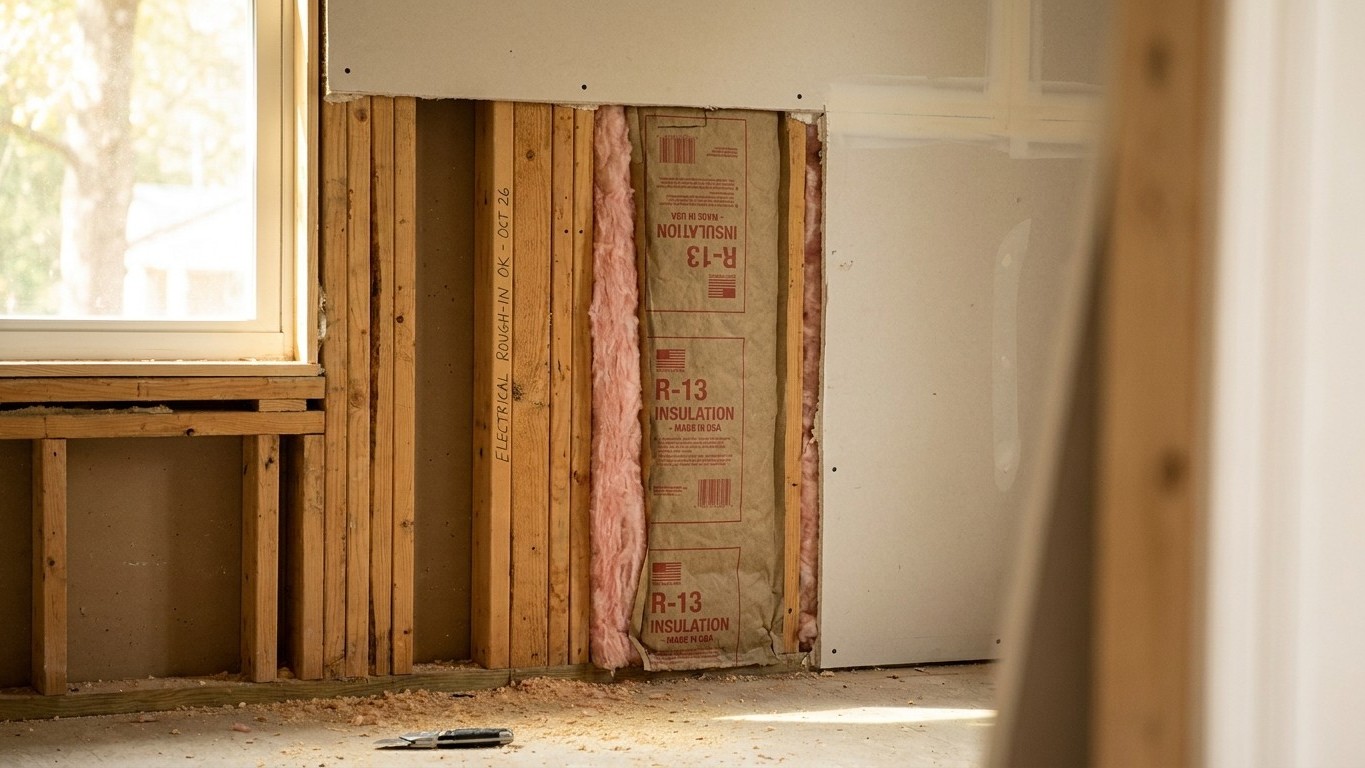

A wall in Kansas needs an interior vapor retarder under the 2021 International Residential Code, because none of the state’s counties fall into the climate zones where that requirement is waived. Kansas splits between IECC Climate Zone 4A (88 counties) and Zone 5A (17 counties), and the code’s exception only applies to Zones 1, 2 and 3.
What the code asks for in Kansas

Section R702.7 of the 2021 IRC states plainly: a vapor retarder of the class listed in Table R702.7(2) “shall be provided on the interior side of frame walls.” That’s the baseline rule for the whole country, not something Kansas invented. What changes state to state is whether the exception carved into that same section applies, and the exception reads: “A vapor retarder shall not be required in Climate Zones 1, 2 and 3.”
Kansas doesn’t sit in any of those three zones. Its 105 counties are divided between two colder zones, 4A across 88 of them and 5A across the remaining 17, according to the IECC’s Table R301.1 county-by-county assignment. Neither number puts a single Kansas county inside the exempted range. That means the retarder requirement stands across the entire state, even though the state technically spans two zones.
What the two Kansas zones actually change
The split between 4A and 5A doesn’t decide whether a vapor retarder is required. It decides which class of retarder Table R702.7(2) assigns, and how the rest of the wall assembly (insulation R-values, in particular) gets sized. A builder working in one of the 17 counties in Zone 5A is dealing with a colder design condition than a builder in the 88 counties of Zone 4A, and that shows up in the numbers on the permit drawings even when the underlying rule about needing a retarder doesn’t change.
This is worth sitting with for a second, because it’s easy to assume “spans two zones” automatically means “two different answers.” Not here. A reader in Sedgwick County and a reader in a county up near the Nebraska line are both under the same interior-retarder obligation. The zone line matters for class and insulation depth, not for the yes-or-no question this page opened with.
None of this tells an individual homeowner what to install in their own wall. The IRC is a model code; it becomes law only once a state or local jurisdiction adopts it, sometimes with amendments. The class assigned to a specific Kansas address depends on the code edition that county or city has actually adopted, and that’s a question for the local building department, not for a general guide like this one. A wall built with the wrong vapor control doesn’t announce the mistake at move-in. It rots quietly inside the cavity, and the damage usually surfaces years later, when someone opens the wall for an unrelated repair.
Why the answer is the opposite in a warm climate
Kansas needing a retarder isn’t a universal truth about houses, it’s a direction-of-travel problem. In a cold climate, the warm, moisture-laden air lives inside the house all winter, and the retarder’s job is to keep that vapor from reaching the cold sheathing on its way outward, where it would condense. That’s the situation across both Kansas zones for most of the heating season.
Flip the climate and the physics flips with it. In a warm, humid region, the moisture load comes from the outside air, not the inside. If a wall in that kind of climate has a Class I, nearly impermeable retarder facing the interior, that layer becomes the coolest surface the incoming humid air meets. The U.S. Department of Energy’s Building America program spells out what happens next: “If the wall contains a vapor retarder on the interior side of the insulation, the water vapor will condense on this cool, impermeable surface,” and the result is “ruined insulation, mold, and structural rot of framing members.”
That single sentence is the reason the code doesn’t hand out one rule nationwide. It isn’t bureaucratic hedging or a state-by-state turf war, it’s the code following the water. Where the vapor drive runs from inside to outside, block it near the inside. Where it runs from outside to inside, blocking it near the inside just traps it against a cold surface instead. Kansas’s two zones both sit on the cold-drive side of that line, which is exactly why the exception written for Zones 1, 2 and 3 skips over the entire state.
The three classes, and why the word matters
Table R702.7(2) doesn’t talk about “vapor barriers” as a single product category. It sorts materials into three classes, defined strictly by how much moisture they let through, measured in perms.
| Class | Example materials | Permeance |
|---|---|---|
| Class I | Sheet polyethylene, nonperforated aluminum foil | 0.1 perm or less |
| Class II | Kraft-faced fiberglass batts, vapor retarder paint | Above 0.1 up to 1.0 perm |
| Class III | Latex or enamel paint | Above 1.0 up to 10.0 perm |
Sheet polyethylene is a Class I material, not “the vapor barrier” as a generic thing, and that distinction is the entire crux of the disagreement between a builder working in Kansas and one working on the Gulf Coast. Nobody is arguing about whether a wall should manage moisture. They’re arguing about which class belongs on which side of that wall, in that climate.
Here’s a detail most homeowners never connect to code language: ordinary latex paint on interior drywall already qualifies as a Class III vapor retarder. Millions of walls across Kansas have one without anyone ever buying a specific “vapor barrier” product. The retarder question, in a lot of existing houses, was already answered by whoever painted the room.
A retarder is not an air barrier
One more distinction worth keeping straight: a vapor retarder controls the slow diffusion of moisture through a material, while an air barrier stops bulk air movement through gaps, seams and penetrations. They’re different jobs. Some products (certain rigid foams, some specialty membranes) do both at once, but the code treats them as separate requirements, and so should anyone reading a wall assembly drawing.
Where the rule stops
R702.7 lists four situations where the interior vapor retarder requirement doesn’t apply, in addition to the zone exception already covered above:
- Basement walls
- The below-grade portion of any wall
- Construction where accumulation, condensation or freezing of moisture will not damage the materials
- Walls in Climate Zones 1, 2 and 3
The basement exception is the one most Kansas homeowners actually run into, because so many houses across the state have a basement or a walkout foundation. Concrete holds moisture and releases it slowly, sometimes for years after the pour, and it also wicks ground moisture from the soil it sits against. A basement wall assembly needs a path to dry toward the interior. Sealing the interior face with a low-perm sheet blocks that path and traps moisture against the concrete instead of letting it escape, which is the opposite problem from the one a vapor retarder is supposed to solve. For the specifics of how that assembly should be built, see this site’s guide to vapor barrier rules for basement walls.
The “moisture will not damage the materials” exception is narrower and more situational, covering wall assemblies where the materials themselves are unaffected by trapped condensation, something a building official evaluates case by case rather than something a homeowner can self-certify from a general article.
Who actually decides, in Kansas
Everything above describes the 2021 IRC as written. Whether that exact language governs a specific Kansas address depends on which code edition that county or city has adopted, and how it’s been amended locally, which is a question only the local building department can answer with certainty. Model codes get adopted state by state, sometimes county by county, sometimes years after a new edition is published, and sometimes with local changes layered on top.
Kansas carries real winter weight behind this question. At Wichita, the NOAA 1991-2020 climate normals put the annual heating degree day total at about 4,414, against roughly 1,774 cooling degree days. Degree days measure heating demand, not a temperature, but that ratio, nearly two and a half times more heating demand than cooling demand, shows why the interior vapor drive dominates the Kansas wall assembly for most of the year and why the code treats the state the way it does.
None of that substitutes for a call to the county or city building department before framing goes up. That office can confirm the adopted code edition, the class assigned under the local Table R702.7(2), and any amendments specific to that jurisdiction, none of which a general guide can know in advance. Getting it wrong doesn’t show up on inspection day. It shows up years later, in a wall cavity nobody thought to check until something started to smell wrong.