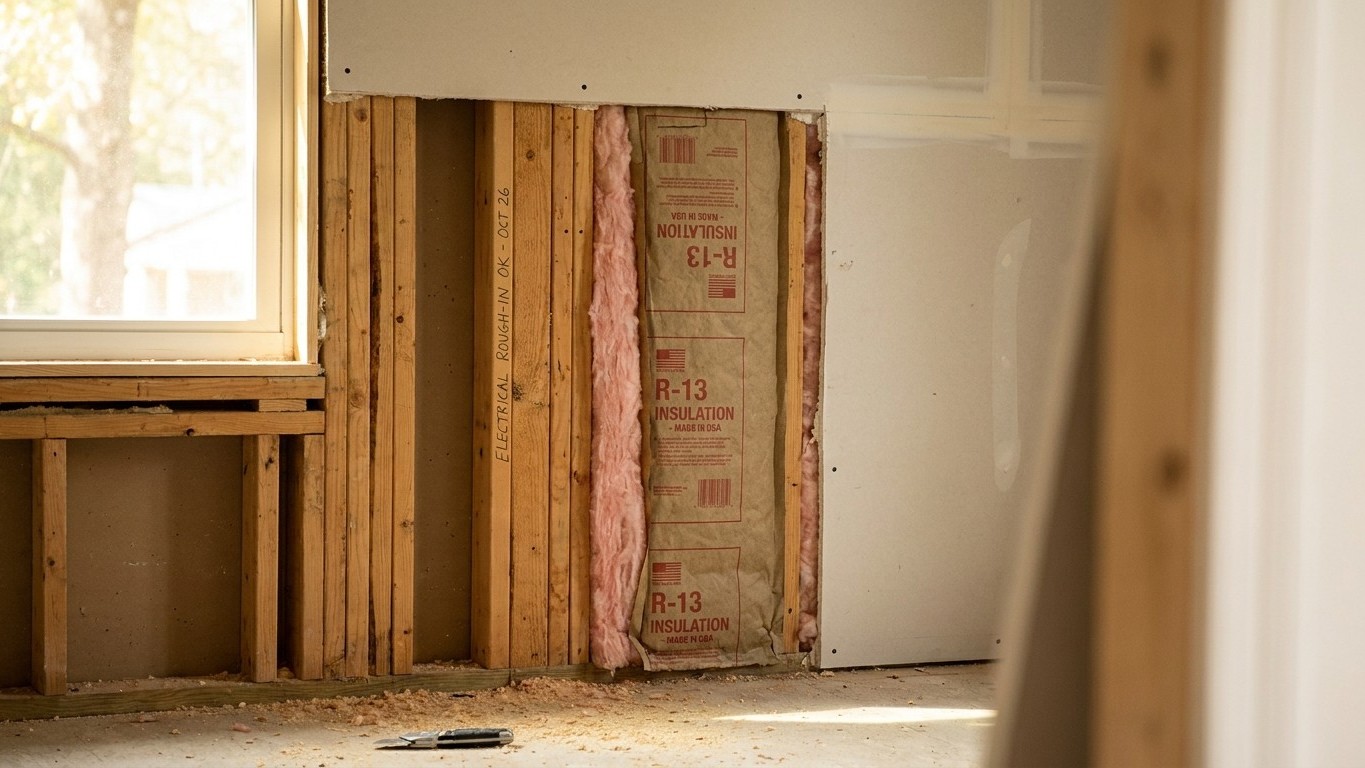

The IRC exempts Climate Zones 1, 2 and 3 from the interior vapor retarder requirement. Texas has 226 of its 254 counties in those zones, but 28 counties, all in Zone 4B, fall outside that exemption and follow the general rule. There is no single Texas answer.
What the code asks for in Texas

The 2021 International Residential Code, Section R702.7, says a vapor retarder of the class listed in Table R702.7(2) “shall be provided on the interior side of frame walls.” That’s the baseline rule, written for the country as a whole. Then the code carves out four exceptions, and the one that decides most of Texas reads: “A vapor retarder shall not be required in Climate Zones 1, 2 and 3.”
Texas doesn’t sit in one zone. Under the 2021 IECC’s county-by-county table, the state splits six ways: Zone 2A covers 81 counties, Zone 3B covers 70, Zone 3A covers 58, Zone 2B covers 14, and Zone 1A covers 3. Add those up and 226 of the state’s 254 counties land inside the zones the exception names. The remaining 28 counties sit in Zone 4B, which the exception does not touch, so the general R702.7 requirement for an interior vapor retarder still applies there.
| Climate zone | Counties in Texas | Interior vapor retarder required by R702.7? |
|---|---|---|
| 1A | 3 | No, exception applies |
| 2A | 81 | No, exception applies |
| 2B | 14 | No, exception applies |
| 3A | 58 | No, exception applies |
| 3B | 70 | No, exception applies |
| 4B | 28 | Yes, general rule applies |
That “not required” needs a plain reading. The exception removes an obligation from the model code; it doesn’t forbid a vapor retarder in a Zone 2A or 3B house, and it doesn’t make one illegal to install. What it means is that the code, on its own, won’t force one into a wall assembly in those counties. Whether a given jurisdiction has adopted this edition of the IRC unchanged, or amended it, is a separate question, and the only place to get that answer is the local building department. A wall built with the wrong vapor control for its climate doesn’t announce the mistake at the final inspection. It shows up years later, in framing that’s already rotted.
Why the answer is the opposite in a warm climate
The reason the code splits the country by zone instead of applying one rule everywhere comes down to which direction the moisture is traveling. In a cold-climate wall, the warm, damp air sits inside the house all winter, pushing outward toward a cold sheathing. An interior vapor retarder blocks that vapor before it reaches the cold surface where it would condense. That’s the logic the rule was built around, and it works, in a cold climate.
Flip the climate, and the physics flips with it. In a warm-humid zone, most of the year’s moisture load arrives from outside, not in. The U.S. Department of Energy’s Building America program lays out what happens if a Class I retarder gets installed on the interior side of the Insulation anyway: “the water vapor will condense on this cool, impermeable surface,” and the result is “ruined Insulation, mold, and structural rot of framing members.” The retarder that protects a wall in Minnesota creates the exact condition it’s supposed to prevent in a wall in Houston.
That’s the whole reason the code writes different rules for different zones. It isn’t bureaucratic hedging or a leftover from an older code cycle. It’s an acknowledgment that the water is moving in opposite directions in different parts of the country, and a single sheet of poly can’t be the right answer for both. Zone 4B counties in Texas still fall under the general requirement precisely because their moisture regime doesn’t match the warm-humid pattern of Zones 1 through 3 closely enough to earn the same exception.
The three classes, and why the word matters
Table R702.7(2) doesn’t describe one product called “a vapor barrier.” It describes three classes, sorted by how much moisture they let through, measured in perms.
| Class | Example materials | Permeance |
|---|---|---|
| Class I | Sheet polyethylene, nonperforated aluminum foil | 0.1 perm or less |
| Class II | Kraft-faced fiberglass batts, vapor retarder paint | Above 0.1, up to 1.0 perm |
| Class III | Latex or enamel paint | Above 1.0, up to 10.0 perm |
Sheet polyethylene is a Class I product, not “a vapor barrier” in some generic sense, and that distinction is exactly where the disagreement between a builder in Amarillo and a builder in Corpus Christi actually lives. It’s never about whether to have vapor control at all. It’s about which class belongs in which climate, and installing a Class I sheet where a Class II or III retarder would have let the wall dry is the mistake the DOE warning describes.
One detail catches most homeowners off guard: ordinary latex or enamel wall paint qualifies as a Class III vapor retarder. Anyone who’s painted an interior wall already has one installed, whether they meant to or not.
Worth separating two jobs that get lumped together. A vapor retarder controls water vapor diffusion through a material. An air barrier stops bulk air movement carrying moisture with it. They’re different functions, sometimes performed by the same sheet of material, sometimes not, and Table R702.7(2) only governs the vapor side.
Where the rule stops
R702.7 lists four situations where the interior vapor retarder requirement doesn’t apply, and one of them shows up in nearly every basement conversation:
- Basement walls
- The below-grade portion of any wall
- Construction where accumulation, condensation, or freezing of moisture will not damage the materials
- Climate Zones 1, 2 and 3, as covered above
The basement exception exists because concrete behaves differently than a stud wall. A poured or block foundation holds groundwater and releases it slowly, sometimes for years after the pour. That assembly needs to be able to dry toward the interior; sealing it with an impermeable sheet on the inside traps moisture against the concrete instead of letting it escape, which is the reverse of what a vapor retarder is supposed to accomplish. For the fuller mechanics of that assembly, the basement wall guide on this site walks through it in more detail.
None of these four exceptions bans a vapor retarder outright. They remove a requirement in specific conditions, and a builder or homeowner can still choose to add vapor control in an exempted wall if the rest of the assembly calls for it. That choice, though, belongs with whoever is designing the wall assembly and the local official reviewing it, not with a general rule written for the whole country.
Who actually decides, in Texas
The IRC is a model code. States and municipalities adopt it, sometimes without changes, sometimes with amendments, sometimes years after a new edition is published. Nothing on this page can tell a reader which edition their county has actually put into force, or whether a local amendment has changed R702.7’s language. That answer sits with the local building department, and it’s the only version of the code that applies to a permit pulled in that jurisdiction.
The stakes vary with how much winter a place actually carries. At Houston Intercontinental Airport, NOAA’s 1991-2020 climate normals put annual heating degree days at about 1,266, against roughly 3,288 cooling degree days. Heating degree days measure demand, not temperature: they add up how far below 65°F the daily mean sits, across the whole year. A total under 1,300 describes a short, mild heating season and a much longer cooling one, which is consistent with why so many Texas counties fall into the warm-humid zones the code exempts. That figure is one reference station, not a statewide number. Zone 4B counties, and any higher-elevation or northern county, will carry a different heating load than Houston does.
None of this replaces a conversation with the local building department. The rule depends on the zone, the zone depends on the county, and the code in force depends on what that jurisdiction has adopted. Getting any one of those wrong doesn’t produce a failed inspection. It produces a wall that looks fine for years before the framing tells the truth.