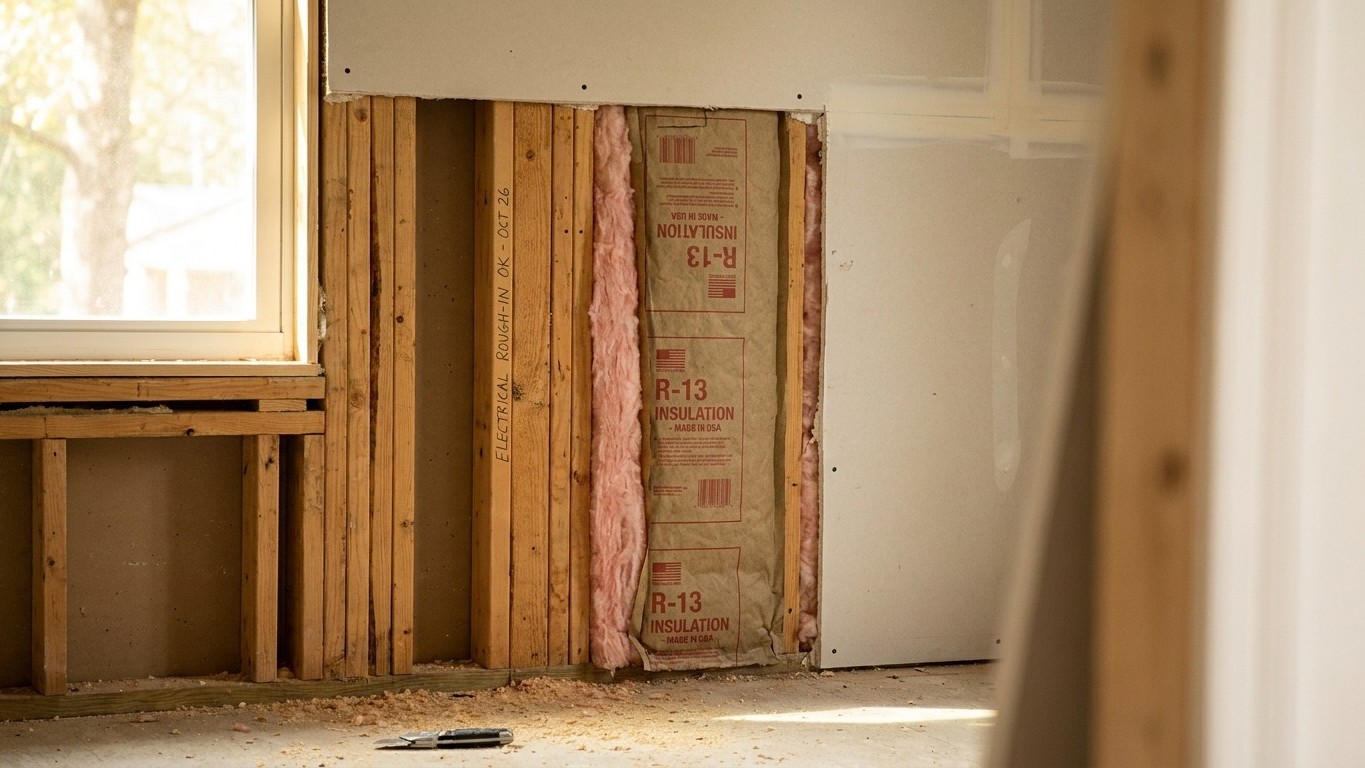

In Washington, a vapor retarder is required on the interior side of frame walls, and it applies to the whole state. That’s because the exception that removes the requirement elsewhere in the country never reaches this state: none of Washington’s 39 counties sit in the climate zones the code exempts. Here’s what that means for a wall going up in Spokane, Bellingham, or anywhere in between.
What the code asks for in Washington

The 2021 International Residential Code, Section R702.7, states plainly: a vapor retarder of the class given by Table R702.7(2) shall be provided on the interior side of frame walls. The code then lists four exceptions, and one of them reads: “A vapor retarder shall not be required in Climate Zones 1, 2 and 3.”
Washington’s 39 counties break down across four IECC climate zones: 18 counties in Zone 5B, 14 counties in Zone 4C, 4 counties in Zone 5C, and 3 counties in Zone 6B. Not one of them lands in Zone 1, 2, or 3. That’s the detail that settles the question for this state, unlike states that straddle the exemption line and end up with a split answer county by county. Here, the exception simply doesn’t apply anywhere, so the base rule stands: a vapor retarder on the interior side of frame walls.
It’s worth pausing on the 14 counties in Zone 4C, since that group covers the milder, marine-influenced parts of the state around Puget Sound. A reader might assume that a mild, wet-winter climate behaves like the warm-humid South, where the retarder gets waived. It doesn’t, at least not under this exception. Zone 4C is grouped differently for Insulation R-value tables (often lumped with Zones 5 and 6 for that purpose), but for the vapor retarder exception specifically, the code only names Zones 1, 2, and 3. Zone 4C isn’t on that list, so the requirement still holds there.
None of this means every wall in the state needs the same class of retarder, or that the general exceptions vanish. Basement walls, the below-grade portion of any wall, and construction where moisture accumulation won’t damage the materials are still exempt everywhere, in Washington and every other state that uses this code. What the zone determines is whether the base rule for above-grade frame walls applies at all, and in Washington, it does. The specific class required, and how a local jurisdiction has amended or adopted the code, is a question for the building department with authority over that address, not a model code chapter.
Why the answer is the opposite in a warm climate
The reason Zones 1, 2, and 3 get waived isn’t arbitrary, and understanding it explains why Washington’s answer looks so different from a house three states south. The vapor retarder’s job is to stop moisture-laden air from reaching a cold surface where it will condense. In a cold northern climate, the warm, humid air sits inside the house all winter, and without a retarder, that air pushes through the wall cavity and hits the cold sheathing on the outside, where it turns to liquid water. The retarder blocks that path.
Flip the climate, and the physics flips with it. In a warm-humid climate, the moisture load usually arrives from outside, not inside. Air conditioning keeps interior surfaces cool, and if a builder installs an impermeable retarder on the interior side of the Insulation anyway, out of habit or because a neighboring state requires it, that cool interior surface becomes the new condensation point. The U.S. Department of Energy’s Building America program describes the result directly: “If the wall contains a vapor retarder on the interior side of the insulation, the water vapor will condense on this cool, impermeable surface,” leading to “ruined insulation, mold, and structural rot of framing members.”
That’s the mechanism behind the zone exception, and it’s the reason the code doesn’t treat this as a one-size-fits-all rule. It isn’t bureaucratic inconsistency. It’s the code tracking which direction the water vapor is actually moving, because a retarder placed on the wrong side of a wall assembly doesn’t sit there harmlessly. It creates the exact condensation surface the whole system was supposed to avoid. Washington’s four zones (5B, 4C, 5C, and 6B) are all classified as having a heating-dominated or mixed profile rather than a warm-humid one, which is consistent with the retarder requirement holding across the state. But the underlying logic is the same logic that exempts a house in Florida or coastal Texas: match the vapor control to the direction the moisture travels, not to a blanket assumption about what a “normal” wall looks like.
The three classes, and why the word matters
Requiring “a vapor retarder” doesn’t specify which kind, and the class matters as much as the presence of one. Table R702.7(2) sorts retarders into three classes by permeance, and the differences are large:
| Class | Example materials | Permeance range |
|---|---|---|
| Class I | Sheet polyethylene, nonperforated aluminum foil | 0.1 perm or less |
| Class II | Kraft-faced fiberglass batts, vapor retarder paint | Above 0.1 up to 1.0 perm |
| Class III | Latex or enamel paint | Above 1.0 up to 10.0 perm |
Sheet polyethylene is a common shorthand for “vapor barrier” in casual conversation, but calling it that without naming the class skips the part that actually decides where it belongs in a wall assembly. A sheet of polyethylene is Class I, the tightest of the three, and it’s exactly the material the DOE warns against installing on the interior side of insulation in a warm-humid climate. Most disagreements between builders in different states aren’t about whether to include a retarder at all. They’re about which class belongs on which side of the wall, given which way the moisture is moving.
There’s a detail here that surprises a lot of homeowners: ordinary latex paint qualifies as a Class III vapor retarder. Anyone with a painted interior wall already has some vapor control in place, whether they intended it or not. It’s a mild one, at the loose end of the permeance scale, but it counts.
One more distinction worth keeping straight: a vapor retarder is not an air barrier. They solve different problems. A vapor retarder slows the diffusion of water vapor through a material. An air barrier stops bulk air movement, which can carry far more moisture in far less time than diffusion ever does. Some products do both jobs on the same sheet, but the two functions are tested and rated separately, and a wall can have one without the other.
Where the rule stops
R702.7’s requirement for an interior vapor retarder comes with exceptions that apply regardless of climate zone. They are:
- Basement walls
- The below-grade portion of any wall
- Construction where moisture or its freezing will not damage the materials
The basement exception is the one most homeowners run into directly, and it’s worth understanding why it exists rather than just filing it away as a rule. A poured concrete or block foundation wall holds moisture in its mass for years after it’s placed, and it continues absorbing and releasing groundwater moisture through its service life. That assembly needs to be able to dry toward the interior, at least to some degree. Seal it behind an impermeable interior sheet, and the wall has nowhere to send that moisture. The water backs up in the assembly instead, which is the same rot-and-mold outcome the code is trying to prevent, just triggered from a different direction. For the specifics of what does work in a below-grade wall, the basement wall guide on this site covers that assembly in detail, since it’s different enough from an above-grade frame wall to deserve its own explanation.
Who actually decides, in Washington
Nothing here should be read as a specification for a particular house. The IRC sets a model rule, and Washington’s climate zone data settles the broad question of whether the zone exception applies (it doesn’t, anywhere in the state). But the code actually enforced on a given wall is whichever edition the local jurisdiction has adopted, sometimes with amendments, sometimes lagging the national model by a code cycle or more. That’s the version that governs a permit, not the R702.7 text quoted above.
This matters more here than in a lot of places, because Washington’s climate isn’t uniform even within its heating-dominated profile. At Seattle-Tacoma International Airport, the 1991-2020 NOAA climate normal comes in at about 4,376 heating degree days a year against a 65°F base, alongside about 265 cooling degree days. That’s a heating demand figure, not a temperature reading, and it tells you the winter season here runs long enough to add up, year after year, even in a location known for mild, wet weather rather than deep cold. A mountain county elsewhere in the state can run considerably colder, which is exactly why a single reference station doesn’t answer the question for every address.
None of this replaces a call to the local building department. The code in force on a given lot is the one that jurisdiction adopted, and that office can confirm the class of retarder expected for a specific wall assembly. A wall built with the wrong vapor control doesn’t announce the mistake right away. It sits quietly for years, and the rot or mold shows up long after the drywall is painted and the framing inspection is a distant memory.