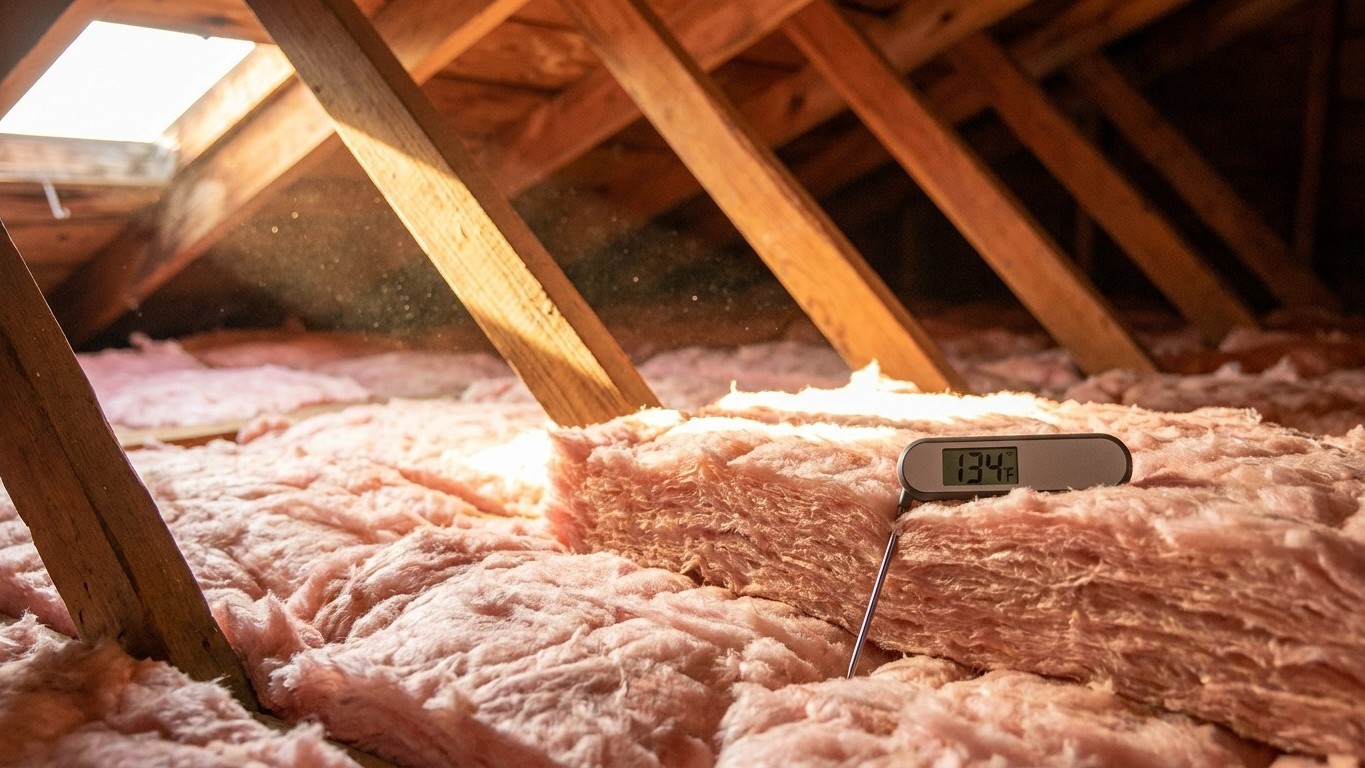

Yes, insulation matters in Arizona, and it matters for most of the year, not just the few weeks when a Phoenix forecast reads triple digits. This state sits on the hot side of the country’s climate divide, with a reference station that logs an average of 168.9 days a year at 90°F or above. Insulation here is a cooling tool as much as a heating one, and the two jobs use the same material.
The short answer for Arizona

Start with the number that sizes the problem: 168.9 days a year above 90°F, measured at the Phoenix reference station over the 1991-2020 period tracked by NOAA. That is not a description of every county in the state, but it is a fair signal of what the low desert deals with for roughly half the calendar. A summer that long turns a house into a box absorbing heat for months on end, and insulation is one of the few things standing between that heat and the living space.
Where this gets complicated is that Arizona is not one climate. The state’s 15 counties fall into four different IECC climate zones: 5 counties sit in zone 3B, 5 in zone 2B, 3 in zone 5B, and 2 in zone 4B. Zone 2B is the hottest and driest of that group, the territory most people picture when they think of Arizona summer. Zone 5B, by contrast, belongs to the higher-elevation counties where winters bite and snow is not unusual. That is a real spread, and a page that gives one answer for the whole state is wrong for part of its readers.
So the honest answer splits in two. In the 2B and 3B counties, where the bulk of the state’s population and its longest, hottest stretches live, cooling is very likely the larger half of the year’s energy use, and insulation earns its keep primarily by slowing heat gain in July and August. In the 4B and 5B counties, the picture shifts: real winters mean the insulation is doing double duty, holding heat in during cold months and out during hot ones, with neither season able to claim the whole story. Nobody reading this should assume which zone applies to their own address. County-level assignment is exactly the kind of thing to check against a map rather than guess from a state average, and that step matters because insulation levels are set by zone, not by state.
What does not change across any of these counties is the basic physics. A house exposed to 168.9 days of 90-plus heat, even if that number describes the desert floor more than the high country, is a house where the attic and the walls are doing constant work. The question is not whether insulation helps, but how much of the year that help is aimed at keeping cool air in versus keeping cold air in.
What happens above the ceiling
An attic on a summer afternoon is its own weather system. Direct sun loads the roof deck, and that deck can run 40 or more degrees above the outdoor air temperature by mid-afternoon. Everything under that roof, the ceiling drywall, any ductwork routed through the space, boxes stored along the joists, sits beneath that superheated layer, absorbing radiant heat downward into the living space below. In a desert climate zone, this happens nearly every day the sun is out for months at a stretch.
The insulation that resists that heat flow is the same insulation used everywhere in the country, including places that only worry about keeping warmth in during January. That is the point worth sitting with: attic insulation is not a winter product that happens to also work in summer. It is a resistance to heat flow in whichever direction that flow is moving, and in July in Arizona, the flow is downward, from a scorching roof deck into a cooled house. The material does not know which season it is. It just slows the transfer either way.
Recommended levels by climate zone
ENERGY STAR publishes retrofit levels for existing wood-framed homes, organized by IECC climate zone, and covering three distinct measurements: attic insulation for an uninsulated attic, attic insulation for an attic that already has 3 to 4 inches in place, and floor insulation over unconditioned space. These are not three attic numbers. The source table merges “Add Insulation to Attic” across two columns, and floor is a separate, third figure entirely.
| Zone | Attic (uninsulated) | Attic (already 3-4 in) | Floor |
|---|---|---|---|
| Zone 2 | R49 | R38 | R13 |
| Zone 3 | R49 | R38 | R19 |
| Zones 4A and 4B | R60 | R49 | R19 |
| Zones 6, 5 and 4C | R60 | R49 | R30 |
Given the state’s spread across zones 2B, 3B, 4B, and 5B, all four of those rows apply somewhere within Arizona’s borders, depending on which county is in question. These figures are retrofit targets for existing wood-framed construction, not new-build code minimums, and the depth in inches is not given here because it depends on the material used. Attic work is the single improvement on this list that serves both the summer cooling load and any winter heating need at the same time.
What homes in Arizona cool with
Air-conditioning equipment shows up in 94% of surveyed households in the state, according to the U.S. Energy Information Administration’s Residential Energy Consumption Survey. Of that group, 86% run a central air-conditioning system, and 12% rely on individual equipment instead, a ductless mini-split, a window or wall unit, or a portable. Ceiling fans appear in 86% of homes as well, doing supplemental work rather than replacing the compressor-based systems. Those percentages describe households surveyed, not every house standing in the state, and gaps of this kind can hide real detail.
The gap between 94% with some form of air conditioning and 86% with a central system is small here, only 8 points, which says something about how thoroughly central systems have penetrated this market compared to states where window units fill a much bigger share of the difference. Still, that 12% running individual equipment is not a rounding error. It is more than one in ten homes.
The honest connection to insulation splits along that same line. In the 86% of homes running central air, the ductwork very often runs through the attic, which, as covered above, is the hottest space in the entire structure during a desert summer. Ceiling insulation does nothing to protect that ductwork once it is up in the attic space; sealing and insulating the ducts themselves is a separate task, addressed in the duct sealing and insulation guides on this site. In the smaller share of homes cooling with a window unit or a mini-split, there is no attic ductwork to worry about at all, and the insulation question narrows to the room’s own walls, ceiling, and window seals, the same envelope basics covered in the room air conditioner guides here.
What the heat asks for that the cold does not
Two additions belong specifically to hot climates and have no real place in a cold-climate insulation plan.
- A radiant barrier reflects radiant heat rather than resisting conducted heat the way bulk insulation does. It carries no R-value and is not a substitute for insulation; it earns its place only under a sun-loaded roof deck, typically installed as a foil-faced product under the roof sheathing or draped over the attic floor. For the state’s 2B and 3B counties, where roof decks bake for months, this describes the territory well. For the higher-elevation 5B counties with real winters, a radiant barrier is not the tool the house needs, and adding one there mostly wastes the material’s purpose.
- Vapor movement reverses direction in summer in warm, humid climates, where the damp air sits outside rather than inside, which is exactly why the model energy code skips requiring an interior vapor retarder in its warmest zones. Arizona’s desert counties are dry, not humid, which changes how this plays out on the ground. That distinction is worth settling on this site’s dedicated vapor barrier page for this territory rather than glossing over here.
What the work is worth
ENERGY STAR’s published estimate reads: “EPA estimates that homeowners can save an average of 15% on heating and cooling costs (or an average of 11% on total energy costs) by air sealing their homes and adding insulation in attics, floors over crawl spaces, and accessible basement rim joists.” Both numbers matter together. Fifteen percent applies specifically to heating and cooling costs combined; eleven percent applies to total energy costs, a broader category that includes things insulation never touches, like water heating or running a refrigerator.
That combined framing, heating and cooling together, is the whole reason this figure fits a page about Arizona summer heat rather than a page about winter alone. The saving is not a cold-weather number that happens to carry over into July. It is built from both halves of the year at once, which lines up with how the state’s own climate zone split works: some counties lean on it mostly for cooling, others split the benefit across both seasons, but the published figure never separates the two.
These are averages drawn from energy modeling of a typical existing U.S. home, not a guarantee for any specific house in Maricopa, Yavapai, or Apache County. The work modeled is also specific: attics, floors over crawl spaces, and accessible basement rim joists. It says nothing about walls, windows, or doors, and no price, payback period, or tax credit accompanies this figure here.