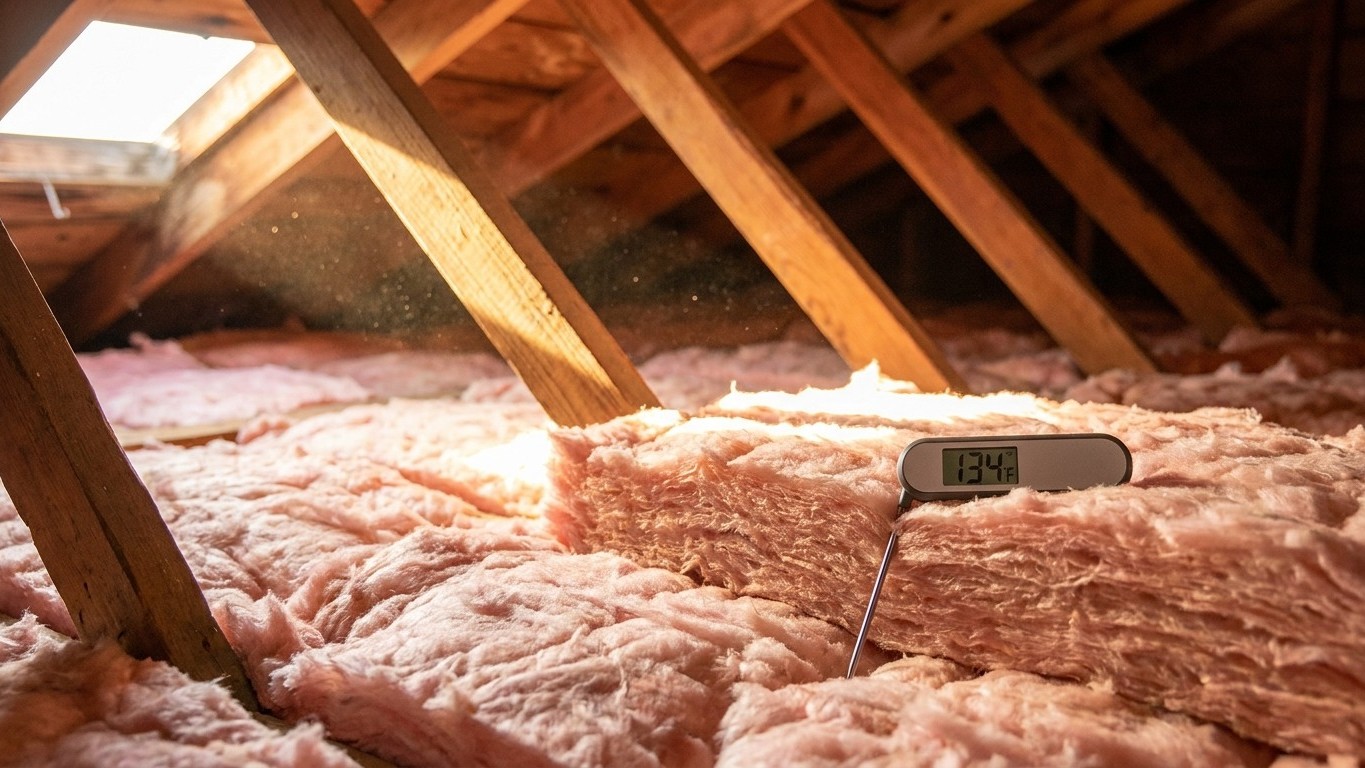

Yes, Insulation keeps a Georgia home cooler, and here the case is stronger than in most states. This is a long, hot-summer climate where the attic works against a house for months at a stretch. The same layer that holds heat in during a rare cold snap is what slows the sun’s heat pouring down through the ceiling every afternoon from May through September. How much that matters, and where the priority sits, depends on which part of Georgia the house is in.
The short answer for Georgia

At the Atlanta reference station, the average is 35.8 days a year that reach 90°F or higher, according to NOAA’s 1991-2020 climate normals. That is not a description of every county in the state, coastal and southern Georgia run hotter, the mountains in the north run a bit cooler — but it puts a number on what “summer” means here: over a month of genuinely hot days most years, not the occasional heat wave a northern state might see. Compare that to a territory where the count sits in single digits, and the difference in what Insulation is asked to do becomes obvious. Where summer is a handful of days, Insulation still helps, but the winter heating season is where the real savings sit. Where summer runs past a month of 90°F-plus days, cooling load is not a footnote to the energy bill. It is a substantial part of it.
The state’s climate zones back this up. Under the 2021 International Energy Conservation Code, Georgia’s 159 counties split between two zones: 118 counties sit in zone 3A, and 41 counties sit in zone 2A. Zone 2A runs hotter and more humid than 3A, and it is the same designation used for parts of the Gulf Coast. That split matters because it tells you which side of the country’s heating-versus-cooling divide a Georgia home sits on. States further north, where winter heating dominates the energy bill, get more return on Insulation from October through March. Georgia’s zone 2A and 3A counties both lean the other way: cooling season is long enough that insulation earns its keep primarily by slowing the summer heat gain, even though it also helps in the shorter, milder winter.
None of this means every house in the state needs the same fix or the same amount of material. A county in zone 2A and a county in zone 3A are not asking for identical insulation levels, and a homeowner should not guess which one applies. The county-by-county breakdown and the official climate zone map settle that question with more precision than a statewide article can.
What happens above the ceiling
A roof deck sitting under a Georgia sun in July does not stay at outdoor air temperature. Asphalt shingles absorb solar radiation and can push the roof deck itself to well over 140°F on a clear afternoon, and the attic air trapped beneath it climbs far above whatever the thermometer reads outside. Everything under that attic floor, the ceiling drywall, any ductwork routed through the space, boxes stored for the holidays, sits under that superheated layer for hours at a stretch. That heat does not stay in the attic. It moves downward into the living space below, through the ceiling, by simple conduction.
Insulation’s job is to resist that heat flow, and here is the point worth sitting with: the resistance works the same way regardless of which direction the heat is moving. Attic insulation installed to keep warmth inside during a cold snap is doing the identical physical job in July, except the flow has reversed and it is now keeping the attic’s heat from moving down into the house. It is not a winter product that happens to help in summer. It is one material solving both problems, which is precisely why it is the single improvement that pays off in every season a Georgia house experiences.
ENERGY STAR publishes recommended retrofit levels for existing wood-framed homes, broken out by climate zone, and the table below shows the two zones present in Georgia. The source header groups the attic recommendation into two situations, one for an attic with no existing insulation and one for an attic that already has 3 to 4 inches, plus a separate figure for the floor.
| Zone | Attic (uninsulated) | Attic (already 3-4 in.) | Floor |
|---|---|---|---|
| Zone 2 | R49 | R38 | R13 |
| Zone 3 | R49 | R38 | R19 |
These are retrofit targets for existing houses, not the code minimums required of new construction, and they are not assigned to any individual reader here. Finding which zone a specific county falls into means checking the county table or the ENERGY STAR map directly, since the R-value that applies to a floor differs between the two zones even though the attic number is identical.
What homes in Georgia cool with
The Energy Information Administration’s 2020 Residential Energy Consumption Survey found that 95% of Georgia households use some form of air-conditioning equipment, and 86% use a central air-conditioning unit specifically. Another 18% report using an individual unit, meaning a ductless mini-split, a window or wall unit, or a portable. Ceiling fans, which don’t cool the air but make occupants feel cooler by moving it, show up in 85% of homes. Those figures are shares of households surveyed, not a count of every house standing in the state, and they describe what got installed when each home was built or renovated, not a recommendation for what should be installed today.
Here is where insulation and equipment connect, and where they don’t. In a Georgia home cooled by central air with ductwork routed through the attic, those ducts sit in the single hottest space in the building on a summer afternoon. Ceiling insulation slows heat moving from the attic into the living space below, but it does nothing to protect the ducts themselves from that superheated air surrounding them, or from the conditioned air inside those ducts picking up heat before it ever reaches a supply register. That is a separate job, handled by sealing and insulating the ducts directly, not by adding attic insulation and assuming the problem is solved.
For the 18% of Georgia households running window units, portables, or mini-splits instead of a central system, the calculation is more local. There is no attic-to-living-space heat transfer to worry about in the same way; what matters is the envelope of the specific room or zone being cooled, its own walls, its own window, its own exposure to the sun. A homeowner running a window unit in a converted attic bedroom is fighting a very different battle than one running central air through a fully insulated attic. Readers dealing with attic ductwork specifically should look at this site’s duct sealing and insulation guides, and those relying on window or mini-split cooling will find more relevant detail in the room air conditioner guides.
What the heat asks for that the cold does not
Two things belong specifically to hot climates, and Georgia’s long, humid summer is exactly the case they were built for.
A radiant barrier is not insulation and carries no R-value. It works by reflecting radiant heat away from the roof deck rather than resisting conducted heat the way fiberglass or cellulose does, and it earns its place only in an attic that takes a real solar hit through the day. Given that Georgia’s counties sit in zones 2A and 3A, both hot-humid designations with more than a month of 90°F-plus days at the reference station, a sun-loaded roof deck describes the state’s housing stock generally. That is not a universal recommendation for every attic in the country; a house in a short-summer climate with a handful of hot days a year gets little from a radiant barrier and should spend that money on air sealing or attic insulation instead.
Vapor movement is the second piece, and it runs backward compared to what a colder climate deals with. In a cold, dry climate, moisture in warm indoor air pushes outward through the walls in winter, which is why an interior vapor retarder makes sense there. In a warm, humid climate like Georgia’s, the situation flips: the damp air sits outside, pushing inward, and the model energy code does not require an interior vapor retarder in its warmest zones for exactly this reason. Installing one anyway can trap moisture inside a wall assembly rather than keeping it out. This is a detail worth getting right for a specific house, and it deserves its own explanation rather than a partial answer here. Georgia readers should check this site’s dedicated vapor barrier page for the territory before making a call on any wall assembly.
What the work is worth
ENERGY STAR puts a number on this that is worth quoting directly rather than paraphrasing: “EPA estimates that homeowners can save an average of 15% on heating and cooling costs (or an average of 11% on total energy costs) by air sealing their homes and adding insulation in attics, floors over crawl spaces, and accessible basement rim joists.” Both figures matter, and neither works without its denominator. Fifteen percent applies to the heating and cooling portion of a bill; eleven percent applies to total energy costs, which includes everything else a house runs on top of climate control.
The reason that number belongs here, and not on a page about winter heating alone, is right there in the wording: it covers heating and cooling together, as one combined saving from one set of improvements. For a Georgia house where cooling season stretches well past a month of genuinely hot days, that combined figure is not a winter number that happens to carry over into summer. Summer is doing real work inside that percentage.
A few limits are worth holding onto. This is an average drawn from energy modeling of a typical existing U.S. home, not a guarantee for any specific house, and actual results shift with a home’s age, current insulation levels, and how tightly it was built to begin with. The modeling also covers specific locations, attics, floors over crawl spaces, and accessible basement rim joists, not walls, windows, or doors, so it should not be stretched to cover a full-scale renovation. And there is no federal tax credit attached to this work anymore; the 25C credit that once applied to insulation projects closed at the end of 2025, so any decision here rests on the energy savings alone, not a rebate calculation.