
Yes, Insulation keeps a Louisiana home cooler, and it matters for a large chunk of the year. At the New Orleans reference station, an average of 70.7 days a year climb above 90 F, meaning the state’s cooling season stretches well beyond the calendar’s official summer. This is not a place where Insulation is a nice-to-have for a few sweaty weeks.
The short answer for Louisiana

Almost 71 days above 90 F a year is not a fluke week in August. It is a stretch that runs from late spring into early fall, and it means the attic, the ductwork, and the walls of a Louisiana home spend a huge share of the year fighting heat gain rather than heat loss. Compare that to a northern state where 90-degree days barely register, and the whole calculus of home improvement flips: up there, Insulation is mostly a heating-season tool that happens to help in summer. Here, cooling load is the bigger half of the energy story.
Louisiana sits in two IECC climate zones: 37 of its 64 parishes fall in zone 2A, and 27 fall in zone 3A. That split runs roughly along a line separating the hottest, most humid southern parishes from the slightly milder northern ones, though the exact boundary follows parish lines, not a simple north-south divide. Both zones are still warm-humid by any national standard, and both call for meaningfully higher Insulation levels than a temperate zone would need.
What that means in practice: a home in either zone is working against sun-loaded roofs, humid outdoor air, and long stretches where the air conditioner rarely gets a full rest. Insulation does not erase that load, but it slows how fast outdoor heat becomes indoor heat, and it keeps a conditioned space from bleeding cool air into an overheated attic or crawl space. In a state where 70-plus days a year cross 90 F, that slowing effect is not marginal. It shows up on the electric bill every single month from May through September, and often beyond.
None of this means insulation is useless in winter here. Louisiana still sees cold snaps, and the same material resists heat flow in both directions. But given the days-above-90 number, the honest framing for this state is that insulation earns its keep primarily by fighting summer heat gain, with winter benefits as a bonus rather than the main event. That is the opposite of the story in a state where 90-degree days are rare and insulation’s real job is holding heat in through a long, hard winter.
What happens above the ceiling
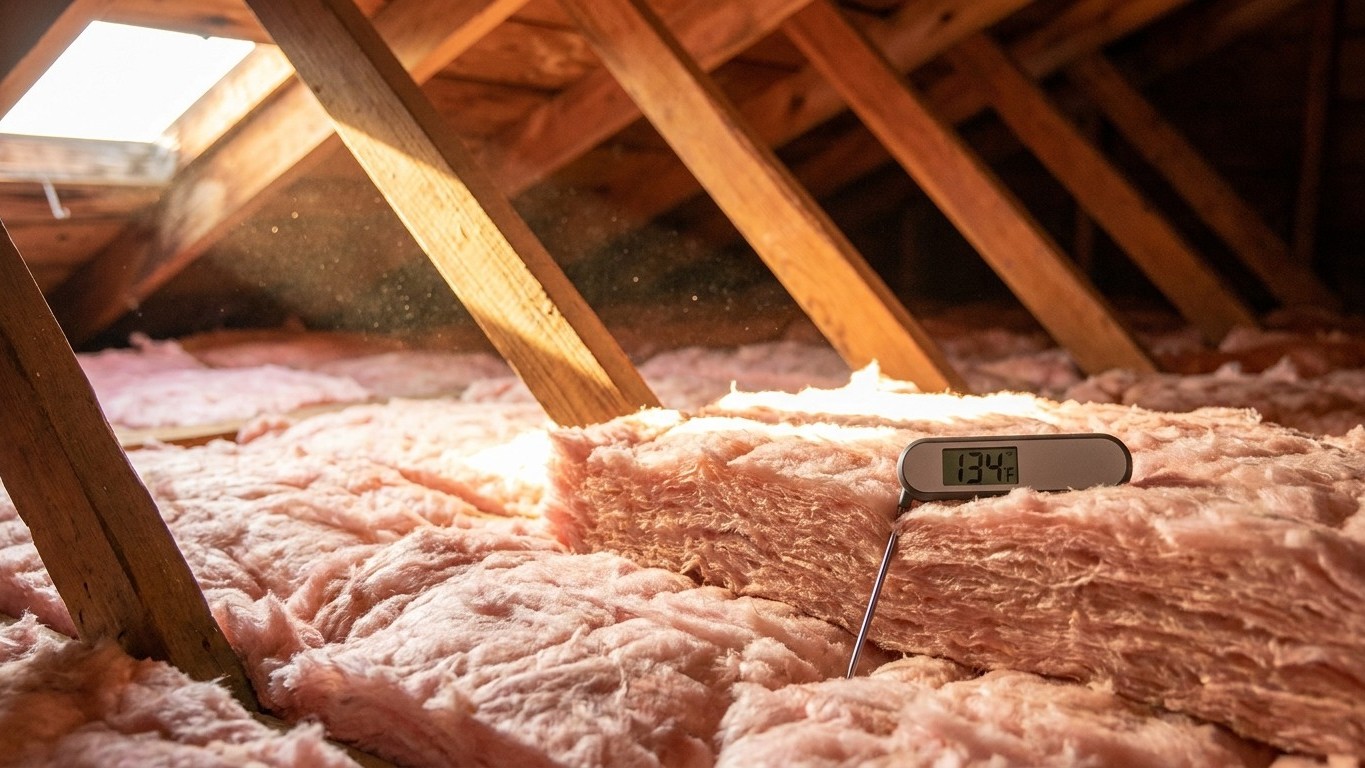
Roof decking absorbs direct sun and radiates that heat downward into the attic space below it. In a state where days above 90 F are common, an attic without adequate insulation can run far hotter than the outdoor air, sometimes uncomfortably so even at midday when the thermometer outside reads a “normal” summer temperature. Everything sitting in that space, the ceiling drywall, any ductwork routed through the attic, stored boxes, sits under that superheated air, and heat migrates downward into the living space below.
Attic insulation is the barrier that slows that migration. It is worth being clear about what insulation actually does: it is not a device that “keeps cold in” or “keeps heat out” as separate jobs. It resists the flow of heat, period, and in winter, that flow runs from a warm house out through a cold ceiling. In July, the flow reverses. Heat radiates down from a hot roof deck and pushes through the ceiling into the living space. The same fiberglass, cellulose, or spray foam that resisted the outward flow in January resists the inward flow in July. It is one material doing one job, in both directions, all year.
What the levels look like by zone
ENERGY STAR publishes recommended retrofit insulation levels for existing wood-framed homes, organized by IECC climate zone. These are retrofit numbers, not new-construction code minimums, and they cover three distinct measurements: attic insulation for a home that currently has none, attic insulation for a home that already has 3 to 4 inches in place, and floor insulation, typically over an unheated crawl space or basement. For the two zones that cover Louisiana:
- Zone 2: R49 attic (uninsulated) / R38 attic (already has 3-4 inches) / R13 floor
- Zone 3: R49 attic (uninsulated) / R38 attic (already has 3-4 inches) / R19 floor
Notice the attic numbers are identical between zones 2 and 3, but the floor recommendation is higher in zone 3. Nobody reading this article should assume which zone applies to their own parish; ENERGY STAR publishes the zone assignments as a map, and the county-by-county breakdown is the only reliable way to confirm which row applies to a specific address. The point that holds across both zones is the same: attic insulation is the one upgrade that pays off in both January and July, because it resists heat flow in whichever direction it happens to be moving.
What homes in Louisiana cool with
Across U.S. households, 93% use some form of air-conditioning equipment, and 76% use a central air-conditioning system, according to the Energy Information Administration’s Residential Energy Consumption Survey. The remaining 25% rely on individual equipment: window units, wall units, portables, or ductless mini-splits. Those figures are percentages of households surveyed, not a count of every house standing, but they describe the real mix of how American homes, including those in hot, humid states like Louisiana, actually stay cool.
That split matters because it changes what insulation can and cannot fix. In a home with central air and ductwork routed through the attic, the ducts themselves sit in the hottest, most punishing space in the entire structure. Ceiling insulation slows heat from moving into the living space below, but it does nothing to protect the ducts sitting above that ceiling, exposed to attic temperatures that can run well past what the thermostat is trying to maintain. Sealing and insulating those ducts is a separate job, and in a state with 70-plus days above 90 F a year, it is not an optional one. Homes losing conditioned air through leaky, uninsulated attic ductwork are often paying for cooling that never reaches a living room or bedroom.
For the roughly one in four Louisiana households leaning on a window unit, wall unit, or mini-split rather than central air, the calculation is different. There is no attic ductwork to worry about, but the room’s own envelope, its walls, windows, and the ceiling directly above it, becomes the whole story. A mini-split working hard in a poorly insulated room is fighting the same battle a central system fights against a leaky duct run: conditioned air escaping or heat pushing in faster than the equipment can compensate. Readers running ducted central air will find more detail in this site’s duct insulation and sealing guides; those relying on window or mini-split units should look at the room air conditioner guides for equipment-specific advice.
What the heat asks for that the cold does not
Two elements belong specifically to hot, humid climates like Louisiana’s, and neither one makes sense in a cold-climate discussion.
The first is a radiant barrier: a reflective material, usually foil-faced, installed in the attic to bounce radiant heat back before it can be absorbed and re-radiated downward. It is worth being precise about what a radiant barrier is not. It carries no R-value. It is not insulation, and it does not replace insulation. It works by reflecting radiant energy rather than resisting conducted heat flow, which is exactly why it only earns its place under a sun-loaded roof deck baking in direct summer sun. Given that Louisiana averages more than 70 days a year above 90 F, this is precisely the kind of climate a radiant barrier was designed for, and it is a reasonable complement to attic insulation here, not a substitute for it.
The second is moisture direction. In a cold climate, water vapor generated inside a heated home pushes outward through the walls in winter, which is why a vapor retarder often goes on the warm, interior side of the wall assembly. In a warm, humid climate, that logic flips: the damp air is outside, and the model residential code does not require an interior vapor retarder in its warmest zones for exactly that reason. Getting this wrong, installing a vapor barrier in the wrong place for a humid climate, can trap moisture inside a wall assembly rather than keeping it out. That is a decision worth its own dedicated look rather than a quick summary here; this territory’s vapor barrier page addresses the placement question directly.
What the work is worth
ENERGY STAR’s published estimate states that “homeowners can save an average of 15% on heating and cooling costs (or an average of 11% on total energy costs) by air sealing their homes and adding insulation in attics, floors over crawl spaces, and accessible basement rim joists.” Both numbers matter, and so do their denominators: 15% applies specifically to heating and cooling costs, while 11% applies to total energy costs, a broader category that includes water heating, appliances, and lighting alongside space conditioning.
That combined framing, heating and cooling together, is the whole point for a state like Louisiana. The figure is not a winter number that happens to carry over into summer. It is modeled across both seasons, and in a climate where cooling likely represents the larger share of the energy bill given more than 70 days a year above 90 F, a meaningful piece of that 15% savings comes directly from keeping the air conditioner from fighting a losing battle against a superheated attic.
Two caveats are worth keeping in view. These figures come from energy modeling of a “typical” existing U.S. home, an average, not a guarantee for any specific house with its own age, layout, and existing insulation levels. And the estimate covers attics, floors over crawl spaces, and accessible basement rim joists specifically. It does not extend to walls, windows, or doors, even though those components also affect comfort and energy use. For a Louisiana homeowner deciding where to start, the modeled savings point squarely at the attic first, with duct sealing and floor insulation over any crawl space close behind.