
Yes. In Mississippi, Insulation is doing serious work against summer heat, not just holding warmth in during a mild winter. The reference station in Jackson logs 71.1 days a year above 90°F, and nearly the whole state sits in a hot, humid IECC zone. That combination means the resistance Insulation provides against heat flow is earning its keep for a long stretch of the calendar, not just a few weeks in July.
The short answer for Mississippi

Seventy-one days above 90°F is not a rounding error. It’s the kind of number that shows up on cooling bills, in stressed lawns, and in attics that turn into ovens by mid-morning. Compare that to a northern territory where the same measure might sit in single digits, and the picture is obvious: Mississippi’s summer isn’t a brief inconvenience wedged between two long winters. It’s a season that stretches from late spring into early fall, and for a lot of households, it’s the dominant driver of the year’s energy bill.
The state’s climate classification backs this up. Under the 2021 IECC, 76 of Mississippi’s 82 counties fall in zone 3A, and 6 counties sit in zone 2A, which is even warmer. Both are “A” moisture regimes, meaning warm and humid rather than warm and dry. That single letter matters more than it looks: it changes how a house should handle moisture, not just heat, and it puts Mississippi firmly on the hot side of the country’s climate divide rather than anywhere near the cold-dominated zones of the Upper Midwest or New England.
In a state built this way, insulation doesn’t split its attention evenly between two competing seasons. Winters here are short and mild by national standards, so the heating half of the equation is comparatively small. Cooling, on the other hand, runs for months, which means the summer side of the ledger is where most of the annual energy math gets decided. This is exactly the opposite of what a homeowner in Minnesota or Maine deals with, where insulation is bought mostly to fight the cold and the summer benefit is a bonus. In Mississippi, it can be read the other way around: insulation bought for winter comfort turns out to be carrying the heavier summer load for most of the year.
None of this means insulation performs differently depending on the season. The physical mechanism is identical whether the heat is trying to escape a house in January or invade one in August. What changes is how often that mechanism gets called into action, and in a state logging over 70 days above 90°F, it’s called into action a lot.
What happens above the ceiling
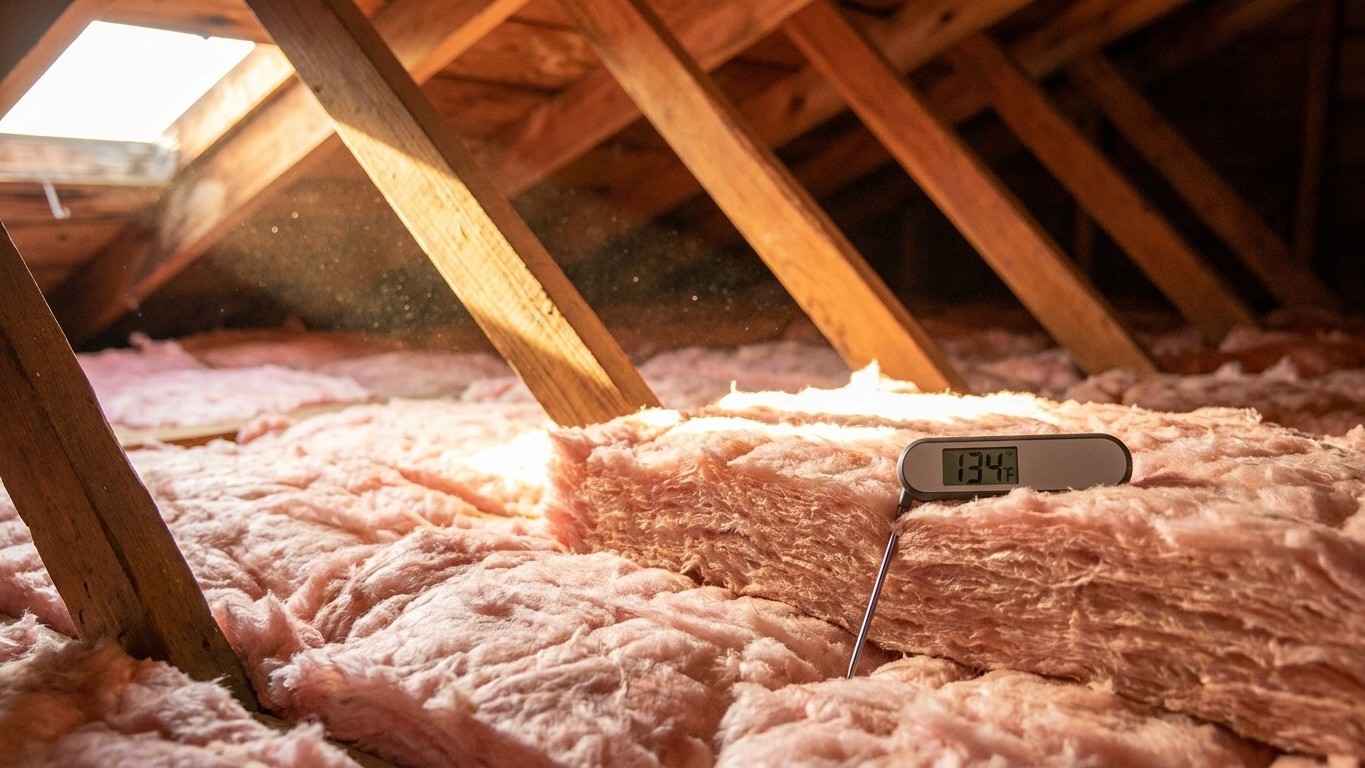
A roof deck sitting under direct Mississippi sun doesn’t just get warm, it gets punishing. Attic temperatures on a 90°F afternoon routinely run 40 to 60 degrees hotter than the outdoor air, because the shingles and decking are absorbing solar radiation directly and have nowhere fast to shed it. Everything under that roof deck sits inside that heat bubble: the ceiling drywall, any ductwork routed through the space, stored boxes, holiday decorations, whatever’s up there. The attic becomes, in effect, a second furnace sitting directly above the living space, and the only thing standing between that furnace and the rooms below is the insulation on the attic floor.
This is where a common misunderstanding gets in the way. Insulation is often talked about as a winter product, something installed to keep furnace-heated air from leaking out. But insulation doesn’t care which direction the heat is moving. It resists heat flow, full stop. In winter, that resistance keeps indoor warmth from escaping upward. In summer, the exact same material is resisting the reverse flow, keeping attic heat from pouring down into the house. It’s the same fiberglass, cellulose, or foam doing the same job, just facing the opposite direction. There is no separate “summer insulation” to buy; the improvement that helps in January is the improvement that helps in July.
What ENERGY STAR recommends by zone
ENERGY STAR publishes recommended retrofit levels for existing wood-framed homes, organized by climate zone, with three figures per zone: how much attic insulation to add if the attic currently has none, how much to add if it already has 3 to 4 inches, and how much insulation belongs under the floor over unconditioned spaces like crawl spaces.
| Zone | Attic if uninsulated | Attic if already 3-4 inches | Floor |
|---|---|---|---|
| Zone 1 | R30 | R25 | R13 |
| Zone 2 | R49 | R38 | R13 |
| Zone 3 | R49 | R38 | R19 |
| Zones 4A and 4B | R60 | R49 | R19 |
| Zones 6, 5 and 4C | R60 | R49 | R30 |
| Zones 7 and 8 | R60 | R49 | R38 |
Mississippi’s counties fall across zones 2A and 3A, so the relevant rows for most readers here are the zone 2 or zone 3 lines above, depending on where in the state a given house sits. This page isn’t the place to sort that out for any individual reader; the county-level assignment is published as a map by ENERGY STAR, and checking it before buying material is worth the five minutes. These figures are retrofit targets for existing wood-framed construction, not new-build code minimums, and they’re the same numbers whether someone is chasing a lower winter heating bill or a lower summer cooling bill. That’s the practical takeaway: one improvement, both seasons.
What homes in Mississippi cool with
Federal survey data gives a clear picture of how Mississippi actually stays cool. Among households surveyed, 93% use some form of air-conditioning equipment, 79% use a central air-conditioning unit, 24% use an individual unit such as a window, wall, or portable air conditioner or a ductless mini-split, and 83% run ceiling fans. Those figures are shares of households surveyed, not a count of every house standing in the state, but they’re a solid read on the norm: central air dominates, with a meaningful minority relying on standalone units instead or in addition.
The gap between “uses air conditioning” (93%) and “uses central air” (79%) is worth sitting with. That 14-point difference represents homes cooling with something other than a whole-house central system, whether that’s a window unit in a bedroom, a mini-split in a converted garage, or a portable unit in a room the central system doesn’t reach well. For those households, ceiling insulation is only part of the story; the performance of that single room, its windows, its exterior wall, matters just as much as anything happening in the attic.
For the 79% running central air, there’s a detail worth knowing: in most Mississippi homes with central systems, the ductwork runs through the attic, which is precisely the hottest, most punishing space in the building. Ceiling insulation slows heat from reaching the living space below, but it does nothing to protect ducts that are physically routed through that superheated attic air. Leaky or poorly insulated ducts up there can lose a meaningful share of cooled air before it ever reaches a vent, regardless of how well the attic floor is insulated. That’s a separate repair, not something ceiling insulation solves on its own, and it’s worth checking independently. Readers dealing with attic ductwork should look at this site’s guide to duct sealing and insulation, and anyone relying on window units, portables, or mini-splits will find more specific guidance in the room air conditioner guides here as well.
What the heat asks for that the cold does not
Two products belong specifically to hot climates, and neither one is standard insulation.
A radiant barrier is a reflective material, usually a foil-faced sheet installed under the roof deck or draped over the attic floor, and it works on an entirely different principle than insulation. Insulation resists conducted heat; a radiant barrier reflects radiant heat before it ever gets absorbed into the attic’s surfaces. It carries no R-value, and it isn’t a substitute for insulation, it’s an addition. Its whole purpose is fighting the intense radiant load of direct sun hitting a roof deck, which is exactly the situation described above for Mississippi’s long stretch of 90-plus-degree days. In a state where the attic genuinely becomes a heat trap for months at a time, a radiant barrier is a tool that fits the climate, unlike in a territory with a short, mild summer where that same product would be solving a problem that barely exists.
The second thing that changes with heat is which direction moisture travels through the walls. In winter, in a cold climate, water vapor pushes from the warm indoor air toward the cold outdoors, which is why interior vapor retarders make sense in northern states. In a warm, humid climate like Mississippi’s, that flow reverses for much of the year: the damp air is outside, pushing inward, not the other way around. That’s precisely why the model building code doesn’t require an interior vapor retarder in the warmest, most humid zones, and why installing one anyway can trap moisture inside a wall instead of keeping it out. Getting this right depends on the specific assembly of a given wall, and it deserves its own dedicated look rather than a quick answer here. This site’s Mississippi vapor barrier page walks through that decision in more detail.
What the work is worth
ENERGY STAR puts a number on all of this. The agency states that “EPA estimates that homeowners can save an average of 15% on heating and cooling costs (or an average of 11% on total energy costs) by air sealing their homes and adding insulation in attics, floors over crawl spaces, and accessible basement rim joists.” Both figures matter, and so does what each one is measuring: 15% applies specifically to heating and cooling costs, while 11% applies to total energy costs, a broader number that includes things like water heating and appliances that insulation has no effect on.
The detail that matters most for this page is that the 15% figure covers heating and cooling together, as one combined estimate, not a winter number that happens to apply in summer as an afterthought. In a state like Mississippi, where cooling likely represents the larger share of that combined heating-and-cooling total given how many months the air conditioner runs, that combined savings figure leans heavily toward the summer side of the calculation. This is the whole reason a page like this exists: the payoff from insulation isn’t a cold-weather benefit that carries over, it’s a number built from both seasons at once, and in a hot, humid state, summer is doing most of the lifting inside it.
These are averages drawn from energy modeling of a typical existing U.S. home, not a guarantee for any specific house, and they apply to the specific places named in the estimate: attics, floors over crawl spaces, and accessible basement rim joists. They don’t extend to walls, windows, or doors, and there’s no federal tax credit tied to this work anymore since the relevant 25C credit closed at the end of 2025. What’s left is the physical reality: a house that resists heat flow in its attic and floor spends less running its air conditioner, for as many of those 71-plus days above 90°F as the summer decides to deliver.