
For a house in Newfoundland and Labrador, Insulation is mostly a winter tool that happens to work in summer too. St. John’s averages zero days a year above 90°F, so cooling load here is negligible next to the province’s long, cold heating season, but the same layer of Insulation resisting heat loss in January also resists any heat gain in July.
The short answer for Newfoundland and Labrador

Yes, Insulation helps against summer heat here, but the honest answer is that summer barely shows up on the calendar. At the reference station in St. John’s, Environment and Climate Change Canada’s 1981-2010 climate normals put the average number of days reaching 90°F or higher at exactly 0.0 a year. That is not a rounding error. It means a typical year passes without a single day crossing that threshold in the provincial capital. Compare that to parts of southern Ontario or the Prairies, where a handful of 90°F-plus days is routine, and Newfoundland and Labrador sits at the opposite end of the country’s climate spectrum.
The bigger number that actually shapes how a house here should be built is on the winter side. St. John’s racks up roughly 4,755 heating degree-days below 18°C a year, which places the station in Natural Resources Canada’s climate zone 6 under the federal zoning system used in Keeping the Heat In. That system runs from Zone 4 (under 3,000 heating degree-days) up through Zone 8 (over 7,000), and a station with nearly 4,800 degree-days sits solidly in the colder half of that range. Zone 6 is not the coldest zone in Canada, but it is a long way from the mild, cooling-dominated zones found in parts of southern British Columbia.
What that means in practice: a home in this province spends the overwhelming majority of its energy budget fighting cold, not heat. Insulation upgrades here are chosen and sized around keeping warmth in through a long winter, and the fact that the same material also slows heat gain on the rare hot afternoon is a secondary benefit, not the reason to do the work. That is a different story from provinces or U.S. states where dozens or hundreds of days a year top 90°F and cooling costs rival or exceed heating costs. Here, the calculation runs almost entirely the other way.
None of this means summer heat never matters in Newfoundland and Labrador. Individual hot spells happen, older homes with dark roofs and little attic ventilation can still get uncomfortably warm upstairs on a sunny July day, and a household that already has a heat pump or window unit still wants the building envelope to hold that cooled air in. But sizing a renovation budget or an insulation project around summer heat, in a place where the reference station reports zero days above 90°F, would be solving for a problem that statistically does not occur in a typical year.
What happens above the ceiling
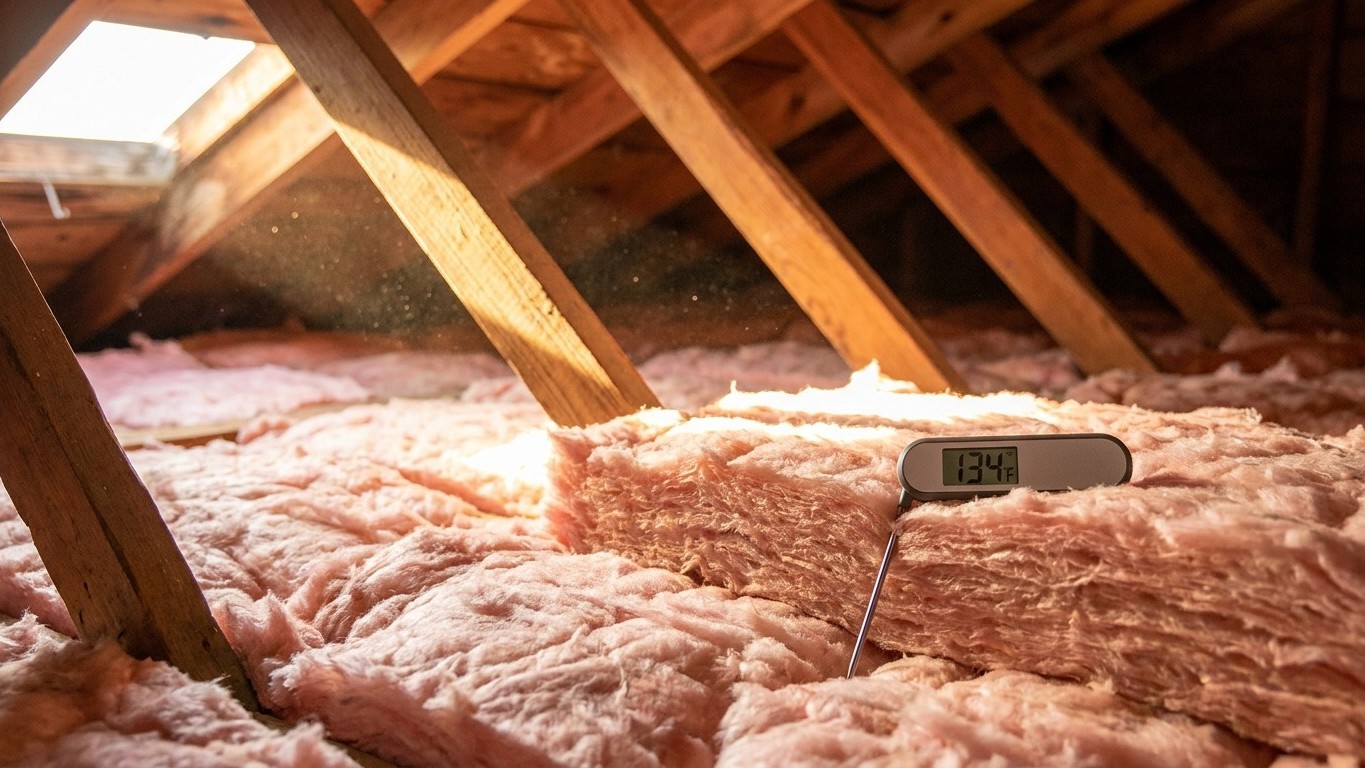
Even in a climate with almost no 90°F days, an uninsulated or under-insulated attic can still get hot enough to matter. A dark asphalt shingle roof deck exposed to direct sun can climb far above whatever the outdoor air temperature happens to be that day, sometimes by 40°F or more, simply because it is absorbing solar radiation directly rather than just sitting in shaded air. That superheated air pools in the attic, and everything under it, the ceiling drywall, any ductwork running through the space, boxes of stored belongings, sits under that elevated temperature for as long as the sun is on the roof.
The physics of insulation does not care which direction the heat is trying to move. A layer that resists heat loss from a warm living room into a cold winter attic is, by the same property, resisting heat gain from a hot summer attic into a cool living room below. It is not a “winter product” that happens to tolerate summer, it is a resistance to heat flow, full stop, and in July that flow simply reverses direction, moving down through the ceiling instead of up through it.
The recommended levels for this climate zone
Natural Resources Canada’s Keeping the Heat In guide sets recommended minimum insulation values by climate zone, and for Zone 6, the zone that covers the St. John’s reference station, the figures are laid out by building component. These are quoted in RSI first, the Canadian metric unit, with the more familiar R-value alongside it, and they are recommended minimums rather than a fixed code requirement, since actual building code obligations are set provincially and municipally and can exceed them.
| Component | RSI | R-value |
|---|---|---|
| Walls | 4.8 | 27 |
| Basement walls | 4.2 | 24 |
| Roof or ceiling | 10.6 | 60 |
| Floor over unheated spaces | 7.1 | 40 |
Those figures apply to the zone the St. John’s station sits in, not automatically to every municipality in the province. A homeowner elsewhere in Newfoundland and Labrador should check their own community’s heating degree-days before assuming the same numbers apply, since a colder microclimate could call for more. Of everything on that list, ceiling or roof insulation is the one improvement that pulls double duty across both seasons: it is the layer standing between a superheated summer attic and the living space below, and the layer holding heated indoor air in through a long winter.
What homes in Newfoundland and Labrador cool with
Cooling equipment is genuinely uncommon in this part of the country, and the numbers back that up. Statistics Canada’s Canadian Social Survey on Quality of Life and Energy Consumption Behaviours found that 58.9% of households in the Atlantic region reported having air conditioning, compared with 68.3% across Canada as a whole. That figure covers the whole Atlantic region, not this province specifically, and it is a share of households surveyed, not a share of houses standing or a measure of need. A lower rate here can reflect a mild summer climate, an older housing stock built without central air in mind, or some mix of both, and the survey itself does not separate those explanations.
Where a household does have air conditioning, the connection to insulation depends entirely on how that cooling is delivered. In homes with central air run through ductwork installed in the attic, the ducts themselves sit inside the hottest space in the entire building envelope, and ceiling insulation does nothing to protect them, since the insulation layer typically sits above the ductwork, not around it. Sealing and insulating that ductwork is a separate job from adding attic insulation, and skipping it means conditioned air is being cooled again by a superheated attic on its way to the living room.
In homes without ducted central air, cooling more often comes from a window unit or a ductless mini-split serving one or two rooms. In that setup, the relevant envelope is much smaller: the insulation, window condition, and air sealing of that specific room determine how hard the unit has to work and how long the cooled air stays cooled once the unit cycles off. A well-insulated room with a tight envelope lets a small unit do the job; a room with gaps around windows or thin, uninsulated walls forces the same unit to run far more than it should. This site’s guides on duct sealing and insulation and on choosing and sizing room air conditioners go into both of these situations in more detail.
What the heat asks for that the cold does not
Two building techniques exist specifically for hot climates, and neither one fits a Newfoundland and Labrador house particularly well given how rare extreme heat is here.
A radiant barrier is a reflective layer, usually a foil-faced material installed in the attic, that reflects radiant heat away rather than resisting conducted heat the way ordinary insulation does. It carries no R-value of its own and is not a substitute for insulation. Its entire purpose is to cut down radiant heat gain under a sun-loaded roof deck in a climate with long, intense hot seasons, the kind of climate where attic temperatures regularly spike well above outdoor air for months at a time. With St. John’s reporting zero days a year above 90°F, that scenario simply does not describe conditions in this province, and a radiant barrier is not the tool this house needs, regardless of how appealing it might sound as an upgrade.
The other summer-specific issue is vapour direction. In a warm, humid climate, moisture-laden air pushes in from outside toward the cooler, air-conditioned interior, which is why the model building code does not require an interior vapour retarder in the country’s warmest zones, since one there could trap moisture inside a wall assembly. Newfoundland and Labrador’s cold winter climate runs the opposite pattern most of the year, with moisture driven from the warm interior outward through the wall in winter. Getting the vapour barrier decision right for this specific province, rather than assuming a rule written for a hot, humid climate applies here, is worth its own dedicated look on this site’s vapour barrier page for Newfoundland and Labrador.
What the work is worth
The U.S. Environmental Protection Agency’s ENERGY STAR program puts a number on what air sealing and insulation are worth: “EPA estimates that homeowners can save an average of 15% on heating and cooling costs (or an average of 11% on total energy costs) by air sealing their homes and adding insulation in attics, floors over crawl spaces, and accessible basement rim joists.” Both figures matter, and neither works without its denominator, since 15% of a combined heating-and-cooling bill is a different thing than 11% of every dollar spent on energy in the home.
That combined figure is exactly the reason a page like this one exists. The saving being described is not a winter saving that happens to keep going into summer, it is a single estimate that folds heating and cooling together into one number, which fits a province like this one where the winter side of that ledger does almost all the work but the same air sealing and insulation still shows up in the summer half of the calculation too, however small that summer half is here.
Two things worth being clear about before treating that figure as a plan. It is an average drawn from energy modelling of a typical existing U.S. home, not a measurement or a promise for any specific house in Newfoundland and Labrador, where the housing stock, climate zone, and heating fuel mix all differ from the American homes in that model. And the estimate covers specific locations only, attics, floors over crawl spaces, and accessible basement rim joists, not walls, windows, or doors, so it should not be stretched to cover a whole-house renovation that includes those other components.