
Insulation does help keep an Alberta home cooler, but the honest answer here is that summer barely enters the equation. The reference station for the province, Calgary, logs an average of zero days a year above 90°F. The Insulation that matters most in this climate is fighting a five-month heating season, not a heat wave that essentially never arrives.
The short answer for Alberta

Yes, Insulation slows heat gain in July the same way it slows heat loss in January, but in Alberta the question of “how much does this matter for summer” has a small answer. According to Environment and Climate Change Canada’s 1981-2010 Climate Normals, the reference station at Calgary averages 0.0 days a year at or above 90°F. That’s not a rounding error, it’s the record: the province’s benchmark station essentially never sees that kind of heat load. Compare that to a Texas or Arizona reference station, where such days number in the dozens or more, and the picture is clear. In this territory, summer heat is the exception, not the season that shapes the building envelope.
That single fact reframes everything else on this page. Where a hot-climate reader needs to weigh radiant barriers and cooling-load math, an Alberta reader is dealing with a climate where the calendar tips hard toward heating. Natural Resources Canada’s zone system backs this up. The Calgary International Airport station sits at roughly 4,979 heating degree days below 18°C, which places it in NRCan climate zone 6, one of the colder zones the country tracks, well past the mild end of the scale where zone 4 (under 3,000 heating degree days) sits. Zone 6 runs from 4,000 to 4,999 heating degree days, and zones 7a, 7b, and 8 climb from there into the north. Calgary is solidly on the cold side of the country’s divide, not the temperate coastal side.
None of that means Insulation is wasted in summer here. The same layer of material that keeps January’s cold out also slows July’s heat in, and on the rare 90-plus day, that resistance is worth having. But the return on investment in this territory comes overwhelmingly from the heating side of the ledger. If a homeowner in this province is deciding where Insulation dollars go, the winter performance should drive the decision, with any summer benefit treated as a bonus that arrives for free, not the reason to act.
One caution worth repeating: a reference station describes one point on the map, not the whole province. Southern Alberta’s foothills, the Peace River region, and the areas near the Rockies can each see a different number of hot days and a different heating degree-day count than Calgary. Anyone outside the immediate Calgary area should check their own municipality’s heating degree-days before assuming this exact zone and these exact numbers apply to their address.
What happens above the ceiling
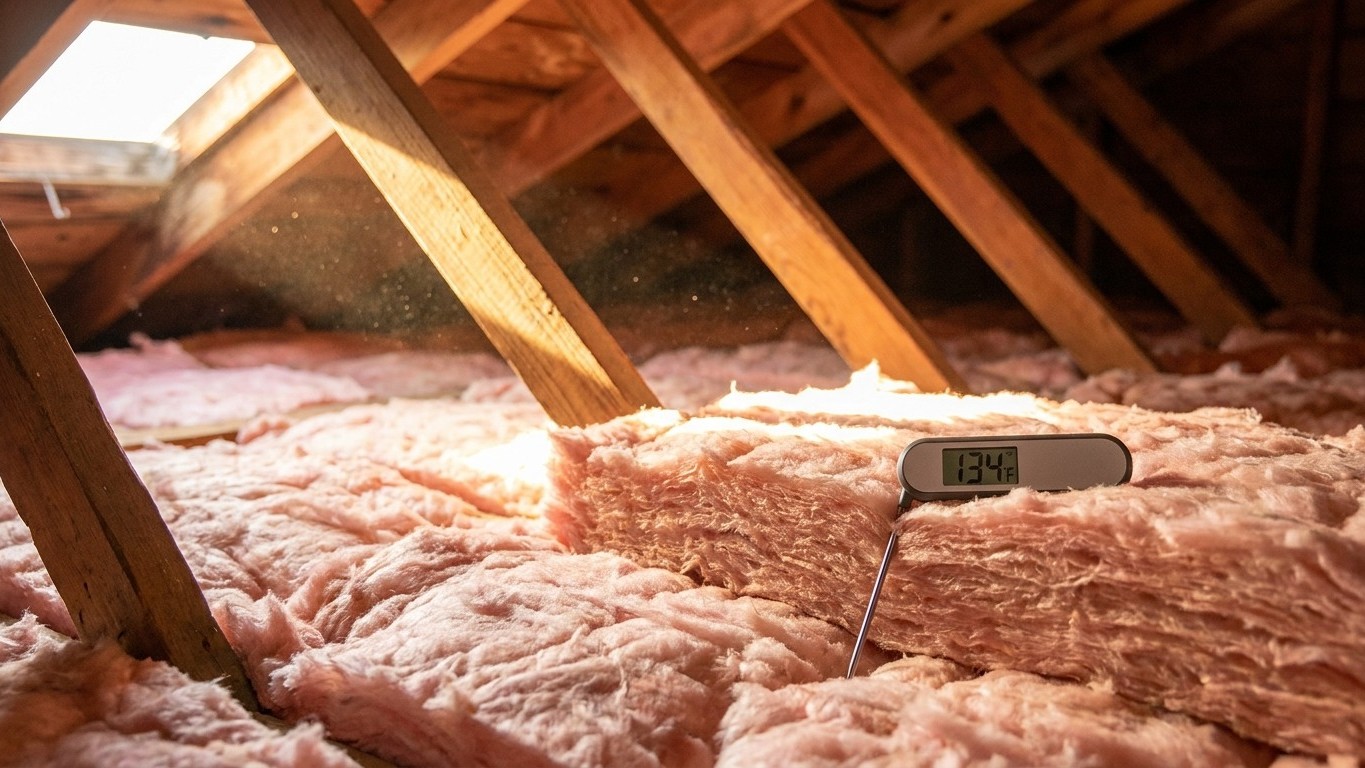
Picture a roof deck sitting under direct sun for eight or ten hours. Asphalt shingles can push surface temperatures well past the air temperature below them, and that heat doesn’t stop at the roofline. It radiates and conducts into the attic space, and an uninsulated or under-insulated attic can run considerably hotter than the outdoor air on a sunny afternoon. Everything under that attic floor, the ceiling drywall, any ductwork routed through the space, boxes stored for the winter, sits underneath that heat load. Without a resistance layer, that heat migrates down into the living space below.
The point that matters for a two-season climate is this: the Insulation doing that job is not a separate summer product bolted onto a winter one. It’s the same batt, blown-in fill, or rigid board doing the same job it does in January, just running the flow in the opposite direction. In winter, heat moves from the warm living space up through the ceiling into a cold attic, and insulation slows it down. In July, heat moves from a hot attic down toward the cooler living space, and the identical layer of insulation slows that down too. It’s a resistance to heat flow, not a one-way valve.
What Natural Resources Canada recommends for this zone
For climate zone 6, the zone that includes the Calgary reference station, Natural Resources Canada’s “Keeping the Heat In” guide lists these recommended minimum insulation values:
| Assembly | RSI | R-value |
|---|---|---|
| Walls | 4.8 | R 27 |
| Basement walls | 4.2 | R 24 |
| Roof or ceiling | 10.6 | R 60 |
| Floor over unheated spaces | 7.1 | R 40 |
These are recommended minimums, not a code requirement on their own. The building code that actually governs a project is set at the provincial and municipal level, and it can call for more than this table. It’s also worth remembering these figures apply to the zone the Calgary station sits in; a home elsewhere in the province with a different heating degree-day count may fall into a colder zone and need a heavier ceiling number still.
What homes in Alberta cool with
Statistics Canada’s Canadian Social Survey on Quality of Life and Energy Consumption Behaviours puts air conditioning ownership across the Prairie region, the block that includes this province, at 57.2% of households, compared with 68.3% nationally. That’s a meaningful gap below the country’s average, and it lines up with the climate story above: a region where 90-degree days are rare doesn’t need mechanical cooling the way warmer parts of the country do. That said, a rate below the national figure is not proof of low demand across the board; it can also reflect an older housing stock or households that simply haven’t added the equipment, and this survey doesn’t separate those explanations. It’s also worth noting the percentage describes households surveyed, not a count of houses standing, so it’s a snapshot of behavior, not an inventory.
Where insulation actually connects to that cooling equipment depends on how the air conditioning is delivered. In a home with central air routed through ductwork that runs through the attic, those ducts sit inside the hottest space in the entire building envelope on a sunny day. Ceiling insulation between the living space and the attic does nothing to protect that ductwork; duct sealing and duct insulation are a separate job, addressed on this site’s duct guides. In a home cooled with a window unit or a ductless mini-split instead, there’s no attic ductwork to worry about, and the insulation and air-sealing of that one room’s walls, ceiling, and windows becomes the whole story for how well the unit performs. This site’s room air conditioner guides cover that side of the equation in more depth.
What the heat asks for that the cold does not
Two products belong specifically to hot-climate construction, and neither one is a natural fit here. A radiant barrier is a reflective layer, usually foil-faced sheathing or a foil product stapled to rafters, that bounces radiant heat back toward the roof deck instead of resisting conducted heat the way insulation does. It carries no R-value of its own and isn’t a substitute for insulation; it earns its keep specifically under a sun-loaded roof deck in a climate where attic temperatures spike hard and often. Given that the reference station for this province averages zero days above 90°F, a radiant barrier isn’t the tool this house needs. That’s a hot-climate product for a hot-climate roof, and Alberta’s roofs aren’t fighting that battle.
The second hot-climate consideration is vapour direction. In a warm, humid climate, moisture-laden air sits outside the wall for much of the year, and it pushes inward through the wall assembly in summer, the reverse of how vapour moves in a cold winter climate. That’s precisely why the model building code doesn’t require an interior vapour retarder in its warmest zones; adding one there can trap moisture instead of stopping it. Alberta’s situation is the opposite case: a cold zone 6 climate where vapour drive is predominantly outward through the winter, which is a different problem with a different answer. Rather than settle that question in a summer-focused page, the province’s dedicated vapour barrier guide on this site is the right place to work through it.
What the work is worth
The U.S. Environmental Protection Agency’s ENERGY STAR program puts a number on this kind of work: “EPA estimates that homeowners can save an average of 15% on heating and cooling costs (or an average of 11% on total energy costs) by air sealing their homes and adding insulation in attics, floors over crawl spaces, and accessible basement rim joists.” Both figures matter, and neither works without its denominator, 15% of combined heating and cooling costs, 11% of total energy costs, which includes everything else the home runs on. That’s the whole point of pairing insulation with a two-season page like this one: the savings figure isn’t a winter number that happens to spill over into summer, it’s built from heating and cooling together from the start.
These are averages drawn from energy modelling of a “typical” existing U.S. home, not a guarantee tied to any single house in Alberta or anywhere else. The modelling also names specific locations, attics, floors over crawl spaces, and accessible basement rim joists, and doesn’t extend to walls, windows, or doors, so it’s a partial picture of the envelope rather than a whole-house figure. There’s no price attached to this estimate, no payback timeline, and no federal tax credit tied to it either; the U.S. 25C residential energy credit that once applied to this kind of work closed at the end of 2025, and in any case a Canadian project wouldn’t have been eligible for a U.S. tax provision to begin with.