
Eight species from the documented list actually feed on carrot in this growing region: aphids, carrot rust fly, cutworms, flea beetles, grasshoppers, slugs, spider mites, and wireworms. The rest of the documented pests target other crops entirely, and knowing which is which is what actually protects a carrot bed.
Which pests attack carrot in British Columbia

The University of Idaho Extension and WSU Extension document a broad list of vegetable garden pests for this border region, and carrot growers need to know which ones actually touch their crop. Of Everything on that list, only a handful bother carrot roots or foliage.
Aphids, carrot rust fly, cutworms, flea beetles, grasshoppers, slugs, spider mites, and wireworms are the species with a real reason to be on a carrot grower’s radar here. Carrot rust fly is the only one of the eight named directly for the crop, and it stays that way because its larvae tunnel the taproot and nothing else on the list does that.
Everything else on the documented roster has a different target. Brown marmorated stink bug feeds mainly on fruiting vegetables and tree fruit, not on root crops, so it has no business on a carrot page. Cabbage maggot and imported cabbageworm (with loopers) are brassica specialists, tied to cabbage, broccoli, and their relatives, not to carrot. Colorado potato beetle wants potato and eggplant foliage. Corn earworm needs a corn ear to develop in. Onion maggot and onion thrips follow the onion family only. Pea leaf weevil is a legume feeder. Squash bug and western spotted cucumber beetle both need cucurbit hosts, squash, cucumber, melon, and skip carrot entirely. Tomato hornworm is a nightshade feeder, tomato, pepper, potato, not carrot.
That sorting matters more than it looks. A gardener who spots a tomato hornworm on a tomato plant three rows over and assumes it explains the ragged carrot tops nearby will miss the actual cause, and miss the window to do something about it. The documented list for this region is short on true carrot feeders, and that is worth taking at face value rather than padding it with pests that happen to share a garden bed.
When each one shows up, and what it does first
Carrot is direct-seeded here, not transplanted, so every timing below counts from the day seed goes in the ground, not from a transplant date. Utah State University Extension notes the crop runs 70 to 100 days from seeding to harvest, and that window is the frame for reading pest activity, since no frost-free date is published on this page to hang it on instead.
In the first few weeks after seeding, before the seedlings have much size, cutworms are the early threat. They work at night, at soil level, and the first sign is a seedling severed clean at the base, lying flat, with no chewing higher up the stem. Slugs act on the same young stand, but leave irregular holes in the cotyledons and a telltale slime trail rather than a clean cut.
Once the carrot tops have filled in, flea beetles show up as a scatter of tiny round holes across the leaves, sometimes called shot-holing, dense enough in a bad year to check the plant’s growth. Aphids follow or overlap, clustering on the undersides of leaves and along new growth, curling the foliage and leaving a sticky residue behind them.
Mid-season, as roots start sizing up, is when carrot rust fly larvae become the real concern. The adult fly lays eggs at the soil line, and the first visible clue is rarely the insect itself, it is rust-colored tunneling and scarring on the root once it is pulled, often not obvious from the top growth at all. Wireworms operate on the same underground timeline, boring narrow, clean holes straight into the root, most often where carrot follows a recently broken sod or grassy patch.
Later in the season, in hot, dry stretches, spider mites turn carrot foliage stippled and dusty-looking, with fine webbing on the undersides of leaves in a heavy infestation. Grasshoppers arrive whenever conditions favor them, chewing ragged notches out of the leaf margins, a coarser kind of damage than flea beetle shot-holing.
Telling the damage apart from everything else
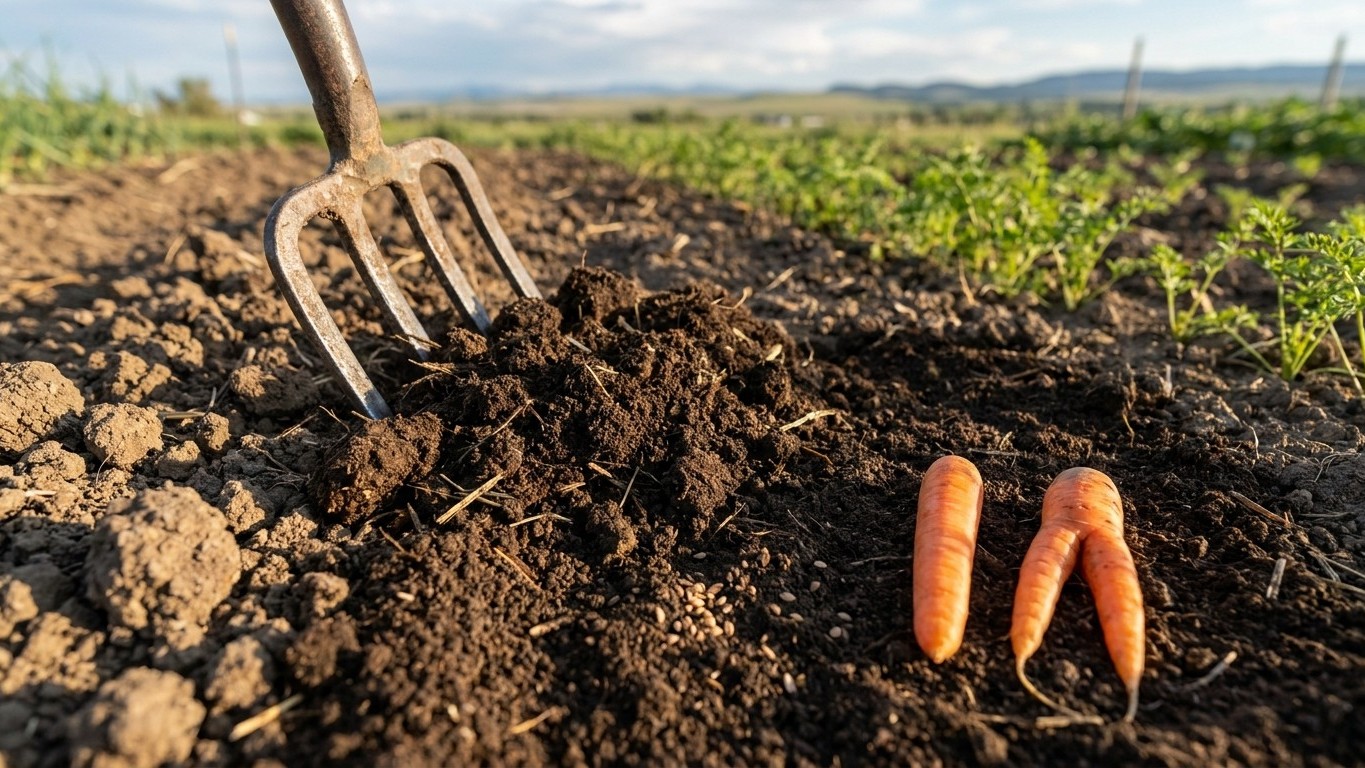
Not every rough-looking carrot is a pest problem. Utah State University Extension points out that heavy or rocky soil makes the root fork on its own, no insect required, and that forking is one of the most common things mistaken for pest damage in a home carrot bed.
The province’s dominant surface soil here runs to a loam-to-silt texture, roughly 52 percent sand, 10 percent clay, and 38 percent silt, and is generally well drained. That is a starting point, not a verdict on any one yard: a soil test on the actual bed is what settles whether compaction or clay content is the real cause of forked, stunted, or misshapen roots.
| Symptom | Likely cause | What tells them apart |
|---|---|---|
| Root splits into two or more prongs | Heavy, rocky, or compacted soil (not a pest) | No tunnel, no insect residue inside the root, whole bed affected evenly |
| Rust-colored tunnel through the root | Carrot rust fly larvae | Tunnel is irregular and rust-tinted, often paired with wilted or yellowing tops |
| Narrow, clean bore hole straight into the root | Wireworms | Hole is smooth-sided, straight, no rust discoloration around it |
| Pale, stunted foliage with no visible chewing | Nutrient deficiency or uneven watering | No holes, no residue, symptom spreads gradually rather than overnight |
| Seedling cut clean at the base | Cutworms | Cut is smooth, plant lies flat, damage is at ground level only |
When the cause still is not clear from the root, the leaf, or the pattern across the row, the local extension office is the next step, not a guess based on what worked in someone else’s garden.
What actually works here, and what is a waste of time
On a direct-seeded crop, timing beats almost anything applied after the fact. A physical barrier placed at seeding, before carrot rust fly or cutworms find the row, works far better than trying to intervene once damage already shows. A fine mesh row cover laid down right after seeding and kept sealed at the edges keeps the rust fly adult from ever laying eggs at the soil line, and it does the same job against grasshoppers and flea beetles looking for young foliage.
For soil-level problems, rotation matters more than any single fix. Wireworms build up where carrot follows ground that was recently sod or pasture, so skipping that sequence for a season or two does more than any treatment applied after larvae are already established. The same logic applies to forked roots from heavy soil: working in compost and double digging, or simply moving the crop to a raised bed, addresses the cause, while nothing sprayed on the leaves will straighten a root already forced around a clay layer.
What tends to waste time is treating foliage damage without knowing which insect made it. Spraying for aphids when the real damage is flea beetle shot-holing, or vice versa, means handling the wrong life stage at the wrong depth in the canopy. It is also worth remembering that none of the extension sources named here list a specific product, rate, or active ingredient for this crop and region, and that is not an oversight to fill in with a guess. What is labeled and legal changes by product and by year, and the local extension office is the only source that keeps that current.
A short season adds one more constraint: whatever is done has to happen early, since there is little time to recover from an infestation that takes hold mid-cycle on a crop already counting down its 70 to 100 days.
Where to check this for your own county
The University of Idaho Extension and WSU Extension are the two services behind the pest documentation used on this page, and both work on a county-by-county and district basis, not a single blanket answer for the whole region. A pest documented for the broader territory is not a guarantee it is active in any one garden, and that gap is exactly what a local office is set up to close.
A provincial or state-level list, and the soil data behind it, describes tendencies across thousands of mapped sites, not the eight rows of carrot behind one particular house. The dominant soil order here, a Brunisol with roughly 5.8 median surface pH, is a fair description of the region’s farmland in general. A backyard bed built on fill, or sitting near a river bottom, or scraped down during construction, can behave nothing like that median, which is exactly why a soil test and a call to the local extension office matter more than the regional average.
The practical next step is straightforward: contact the county extension office nearest the garden, describe the symptom using the terms in the table above, root tunneling versus forking, clean cut versus ragged notch, and ask what has actually been reported active in that specific area this season. That single call replaces guesswork with something closer to a local answer.
Common questions
Does carrot rust fly affect every carrot bed in the region?
No. It is documented for the broader territory by the extension services named on this page, but activity varies by location, by what was grown in that ground before, and by how close the bed sits to grassy or wooded edges where the fly overwinters. A county extension office can say whether it has been reported active locally this season.
Can forked carrots be fixed once they have already grown that way?
Not for that root. Forking happens as the taproot grows, when it meets rock, compacted soil, or heavy clay, and by the time it shows at harvest the shape is set. The fix is for the next planting: working in compost, double digging, or moving to a raised bed ahead of seeding.
Is spider mite damage something to treat right away?
It depends on how far it has spread and how hot and dry conditions have been, since mites build up fastest in those stretches. Confirming the fine stippling and webbing described above, rather than assuming based on wilted-looking leaves alone, is the first step before deciding anything.
Why does the pest list on this page look shorter than lists for other crops?
Because it only names species the documented sources tie to carrot specifically. Pests aimed at tomato, cabbage, onion, squash, or corn appear in the same regional documentation but have no reason to be listed on a carrot page, so they were left out rather than padded in.