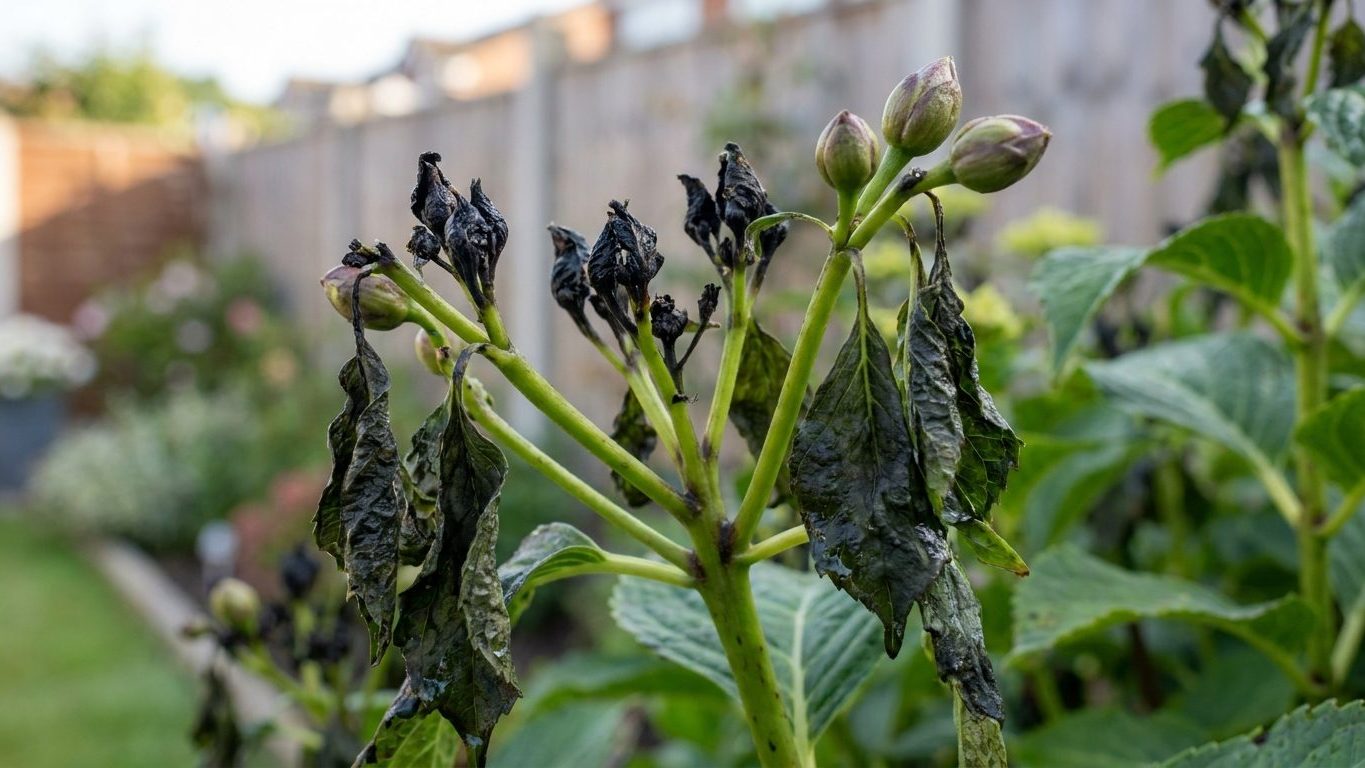

That blackened, limp tip on your hydrangea is bud death from a late-season freeze that hit after the plant had already woken up. It matters a lot if you have a bigleaf, oakleaf, mountain, or climbing hydrangea, because those bloom on last year’s wood and the damaged buds were this year’s only flowers. It barely matters at all if you have a panicle or smooth type, since those flower on new growth regardless of what the old wood did.
What you are looking at
Look first at the buds themselves, not the whole stem. A frost-killed bud turns black or dark brown, feels soft or mushy rather than firm, and often collapses inward within a day or two of the cold snap. If leaves had already emerged, they go from green to blackened and limp almost overnight, sometimes hanging like wet paper. This is different from a bud that simply hasn’t opened yet: an undamaged dormant bud is firm and green or tan inside if you scratch it lightly with a fingernail.
Do not confuse this with ordinary winter dieback, where entire stems (not just the bud tips) are brown and brittle all the way down, usually from cold exposure months earlier rather than a single spring event. It also isn’t leaf spot disease, which shows distinct round or angular spots with defined edges rather than a uniform blackened, collapsed look. And it isn’t bud blight, a disease named specifically on panicle hydrangea, which tends to show discolored, distorted buds rather than the sudden blackening tied to a cold snap.
Timing is the giveaway. If the damage appeared within a day or two of a night that dropped well below normal for that point in spring, especially after a stretch of mild weather that encouraged early growth, you’re looking at frost injury. If your plant is a panicle (H. paniculata) or smooth (H. arborescens, the Annabelle type) hydrangea, check whether the damaged growth is old wood or new: on these types, new shoots from the base will still carry this year’s flowers, so the loss is cosmetic, not a bloom-ending event.
What actually causes it
Flower buds on old-wood Hydrangeas (bigleaf, oakleaf, mountain, climbing) were formed the previous summer and spent winter dormant, protected by their own tissue and, on some plants, by scale-like bud coverings. A run of warm spring days signals the plant to break dormancy: buds swell, cells fill with water, tissue softens as it prepares to grow. That swollen, water-filled state is exactly what makes it vulnerable. When temperatures then drop below freezing, ice crystals form inside the cells and rupture their walls, killing the tissue outright. A bud that stayed fully dormant through the same temperature drop would likely have survived; the injury happens because the plant had already committed to growth.
The common explanation people reach for is that the hydrangea “isn’t hardy enough” for their zone. That’s usually the wrong diagnosis. This is a timing problem, not a hardiness problem — the same plant, the same zone, survives most winters fine. The damage happens because bud break occurred before the last frost risk had passed, not because the genus is unsuited to the climate.
Not every old-wood hydrangea reacts the same way. Mountain hydrangea (H. serrata) buds tolerate a late frost noticeably better than bigleaf buds, even though both flower on old wood and both form buds the summer before. If you have two hydrangeas that took the same cold night and one shows far more damage, the type explains the difference more than the exposure did.
| Type | Blooms on | Late-frost vulnerability |
|---|---|---|
| Bigleaf / mop-head / lacecap | Last year’s wood | High |
| Mountain | Last year’s wood | Lower than bigleaf |
| Oakleaf | Last year’s wood | High |
| Climbing | Last year’s wood | High, and slow to recover given how slowly it flowers to begin with |
| Panicle | Current season’s growth | Essentially none for bloom; only cosmetic damage to old wood |
| Smooth (Annabelle type) | Current season’s growth | Essentially none for bloom |
What to do now
Be clear-eyed about what’s gone: a blackened bud will not recover and will not open into a flower this season. There is nothing you can spray, water, or feed into it that reverses the cell rupture that already happened. On bigleaf, oakleaf, and climbing hydrangeas, that often means this year’s main flush is over before it started, since most of the flower buds were set on the same old wood the frost reached.
The move that actually helps is watching what’s still alive rather than mourning what isn’t. Bigleaf and mountain hydrangeas sometimes carry secondary or lower buds that broke dormancy later and escaped the freeze; leave those stems alone and give them time, since they can still produce a smaller bloom later in the season. Trim off only the obviously blackened tips, cutting back to where the stem tissue is green and firm again, so the plant isn’t wasting energy trying to push growth through dead tissue. Resist the urge to prune hard across the whole shrub. Cutting into wood that still has live buds lower down removes flowers you haven’t lost yet.
If your plant is a panicle or smooth type, do essentially nothing different. New growth from the base will carry this year’s blooms regardless of what the old wood looks like, so a damaged old cane is a shaping issue, not a flowering one. Keep watering and feeding on your normal schedule either way; a frost-damaged hydrangea isn’t a stressed hydrangea in the soil-and-water sense, and piling on extra fertilizer or water doesn’t speed bud recovery, because there’s no bud left to recover.
What does not work
Once tissue has frozen and collapsed, nothing applied afterward brings it back, and several of the first things gardeners reach for target a completely different problem.
Crushed eggshells worked into the soil are a slow-release calcium source, and foliar calcium sprays deliver calcium directly to leaf surfaces. Both address calcium deficiency in plant tissue, which has nothing to do with frost injury. The bud didn’t die from a lack of calcium; it died because ice physically ruptured its cells. No amount of calcium changes that outcome, because the tissue is already dead.
Adding lime is meant to raise soil pH in soil that’s too acidic for a given plant’s needs. Most home soils already carry enough calcium for a hydrangea’s general health, and lime does nothing to reverse freeze damage regardless. Worth noting separately: lime pushes hydrangea soil toward alkaline, which on bigleaf and mountain hydrangeas shifts flower color toward pink, an effect completely unrelated to frost recovery and one you don’t want to trigger by accident while chasing a fix that isn’t there.
Wrapping the plant in extra mulch or fertilizer after the fact, or spraying an anti-freeze product once the damage is visible, falls into the same trap: these are timed for prevention, not repair. None of it un-kills a bud that’s already black. The honest answer is that there is no rescue treatment. The only useful work happens before the frost, not after.
Preventing it next time
The single change that matters most is choosing hydrangea type to match your actual spring frost pattern, not just your winter hardiness zone. If your area regularly gets a late warm spell followed by a hard cold snap, a panicle or smooth hydrangea sidesteps the whole problem, since neither depends on old-wood buds surviving winter and spring intact. The source specifically notes panicle hydrangea as a good substitute for bigleaf in areas where bigleaf isn’t reliably winter hardy, and the same logic applies to late-frost exposure.
If you’re committed to a bigleaf, oakleaf, mountain, or climbing hydrangea, the next best habit is delaying anything that encourages early bud break: don’t rush to remove winter protection, and don’t prune bigleaf hydrangea in a way that stimulates new growth before your last frost risk has passed for the year. Timing details for pruning windows and protective mounding depth vary by zone and by type, so check the guidance specific to your state and your hydrangea type rather than applying a single date nationwide.
Mulch helps in a different way: both bigleaf and panicle hydrangeas are shallow-rooted, and a consistent mulch layer buffers soil temperature swings that can trigger premature bud swelling during an early warm stretch. It won’t stop a hard freeze from doing damage once buds have broken, but it reduces how early that break happens in the first place, which is the real point of leverage here.
Common questions
Will a frost-damaged hydrangea die? No. Losing this year’s buds to a late frost is a bloom problem, not a survival problem. The plant itself, roots, stems, and next year’s bud-forming wood, is unaffected as long as the freeze wasn’t severe enough to damage the whole cane.
Should I cut the whole shrub back after frost damage? No. Trim only the visibly blackened tips back to green, live tissue. Hard pruning removes lower buds that may have escaped the freeze and could still flower.
Why did my neighbor’s hydrangea survive the same frost? Type and timing differences explain most of this. Mountain hydrangea buds tolerate late frost better than bigleaf buds even though both bloom on old wood, and a plant whose buds hadn’t broken dormancy yet is less vulnerable than one already swelling.
Does frost damage affect flower color later? No, not directly. Color on bigleaf and mountain hydrangeas is set by soil pH and aluminum availability, not by frost exposure. A surviving secondary bloom will still follow the same blue-below-pH-5.5, pink-above-pH-6.5 pattern as any other year.