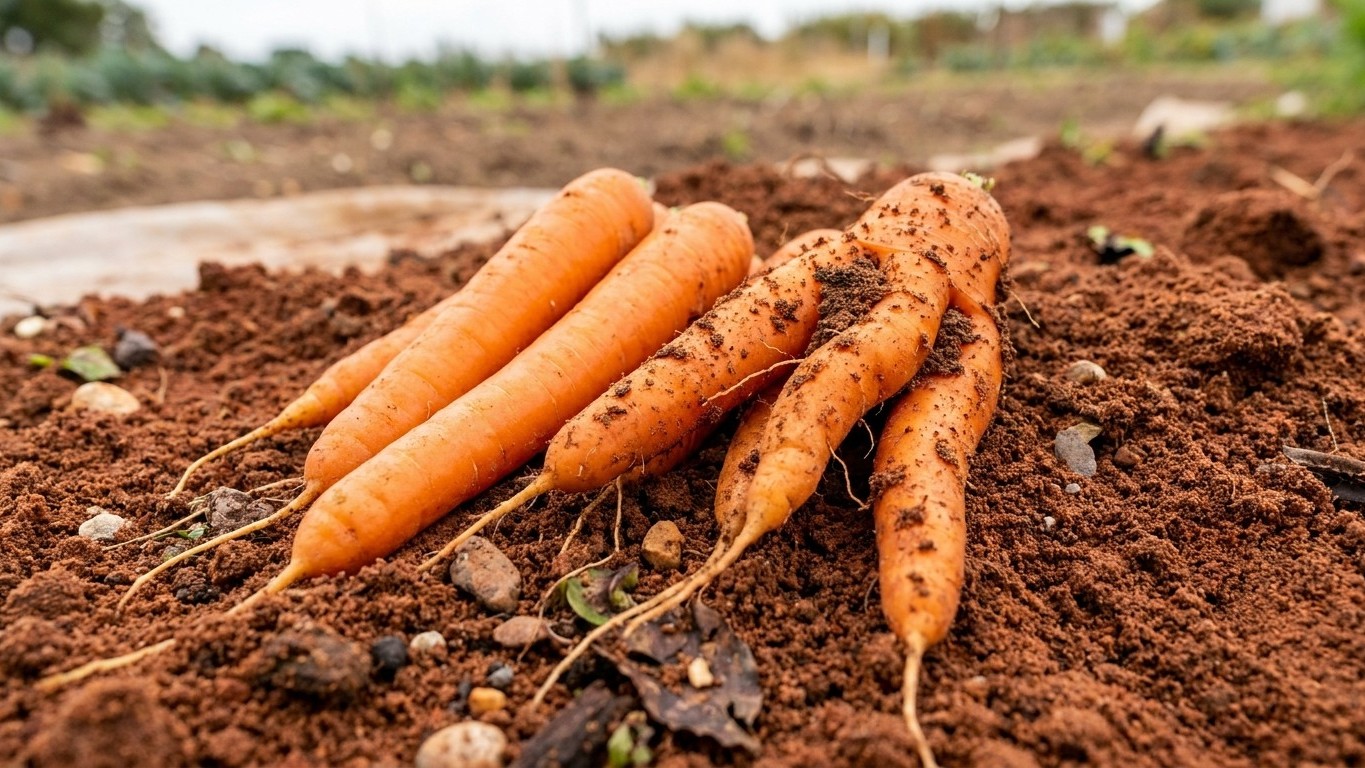

California gardeners growing carrots deal with a short list of documented pests: aphids, brown garden snail and slugs, earwigs, root-knot nematodes, spider mites, and whiteflies. Some go after the ferny tops, one attacks the root itself, and timing depends less on the calendar month than on how far along the crop is since seeding.
Which pests attack carrot in California

UC Agriculture and Natural Resources documents eleven pests across California vegetable gardens, and not all of them have any business on a carrot bed. Sorting the list matters more than reciting it, because a gardener who spots a pest name that has nothing to do with root vegetables starts to doubt the whole page.
Of the documented pests, six actually feed on carrot: aphids (including melon aphid), brown garden snail and slugs, earwigs, root-knot nematodes, spider mites, and whiteflies. Aphids and whiteflies are sap feeders that cluster on the ferny foliage and weaken the top growth. Brown garden snail and slugs rasp at soft leaves, especially on young seedlings before the tops toughen up. Earwigs chew ragged holes in seedling foliage at night. Spider mites show up on the foliage in hot, dry stretches, sucking cell contents until leaves stipple and bronze. Root-knot nematodes are the one to watch closest, because they attack underground, causing the root to fork, stub, or grow small galls that ruin the harvest before a gardener ever sees a leaf symptom above ground.
Five pests on the UC ANR list have no real reason to show up on carrot. Corn earworm targets corn ears and tomato fruit, structures a carrot never produces. Cucumber beetles are cucurbit specialists, drawn to cucumber, squash, and melon foliage and flowers, not a root crop’s ferny top. Leaffooted bugs feed on developing fruit, nuts, and pods, piercing structures carrots simply don’t grow. Stink bugs follow the same pattern, favoring fruiting crops over a leafy, rootbound vegetable. Tomato hornworm is a solanaceous specialist, built to strip tomato, pepper, and eggplant foliage, and it has no documented interest in carrot tops.
That leaves a shorter, more useful list than the full UC ANR roster suggests. The single biggest risk to the actual harvest is root-knot nematodes, because every other pest on this list damages foliage that a plant can often outgrow, while nematode damage shows up in the one part of the plant a gardener is growing carrots for.
When each one shows up, and what it does first
Carrots are sown directly in the ground, never transplanted, and the whole crop runs on a seeding-to-harvest window of roughly 70 to 100 days. That window is the clock to use here, not a named month, because sowing dates shift from one part of the state to another.
In the first couple of weeks after seedlings emerge, slugs and brown garden snail cause the earliest visible damage: ragged notches or missing chunks out of the first true leaves, often overnight, with slime trails as the giveaway. Earwigs follow a similar early script, chewing irregular holes in the same tender young foliage, usually worse right after watering when the soil surface stays damp after dark.
As the ferny tops fill in over the following weeks, aphids and whiteflies become the pests to watch. Aphids cluster on new growth and the undersides of leaves, and the first sign is often curled or yellowing foliage rather than the insects themselves, which are small enough to miss at a glance. Whiteflies give themselves away when a gardener brushes a plant and a small cloud of white insects lifts off the leaves.
Spider mites tend to show up once the weather turns hot and dry, mid-season for most plantings. The first symptom is a fine stippling or bronze cast across the foliage, sometimes with faint webbing on the underside of leaves before populations get bad enough to see with the naked eye.
Root-knot nematodes work on a different schedule entirely, feeding on roots from the seedling stage onward with no above-ground symptom until harvest, or until a gardener pulls one root early to check on size. The forked, stubbed, or knotted root at harvest is often the first and only sign, which is what makes this pest harder to catch early than any of the foliage feeders.
Telling the damage apart from everything else
Not every rough-looking carrot root or ragged leaf traces back to an insect. Carrots are already prone to forking on their own, and Utah State University Extension notes that heavy or rocky soil makes the root fork regardless of any pest being present. That single fact rules out a lot of false alarms before a gardener ever looks for a bug.
| Symptom | Possible pest cause | What points elsewhere |
|---|---|---|
| Forked, stubby, or knotted root | Root-knot nematodes | Heavy, rocky, or compacted soil produces the same fork without any pest involved |
| Ragged holes, missing seedling leaves | Slugs, snails, earwigs | Slime trails or nighttime chewing point to mollusks and earwigs; clean-edged cuts suggest mechanical damage from tools or foot traffic |
| Curled, yellowing new growth | Aphids | Yellowing across older leaves evenly, with no curling, often points to a nutrient shortfall rather than an insect |
| Stippled, bronzed foliage | Spider mites | Uniform pale leaves without stippling or webbing can be drought stress in a hot stretch with inconsistent watering |
| White insects lifting off when disturbed | Whiteflies | No insects visible, just wilting, usually means a watering or root problem instead |
Soil texture drives more of this than gardeners expect. The San Joaquin series, California’s official state soil, runs 51 percent sand, 18 percent clay, and 32 percent silt at the surface, with organic matter around 0.8 percent, moderately well drained. That is one representative soil mapped by USDA NRCS, not a stand-in for the ground in any particular yard, but it illustrates the kind of clay-heavy, moderately drained profile that produces forked roots with no pest involved at all. A soil test on the actual bed is the only way to settle which explanation fits, and a local extension office can point to where to send a sample.
What actually works here, and what is a waste of time
Physical barriers timed early do more for carrots than almost anything applied later. Floating row cover laid down at seeding, before earwigs and snails start working on the first true leaves, blocks the early foliage feeders without a single spray. The cover has to go on before seedlings emerge to matter, because once slugs or earwigs have already found the bed, a cover just traps them inside with the plants.
Handpicking or trapping deals with brown garden snail and slugs reasonably well on a small home bed, especially checked in the evening or early morning when both are active. Improving soil texture ahead of planting, working in compost and double digging a heavy bed, addresses forking and gives roots room to grow past root-knot nematode damage rather than fighting the nematodes directly once they are established in the soil.
What tends to waste time: treating a forked root as a pest problem when the soil texture is the real driver, since no aphid or mite spray fixes compacted, clay-heavy ground. Late-season sprays for aphids or whiteflies, applied after the ferny tops have already been stripped, rarely bring a carrot planting back to full vigor either, since the damage to that leaf tissue is already done. Because a local extension office is the only source that knows what is currently registered for use in California, this page won’t name a product, an active ingredient, or a dose. That call belongs to a county Cooperative Extension office, not to a general gardening article.
Where to check this for your own county
UC Agriculture and Natural Resources documents these pests at the state level, and that is a starting point, not a guarantee about what is actually in any one garden. A county Cooperative Extension office is the next stop, because pest pressure shifts noticeably from a coastal county to an inland valley to a desert county even within the same state.
The San Joaquin soil profile referenced above is the same story at a smaller scale: it represents one mapped series, and a state spans hundreds of different soil series, so a garden a few miles away can behave completely differently. A local office can help identify which soil series actually sits under a specific yard, and whether root forking on a harvest points to nematodes, compaction, or both.
The next useful step for a gardener seeing carrot damage right now is a call or visit to the county Cooperative Extension office tied to their address, sample or photo in hand, rather than trying to match a symptom to a pest from a general list alone.
Common questions
Do carrots need to be transplanted to avoid these pests?
No. Carrots are sown directly in the ground, and Utah State University Extension counts the 70 to 100 day growing window from seeding, not from any transplant date, since carrots are never transplanted.
Can heavy soil alone cause the same damage as root-knot nematodes?
Yes. Utah State University Extension notes that heavy or rocky soil makes the root fork on its own, which is why a forked carrot at harvest doesn’t automatically mean nematodes are present.
Is the state soil a reliable guide to what’s under a home garden?
Only as a general starting point. The San Joaquin series is one mapped soil representing the state, but a state contains hundreds of soil series, and yards, especially ones a builder has graded or filled, can differ completely.
Which documented pest poses the biggest risk to an actual carrot harvest?
Root-knot nematodes, since they damage the root underground with no visible warning above the soil line, unlike the foliage feeders on the list, which usually show themselves on the leaves first.