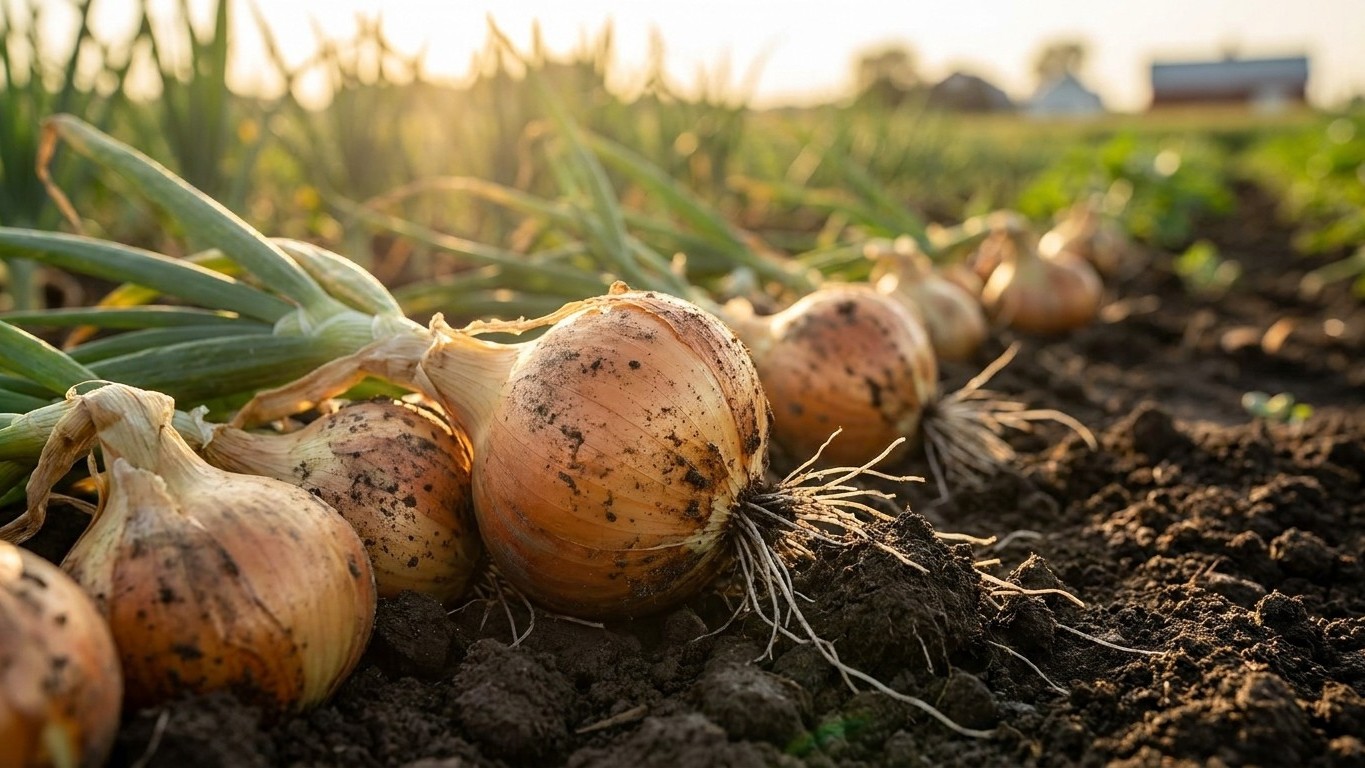

California gardens report six pests that regularly attack onion, according to UC Agriculture and Natural Resources: aphids (including the melon aphid), brown garden snail and slugs, earwigs, root-knot nematodes, spider mites, and whiteflies. Which one shows up first has less to do with the month on the wall than with the stage of the plant, from a soft seedling to a curing bulb, and with how far south or north in the state the garden sits.
Which pests attack onion in California

UC Agriculture and Natural Resources documents eleven pests across California vegetable gardens: aphids including the melon aphid, brown garden snail and slugs (Cornu aspersum), corn earworm, cucumber beetles, earwigs, leaffooted bugs, root-knot nematodes, spider mites, stink bugs, tomato hornworm, and whiteflies. That’s the full list for this territory. Not every name on it belongs on an onion bed.
Only six of those eleven pests actually feed on onion. The other five are documented pests of California gardens generally, but they target different plant tissue and skip alliums almost entirely:
- Corn earworm feeds on developing corn ears and tomato fruit. Onion has no ear and no fruit for the larvae to bore into.
- Cucumber beetles are drawn to cucurbit leaves and blossoms, not the waxy, tubular foliage of an onion.
- Leaffooted bugs use piercing mouthparts on seeds and soft fruit, like tomatoes, pomegranates, and almonds. An onion bulb, sitting underground, is out of reach.
- Stink bugs share that same fruit-and-pod habit, favoring beans and tomatoes over anything in the ground.
- Tomato hornworm is a foliage feeder built for tomato and pepper leaves specifically, not the round, hollow leaf of an onion.
The six that remain do real damage, and each one goes after a different part of the plant. Aphids and whiteflies cluster on leaves and drink sap. Earwigs and snails chew through soft new growth at ground level. Spider mites rasp the leaf surface until it turns pale and stippled. Root-knot nematodes work underground, feeding on roots and stunting whatever grows above them. That’s a short list for a state this size, and it’s worth saying plainly: UC Agriculture and Natural Resources doesn’t document a longer one for onion in California, so this page won’t pad it with pests borrowed from other crops.
Six pests, one shared trait: none of them need warm weather to get started. Snails move on cool, damp mornings. Aphids build colonies whenever new leaf tissue is soft enough to pierce. That’s the detail that decides what to check first in the next section, not the date on the calendar.
When each one shows up, and what it does first
Onion timing in California runs on plant stage more than on the month, and the stage that matters most is bulbing, which is triggered by day length rather than heat. At the reference latitude of 33.94 degrees north, the longest day of the year delivers 14 hours and 16 minutes of daylight, enough to satisfy a long-day onion’s requirement of 14 to 16 hours, but a short-day variety will already have started bulbing back when the day length crossed roughly 12 hours. That single threshold reshuffles when each pest actually does damage, because a short-day onion moves through its whole cycle faster than a long-day one planted at the same latitude.
Right after transplanting, while the seedling is still thin and soft, brown garden snail, slugs, and earwigs are the ones to watch, since they favor tender tissue and can cut a young onion off at the base overnight. A seedling that’s simply gone, or one sheared close to the soil line, points here before anything else.
As the plant puts on leaf growth, aphids and whiteflies move in. Both feed on sap from the underside or interior fold of the leaf, and both leave a sticky residue that draws sooty mold. Curled, yellowing leaf tips at this stage usually trace back to one of these two rather than to a nutrient problem.
Spider mites tend to appear once the weather turns hot and dry, in the stretch when day length is climbing toward that 14-hour bulbing threshold for long-day types. Look for a dry, stippled, almost dusty look on the leaf surface, worse on plants already stressed by inconsistent watering.
Root-knot nematodes work quietly the entire season, but the damage becomes visible late, at bulb development, as a plant that’s noticeably smaller and slower than its neighbors despite even watering. By the time it’s obvious above ground, the roots below have already been galled for weeks.
Telling the damage apart from Everything else
Onion problems get misdiagnosed more often than most garden crops, mostly because a bulb hides its roots and its stress signals look alike from the top. The single move that clears up most confusion is pulling one plant and looking at the roots and neck, not just the leaves. A pest almost always leaves a visible trace there; a growing-condition problem usually doesn’t.
| What you see | Could be a pest | Could be something else | What tells them apart |
|---|---|---|---|
| Yellow, curling leaf tips | Aphids or whiteflies feeding on sap | Nitrogen deficiency or uneven watering | Check the underside of the leaf for clusters of small insects or sticky residue; a nutrient issue shows no insects at all |
| Seedling cut off or missing overnight | Snails, slugs, or earwigs | Mechanical damage from foot traffic or a dropped tool | A slime trail or ragged chew marks point to the pest; a clean, angled break points to mechanical damage |
| Dry, stippled, dusty-looking leaves | Spider mites | Drought stress or heat scorch | Mites leave fine webbing near the leaf base under close inspection; drought stress affects the whole bed evenly, mites show up in patches first |
| Stunted plant, small bulb, otherwise healthy-looking leaves | Root-knot nematodes | Compacted soil or shallow planting | Pull the plant: galled, swollen roots mean nematodes; smooth but shallow or tangled roots mean a soil or planting problem |
None of this replaces an actual look at the plant by someone trained to tell them apart. If the roots are ambiguous, or two possibilities still fit after checking, that’s the moment to bring a sample, or a clear photo, to a local expert rather than guess and treat for the wrong thing.
What actually works here, and what is a waste of time
Timing beats treatment on a crop this fast-moving. A physical barrier put down at transplant, before the seedling has its first true leaf, stops far more snail and earwig damage than anything applied after the chewing has already started. Copper strips or a simple collar around young transplants work because they block movement, not because they poison anything, and they need zero re-application once they’re in place.
For aphids and whiteflies, a strong water spray to knock colonies off the leaf, repeated every few days while numbers are still low, does real work and costs nothing. Waiting until a colony has covered the leaf and gone sticky with residue is the point where that same spray stops being enough.
Root-knot nematodes are the one pest on this list where in-season action mostly fails. Once they’re established in the soil, treating the current crop rarely helps; the real fix is rotating onion and other susceptible vegetables out of that bed for a season or more, and choosing that bed’s next crop with the extension service’s guidance rather than guessing.
Spider mites are misread more than any pest here. Spraying water on the whole bed on a hot afternoon, hoping to wash them off, mostly just wastes water, since mite outbreaks usually track back to a plant that’s already under-watered, not to the mites choosing that plant first. Fixing the irrigation schedule does more than any spray.
None of this is a recommendation for a specific product or active ingredient. What’s labeled for use on onion, and what’s legal to apply in California, changes and is not something a general gardening page should guess at. That decision belongs with the local extension office, covered next.
Where to check this for your own county
Everything above comes from statewide documentation, and a state this size covers a lot of ground between its coast, its valleys, and its deserts. A pest list built at the state level tells a gardener what’s possible, not what’s actually in their own soil. Snails that are a constant problem in a coastal garden may barely appear in a hot inland valley, and the reverse is just as true for spider mites.
UC Agriculture and Natural Resources runs county-level Cooperative Extension offices across the state, and those offices, along with the UC Statewide Integrated Pest Management Program, are the resource built for narrowing a statewide list down to a single garden. They track what’s actually showing up locally, season to season, and they’re the ones positioned to say whether a treatment is legal and labeled for use in that specific county this year.
A reader near the edge of the state, whether that’s far enough north for the day length math to shift meaningfully or far enough south that the 33.94-degree reference point doesn’t quite apply, gains the most from checking their own latitude against their local office’s guidance before assuming this page’s timing lines up exactly with their yard.
The next useful step isn’t more reading. It’s a call or a visit to the county Cooperative Extension office, ideally with a sample or a clear photo of the actual plant in hand, before deciding what’s eating an onion bed and what to do about it.