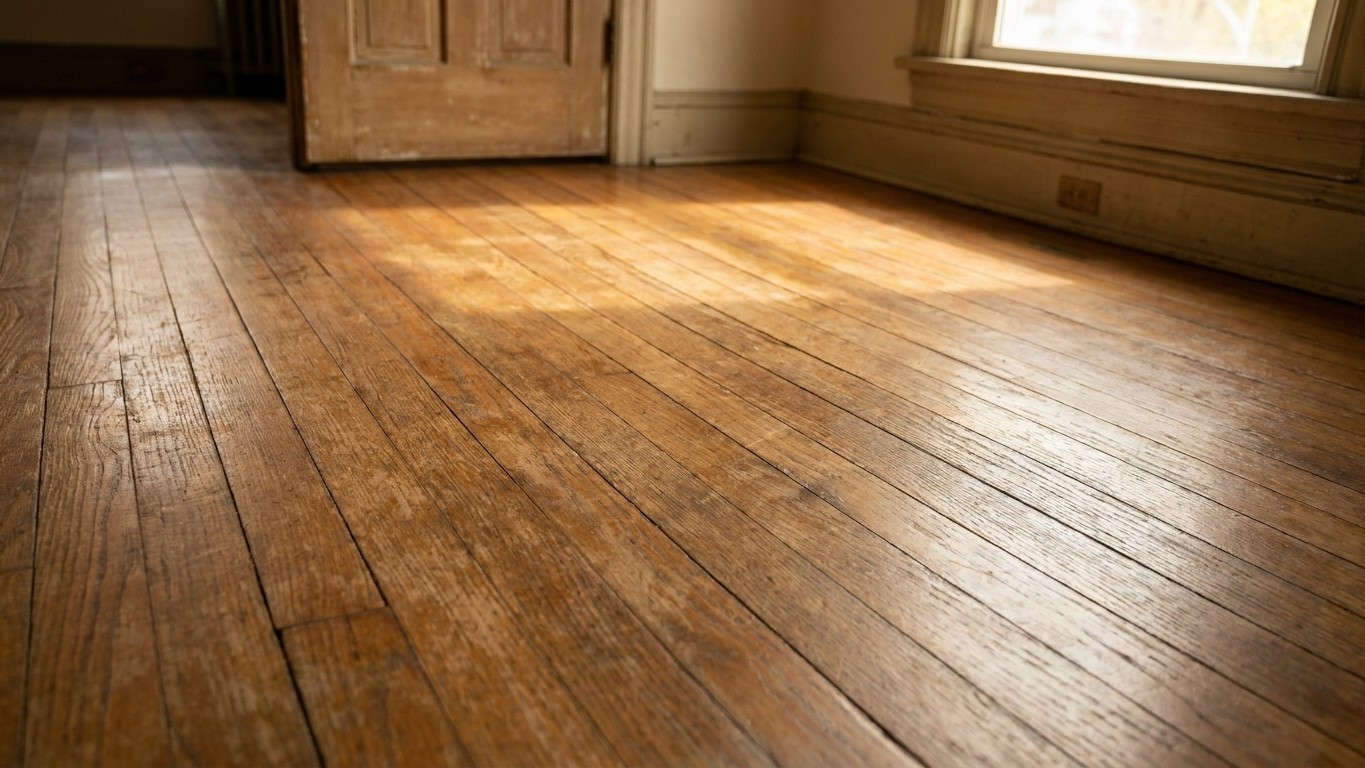

A sloping floor worries people because it looks structural, but most of the time it’s old news: houses settle once, early in their life, and the slope you’re standing on has been there since before you moved in. What separates a floor to ignore from a floor to investigate isn’t the slope itself. It’s whether it’s changing.
What is actually happening

The thing to understand here is that a slope which has been there for decades and one that appeared this year come from different causes, and they don’t look the same once you know what to check.
An old house settles because the ground under it compresses over time, and because wood framing shrinks as it dries out over the first years after construction. That process has a beginning and an end. A house built in the 1920s finished most of its settling by the 1940s. What’s left today is a permanent record, not an active process. The floor tilts toward the middle of the house, or toward one corner, and it has tilted that way for as long as anyone living there can remember. Family lore, old photos, a level laid along the same baseboard ten years apart, all confirm the same number. Nothing is getting worse. That’s the signature of settling, and it’s the reason so many older homes have a floor that dips an inch or two over the width of a room without anything being wrong.
Live movement reads differently. It shows up as a new gap, a door that used to close and now catches on the frame, a crack in drywall that wasn’t there last spring, or a slope that a level confirms is steeper this year than last. This kind of movement usually traces back to something still happening under the house: a foundation footing losing support because water is washing soil out from under it, a wood joist that’s decaying because moisture has been sitting against it, or a support post that’s no longer doing its job. None of these causes stop on their own. They keep moving until whatever is feeding them (water, decay, lost soil) gets addressed.
The distinction matters because the fix is completely different depending on which one you’re looking at. An old, stable slope can often be left alone, or worked around with flooring installation choices that tolerate a gentle grade. A slope that’s still moving needs someone to find out why before anyone touches the floor covering, because covering over an active problem just hides it while it keeps getting worse underneath.
The covering, or what is under it
The rule that matters most in any flooring problem is separating what you can see (the covering) from what you can’t (the subfloor, the joists, the ground below). A slope is a subfloor-and-below problem almost every time; the covering just shows you the result. But a few surface signs help sort which layer is actually talking.
| What you observe | What it usually means | Which layer it belongs to |
|---|---|---|
| Gentle, even slope across a whole room, unchanged for years | Old settling, finished long ago | Foundation history, not the covering |
| Slope that’s worse in one corner or along one wall, and getting more visible | Localized loss of support under that area | Joists, a beam, or a footing below |
| Boards cupped or crowned right where the floor dips | Moisture reaching the covering from below | Subfloor moisture, water source underneath |
| Springy or soft feel underfoot in the sloped area | Wood losing strength, likely from sustained dampness | Joists or subfloor, not the surface material |
| Slope with no cupping, no softness, boards flat and tight | Structure is dry and sound. Slope is just geometry | Historical settling, covering is fine as-is |
That last row is the one worth sitting with, because it’s the outcome for most old-house slopes. The covering can be flat, tight, and dry while the floor underneath it still tilts. In that case, sanding, refinishing, or replacing the surface material won’t change the slope and doesn’t need to. The mistake is treating the covering as the problem when the covering is just reporting on something below it that finished moving generations ago.
The opposite mistake is more costly: refinishing or replacing a floor that’s cupping or feels soft without ever finding out why. A professional flooring installer can sand and finish a cupped board, and it will look perfect for a while. If the moisture that caused the cupping is still there, the new finish cups again, sometimes within a single season. This is the point where a moisture meter comes in, not to produce a number for this page to quote, but so whoever’s doing the work can confirm the subfloor and joists have dried out and stayed dry before any covering goes back down. That test belongs to a flooring contractor or a home inspector, and its only job is to answer one question: is the wood below dry enough to trust, yes or no.
What to check, in order
Before calling anyone, a few checks separate an old, harmless slope from something that needs a professional, and none of them require lifting a board or opening a wall.
- Run a level across the floor and write down the reading. Do this along the same line in six months. If the number hasn’t changed, the slope is old. If it has, something is still moving, and that alone justifies a call to a foundation specialist.
- Check doors and windows in the sloped room. A door that’s always dragged in the same spot for years is consistent with old settling. A door that used to close fine and now sticks, or a window that’s newly hard to open, points to movement that’s active right now.
- Look at the baseboards and drywall corners near the slope. Old, painted-over cracks with rounded, aged edges suggest history. Fresh cracks with sharp, clean edges, or cracks that reopen after being patched, suggest ongoing movement.
- Press on the floor in the sloped area with your palm or walk it slowly in socks. Firm and flat, even while sloped, rules out active decay. Soft, spongy, or bouncy suggests the wood underneath has been compromised, most often by moisture.
- Look at the covering itself for cupping, crowning, or gaps that have opened between boards. A flat, tight surface over a sloped floor supports the old-settling explanation. Cupped or gapping boards suggest a moisture source that needs finding before any covering work happens.
- Check the basement or crawl space, if accessible, for staining on joists, a musty smell, or standing water. This is the last check a homeowner can do alone, and it’s often the one that turns a flooring question into a plumbing or foundation question. This is also the point where the next step, opening up the subfloor or probing the joists with a moisture meter, is a job for someone trained to do it, not a weekend project.
Each of these checks rules something out as much as it points something in. A steady level reading over months, tight doors that have always dragged, and a firm, flat covering together make a strong case for an old, stable slope that needs no repair. Any one of the opposite signs, especially a level reading that’s changing or a floor that feels soft, is reason enough to bring in someone who can look past the covering.
When this stops being a flooring job
Three things end this page and hand the problem to a different trade. The first is anything structural: a joist that’s cracked or sagging, a beam that’s no longer level, or a support post that’s shifted or rotted. That’s a call to a structural engineer or a foundation contractor, not a flooring installer, because the fix involves jacking, sistering joists, or replacing supports, work that changes how the house carries its own weight.
The second is active water. A pipe that’s leaking under the floor, a sump pump that’s failed, or grading outside the house that’s sending rainwater toward the foundation all need a plumber or a general contractor before anyone thinks about flooring. Covering a floor over an active leak guarantees the problem comes back, usually worse, because the wood keeps absorbing moisture the whole time it’s hidden.
If the water’s source is a roof, gutter, or flashing problem feeding down into the floor structure, that’s a job for the roofing and exterior guides on this site, not a flooring fix.
The third is smell. Wood that’s been wet long enough to smell musty or sour has usually been wet long enough to start decaying or growing mold, and at that point the question isn’t cosmetic anymore. A professional will open the area, confirm how far the damage extends, and decide what needs to be cut out and replaced versus what can be dried and saved. That’s a judgment call that depends on seeing the actual wood, not on anything visible from the surface.
A flooring fitter, a plumber, and a structural engineer solve three different problems, and mixing them up wastes time. The flooring fitter can only make the surface look right once whatever’s underneath is confirmed sound and dry. Getting that order right, structure and water first, covering second, is the difference between a repair that lasts and one that has to be done twice.