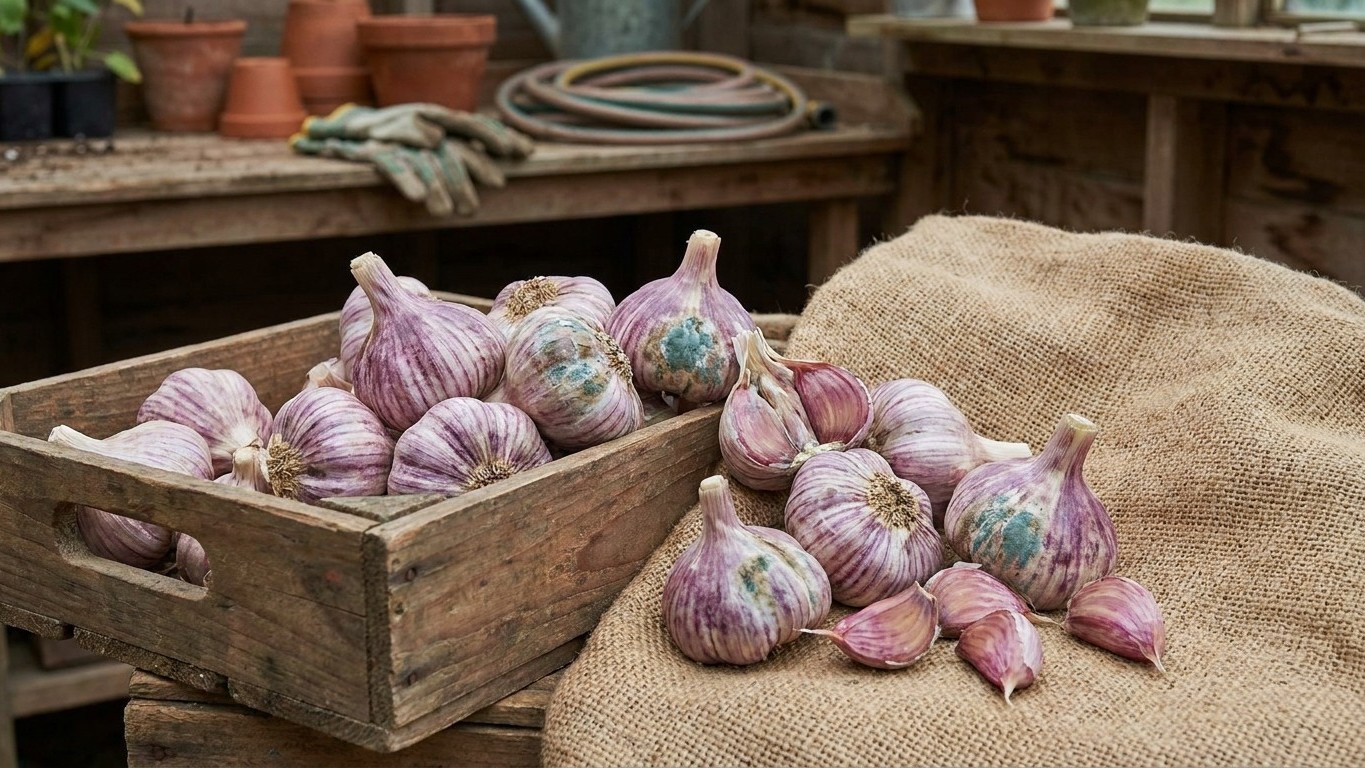

Garlic in Colorado comes out of the ground by the look of its leaves, not by a date on the calendar. When the bottom leaves have browned and dried while several upper leaves are still green, it’s time to lift. Once out, cure the bulbs whole in a shaded, dry, breezy spot for several weeks before trimming and moving them into cool, dark storage for the winter.
When garlic is ready to lift in Colorado
Garlic grown in Colorado follows a long arc that starts the previous fall. Cloves go into the ground before the soil locks up hard, spend the winter dormant under mulch, push up leaves in spring, and finally bulb up through early and mid summer. That fall planting window matters more than most gardeners realize, because it sets the clock for everything that follows. Get the cloves in too late and the root system never establishes before winter; get them in too early and top growth can be lush going into freezing weather, which isn’t what you want either.
For the Front Range and plains around Denver, the average first fall freeze falls between September 30 and October 12, based on NOAA’s 1991-2020 Climate Normals for station USW00003017. That’s a midpoint, not a guarantee: in roughly half of all years, the freeze arrives later than that window, sometimes weeks later. Treat it as a planning reference for fall planting, not a hard deadline. And Colorado’s geography makes any single date almost useless outside the immediate area it describes. Denver sits at 5,280 feet on open plains; a mountain town at 8,000 or 9,000 feet can see its first hard frost in July, and the Western Slope runs on its own separate pattern entirely.
None of that tells you the harvest date itself, because bulb maturity depends on the growing season that follows, on soil temperature, on how much moisture the bed gets, and on which variety went in the ground. What does tell you: the plant itself. Watch the lower leaves. As they yellow and then brown, moving up the stalk one at a time, the bulb below is sizing up and starting to form the papery wrapper it needs for storage. Pulling a test bulb or two and slicing it open is the most reliable check, since a bulb that looks ready from above can still have thin, unformed skins underneath.
Because local timing varies so much by elevation and microclimate, county-level guidance from Colorado State University Extension is worth checking against your own garden’s history rather than relying on a statewide rule of thumb.
Curing it, and where to hang it here
Curing is the step that turns a freshly pulled bulb, still full of moisture, into something that will keep for months. Leave the whole plant intact, roots and stalk attached, and resist the urge to wash off the soil. A soft brush or dry cloth to knock off loose dirt is enough. Wet garlic in storage is garlic that rots.
Lay the bulbs in a single layer or hang them in loose bunches somewhere shaded, dry, and open to air movement. A garage with the door cracked, a covered porch, a shed with a window, or a barn all work, as long as direct sun doesn’t hit the bulbs. That last point matters more in Colorado than in a lot of other states. The state’s high elevation and low humidity mean stronger, more direct sunlight than gardeners moving here from lower, muggier states are used to, and bulbs left in a sunny spot can scorch or cook right through their skins in a single hot afternoon.
Why the dry climate helps, up to a point
Colorado’s low ambient humidity is actually an advantage for curing, since it speeds up the drying process compared to a muggy Southeastern summer. That’s the upside. The downside is that airflow needs to stay gentle rather than forced, and the space needs to stay out of direct sun and away from heat sources, or the outer wrappers can dry and crack before the inside of the bulb has finished curing properly. A bulb with brittle, split skin has lost its main protection against soil organisms and moisture loss in storage.
Curing generally runs several weeks. You’ll know it’s done when the outer skins are fully papery, the neck above the bulb is dry and tight rather than green and pliable, and the roots have shriveled. At that point, trim the roots close and cut the stalk down, leaving an inch or two above the bulb, or braid softneck types if that’s your preference. Set aside any bulb with soft spots, bruising, or mold rather than storing it, since one bad bulb in a bin can spread rot to its neighbors over the winter.
Storing it through a Colorado winter
Once cured and trimmed, garlic wants three things for the months ahead: cool temperatures, darkness, and steady dryness without going to extremes. A basement corner, an unheated closet, a mudroom, or a detached garage that doesn’t freeze solid all tend to work better than a kitchen counter or a spot near a heat vent.
Colorado’s indoor winter air runs dry, sometimes uncomfortably so for people, thanks to the same low-humidity climate that helps with curing. For stored garlic that’s generally a plus, since damp air is what triggers mold and premature sprouting in stored bulbs. The tradeoff is that a heated home in January can also be dry enough to shrivel bulbs faster than a root cellar would. That’s part of why an unheated space, garage shelf, or insulated but unconditioned area often outperforms an indoor pantry for longer-term storage, provided it doesn’t dip below freezing.
Mesh bags, loosely woven baskets, or open crates all beat sealed plastic containers or bags, which trap moisture against the skins. Check stored bulbs every few weeks through the winter and pull any that have started to soften or sprout, since a garlic clove that’s begun putting out a green shoot is drawing on its own stored energy and will keep shrinking from the inside out even while it looks fine from the outside.
Softneck types generally store longer than hardneck types, which is one reason gardeners at higher, colder elevations sometimes lean toward hardneck varieties for the growing season and accept a shorter storage window, while those in milder valley locations plant softneck for a bulb that holds into spring. Either way, save your best, largest, most disease-free bulbs from this year’s harvest as next fall’s seed stock rather than buying new every year, since garlic saved from your own soil tends to adapt to your specific conditions over a few seasons.
What goes wrong here
Most garlic problems in Colorado trace back to one of three points: pulling too early, pulling too late, or storing damp bulbs.
Bulbs lifted too soon, before enough lower leaves have browned, tend to be small with thin, underdeveloped wrappers that won’t hold up in storage. Left in the ground too long past maturity, the opposite happens: the wrapper splits, individual cloves separate and push apart, and the bulb becomes an easy target for soil moisture and rot, especially after a late-summer rain. Neither mistake is obvious until the bulb is out of the ground and cut open, which is why a test bulb partway through the browning process is worth the trouble.
On pest pressure, Colorado State University Extension documents several pests active in the state’s vegetable gardens, including corn earworm, cutworms and seedcorn maggots, flea beetles (Phyllotreta and Epitrix spp.), grasshoppers (Melanoplus spp.), harlequin bug, slugs, spider mites (Tetranychus urticae), spotted cucumber beetle, squash bug (Anasa tristis), and tomato/potato psyllid. Of these, cutworms, seedcorn maggots, slugs, and spider mites are the ones most likely to turn up around a garlic bed, since they work at or below the soil surface or move through mixed vegetable plantings where garlic is often tucked in alongside other crops. A gardener who’s dealing with damage to garlic foliage or roots should compare it against this documented list before assuming a different pest is responsible, since naming the wrong culprit leads to the wrong control approach.
The other common failure has nothing to do with pests or timing: it’s curing garlic in a spot that gets afternoon sun, or storing it in a sealed plastic bag “to keep it fresh.” Both trap heat or moisture against the bulb and undo weeks of careful growing in a matter of days.
Common questions
Can garlic be harvested by counting days from planting instead of watching the leaves?
A day count is a rough starting point at best. Because Colorado’s growing conditions swing so much with elevation, soil, and how a given summer plays out, the leaf-browning pattern on the actual plant is a far more reliable signal than a fixed number of days from fall planting.
Does the same first-frost timing apply across the whole state?
No. The September 30 to October 12 window applies to the Front Range plains near Denver. Mountain towns can see frost far earlier, sometimes in July, and the Western Slope runs on its own pattern. Check conditions for your specific area rather than applying one region’s average statewide.
Is it safe to store cured garlic in the refrigerator?
A cool, dark, dry room or unheated storage space generally works better than a refrigerator, which tends to be more humid than ideal and can encourage sprouting in whole bulbs over time.
Why did the outer wrappers on my bulbs crack during curing?
That’s usually sun or heat exposure during curing rather than anything wrong with the bulb itself. Colorado’s strong, direct sunlight at elevation can dry and split skins fast if bulbs cure anywhere the sun reaches them directly, even briefly.