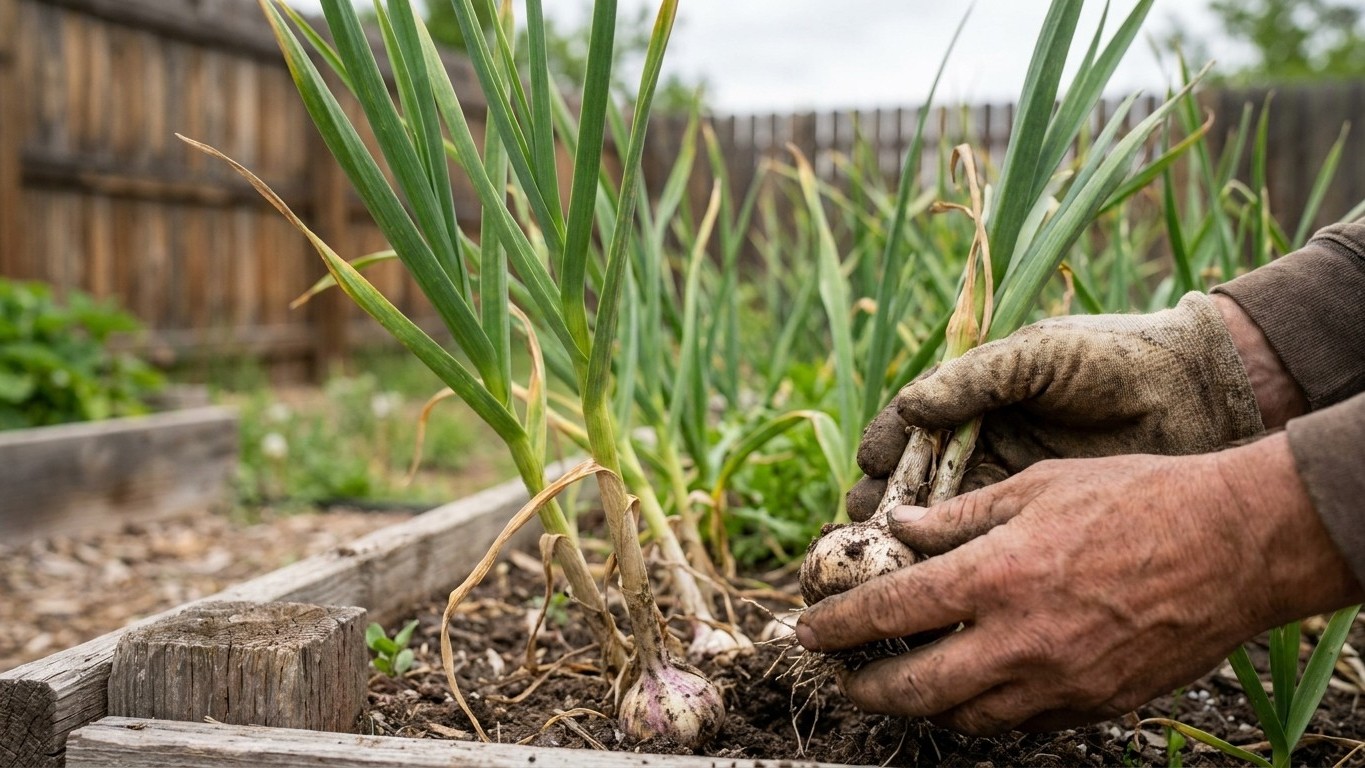

Colorado’s winter gives garlic more cold than it needs, not less. NOAA’s 1991-2020 climate normals put the first fall freeze at the Denver-area reference station between September 30 and October 12, and the season that follows keeps air temperatures below 40°F for well past the six-to-eight-week minimum University of Georgia Extension (publication C854) sets for a clove to split properly. Set cloves in the ground in early to late September, ahead of that freeze, and mulch once the soil starts to firm up with cold.
Will garlic get the cold it needs in Colorado

Garlic doesn’t grow like a typical bulb crop. Plant a clove without enough cold behind it, and instead of a head that splits into eight or ten cloves by harvest, you lift one solid, round bulb the following summer, nothing to peel apart and nothing worth saving for next year’s planting. That cold requirement is why garlic goes in the ground in fall everywhere it’s grown, and it’s the first question worth settling before you pick a variety or a date.
What the cold threshold actually is
University of Georgia Extension (publication C854) puts the minimum at six to eight weeks of air temperatures below 40°F after the clove is planted. Colorado clears that bar with room to spare across almost the entire state. NOAA’s 1991-2020 climate normals put the first fall freeze at the Denver-area reference station in the September 30 to October 12 window, and the cold that follows through winter runs well past the eight-week minimum before spring growth resumes in earnest. Compare that to growing garlic in Connecticut, where a maritime-moderated winter can leave the cold season shorter and less predictable than a gardener expects. Colorado’s continental climate doesn’t have that problem.
If your winter isn’t cold enough
NOAA’s figure comes from one station on the plains at 5,280 feet, and the state doesn’t behave like one climate. Mountain towns can see a hard frost in July and run a cold season on a completely different schedule, while some Western Slope valleys stay milder than the Front Range through much of fall. If you garden in one of those warmer pockets and worry the ground won’t hold cold long enough, refrigerate the cloves at 35-40°F for six to eight weeks before planting to guarantee the vernalization the plant needs, the same workaround growers in genuinely mild-winter states rely on. The simpler fix for most Colorado gardens is to lean on a softneck variety, which divides reliably with less cold than a hardneck demands and gives you a margin of safety if your yard runs warmer than the regional average. For a closer look at which cultivars fit this climate, see Garlic Varieties That Suit Colorado Winters.
When to put the cloves in
Anchor the planting date on the ground freeze, not a month on the calendar. For a full breakdown of When to Plant Garlic in Colorado, know that NOAA’s 1991-2020 climate normals put the first fall freeze at the Denver-area reference station in the September 30 to October 12 window, and that’s a range worth taking seriously as a range: some years the freeze lands early in it, some years late, and no single date describes every Front Range garden, let alone the rest of the state.
Working backward from the freeze
Garlic wants three to six weeks of root growth before the ground locks up solid, enough to anchor the clove and start feeder roots, but not so long that the shoot pushes far above the surface before winter arrives. Counting back from that late September to mid-October freeze window puts the planting date for most Colorado gardens near Denver’s elevation at early to late September, which is exactly the set-out window the varieties below are figured against.
What moves the date
Colorado has no coastline and no lake large enough to moderate frost timing the way the Great Lakes do further east, so elevation and terrain matter more here than in a flatter state. Above roughly 7,000 feet, plan on planting earlier and watching soil temperature rather than the calendar. That contrast is worth naming if you’re comparing this state’s dates to a guide written for somewhere like North Dakota, where the state sits at a fairly uniform, low elevation and the freeze date varies far less from one town to the next. Here, if you’re unsure which side of the elevation split your garden falls on, watch soil temperature at planting depth instead: garlic roots well once soil cools into the 50s Fahrenheit, and waiting for that drop is a more reliable signal than any printed date.
Which types suit Colorado
Hardneck and softneck garlic are not interchangeable, and here the difference matters more than it would in a milder state. Hardneck varieties come from strains bred for a real winter: they send up a stiff central stalk called a scape, produce fewer and larger cloves, and generally taste sharper, but they don’t store much past midwinter. Softneck varieties, the kind sold braided in most grocery stores, tolerate mild winters better and store for eight months or more under the right conditions.
Colorado’s cold removes the usual tradeoff
With a cold season long enough to satisfy even a demanding hardneck strain, there’s no climate reason to default to softneck here the way a mild-winter gardener might. That leaves the choice down to flavor, whether you want a scape harvest (softneck rarely gives you one), and how long the crop needs to keep in storage. A garden that gets both types in the ground hedges on all three.
Varieties for Colorado, by type
| Variety | Type | Set-out window |
|---|---|---|
| Early Red Italian | Softneck | Early to late September |
| Inchelium Red | Softneck | Early to late September |
| Italian Late | Softneck | Early to late September |
| Lorz Italian | Softneck | Early to late September |
| Bavarian Purple | Hardneck | Early to late September |
| Blue Music | Hardneck | Early to late September |
| Chesnok Red | Hardneck | Early to late September |
| Duganski | Hardneck | Early to late September |
| Fall Festival | Hardneck | Early to late September |
| Georgian Crystal | Hardneck | Early to late September |
| Georgian Fire | Hardneck | Early to late September |
| German Red | Hardneck | Early to late September |
| German White | Hardneck | Early to late September |
| Ivan | Hardneck | Early to late September |
Among the hardnecks, Chesnok Red and German Red are widely grown purple-stripe types with a milder flavor cooked than raw, while Duganski and Georgian Fire lean toward the hotter, more pungent end of the range. Among the softnecks, Inchelium Red and Lorz Italian are the better pick if long storage into next spring matters more to you than a scape harvest, since softneck bulbs generally outlast hardneck bulbs in the pantry.
Soil and bed preparation
Garlic sits in the same patch of ground for eight or nine months, through the wettest and coldest stretch of the year, so drainage matters more here than almost anything else you control. A clove sitting in saturated soil through a wet spring thaw rots before any disease gets involved. If your soil is heavy clay, common along much of the Front Range, raised beds or a mounded row four to six inches above grade solve the problem outright and are worth building before planting rather than after a rotted crop turns up in July.
Feeding and structure
Work compost into the bed a few weeks before planting, not fresh manure, which can burn young roots and carries its own mild disease risk. Garlic feeds heavily over its long season, and organic matter improves drainage in clay soils while helping the sandy, fast-draining soils found in other parts of the state hold moisture better. Many Colorado soils run alkaline, and garlic does best in soil that isn’t extreme in either direction, so a soil test before amending is worth more than guessing at lime or sulfur.
Break up compaction to a full spade depth before planting. Garlic roots aren’t aggressive, and a hardpan a few inches down will stunt the bulb even if the topsoil looks fine. Rake the bed level, pull out rocks and old root debris, and plant into loose, crumbly soil rather than a bed that was worked wet and has since dried into clods, which garlic roots struggle to push through.
What the climate here favours, and what it does not
UC IPM’s Pest Management Guidelines for Onion and Garlic (UC ANR Publication 3453) publish temperature ranges for the pathogens behind the worst garlic diseases. Measured against Colorado’s growing season, air temperatures here spend real time inside two of those ranges and stay outside the other two, though what that means takes some care to state correctly.
Where the pressure is real
White rot, caused by Sclerotium cepivorum, is the one to watch most closely. UC IPM lists its active range as 50-75°F, and Colorado’s mean air temperature falls inside that window in five separate months of the growing season, September, October, May, June and July, with one of those months landing right at the disease’s published optimum. That’s a wide stretch of the season sitting in range for a pathogen with no effective in-season cure and sclerotia that persist in soil for years once introduced. Fusarium basal rot (Fusarium oxysporum f. sp. cepae) needs warmer conditions, 59-90°F, and Colorado’s mean air temperature lands inside that range in three months: September, June and July.
Where it isn’t
Southern blight and pink root both have narrow optimum ranges, 86-95°F and 75-85°F, that no month of the Colorado growing season’s mean air temperature reaches. That doesn’t mean either disease is impossible here, just less active outside its optimum: both travel on infected seed garlic or in contaminated soil regardless of what the climate favors, and a hot stretch can push local conditions into range even in a state whose averages run below it. Two caveats matter more than any of these numbers. UC IPM’s thresholds are published as soil temperatures, while everything counted above is air temperature, which swings wider and faster than the soil a clove actually sits in, and a monthly mean hides its own range, a month averaging 65°F holds cold mornings and hot afternoons alike. None of this predicts infection in any specific garden. It says where the odds lean, which is why clean, certified seed garlic and a bed that drains fast after snowmelt matter more than any spray once white rot is established in soil.
Getting it through the winter
Mulch is what separates a bed that overwinters cleanly from one that heaves cloves half out of the ground by March. Lay four to six inches of straw or shredded leaves once the top inch of soil has started to firm up with cold, generally a few weeks after planting rather than right away, since mulching too early traps warmth and can push soft top growth you don’t want heading into winter.
Why heaving happens here
Freeze-thaw cycling, not the depth of the cold itself, is what heaves garlic out of the ground on the Front Range. A hard freeze followed by a warm, sunny stretch that thaws the top few inches, then another freeze, is a normal winter pattern here. A clove planted at the recommended two to three inches deep and covered with mulch is buffered from most of that cycling. A clove planted shallow, or left bare, can work itself halfway out of the soil by spring, exposing the bulb’s top to cold and drying wind.
Leave the mulch in place through winter and into very early spring. Once green shoots start pushing through, pull the mulch back to a thinner layer rather than removing it outright, enough to let the soil warm and shoots grow freely while still holding moisture and suppressing weeds through the rest of the season. Stripping mulch entirely at that point exposes the bed to Colorado’s spring wind, which dries soil fast at this elevation and can stress young garlic right when it’s building the root system it will bulb from later in summer.
Harvest and curing here
Watch the plant, not the calendar. Garlic is ready to lift when the lower third to half of the leaves have browned and dried while the top few stay green, usually sometime in mid-summer here rather than on a fixed date, since a cool wet spring or a hot dry one shifts the timeline a couple of weeks either way. Pull a test bulb or two and check the wrapper. It should still be tight and papery, with distinct cloves visible underneath, not splitting apart.
Curing in a dry climate
Colorado’s low humidity is an advantage for curing, not a complication. Cure bulbs out of direct sun, in a shaded, airy spot with good cross-ventilation, for two to four weeks, leaves and roots still attached, until the outer wrappers are fully dry and papery and the neck has tightened down completely. Direct sun at this elevation is intense enough to scald bulbs left curing outdoors uncovered, even for an afternoon, so cure under a porch roof, in a garage with the door open, or in a shed rather than laid out in the open yard.
In a genuinely humid climate, growers fight mold through the whole curing process. Here the risk runs the other way: bulbs can dry too fast on the outside while the neck and core still hold moisture, which traps rot inside a bulb that looks finished from the outside. Cure with airflow but out of the hottest, driest part of the day if you’re in one of the state’s hot, low-humidity summer locations, and cut across the neck of a few bulbs to check before committing the whole harvest to long-term storage.
Local help
For county-level planting dates, soil testing and variety performance specific to your part of the state, contact Colorado State University Extension. Extension soil tests will tell you exactly where your garden’s pH and drainage stand, information no state-wide guide can give you, and county agents track which practices have actually held up at your elevation.
Common questions
Can I Plant Garlic in spring instead of fall in Colorado?
Not if you want a real head of cloves. Spring-planted garlic misses most or all of the cold period that triggers clove division, and the usual result is a single small round bulb rather than a head. Fall planting, timed to the first freeze window described above, is standard practice for a reason.
I missed the early-to-late September window. Can I still plant in October?
You can, as long as the ground isn’t frozen solid, but you’re cutting into the root-establishment time the clove needs before the first freeze. A late-planted clove that hasn’t rooted well going into winter is more vulnerable to heaving and to drying out, so mulch heavier and earlier than you would for a September planting.
Do I need to cut the scapes off my hardneck garlic?
Cutting the scape, the curling stalk hardneck varieties send up in early summer, redirects the plant’s energy into the bulb instead of the stalk, and most growers report a noticeably bigger head as a result. The scapes themselves are edible and good in cooking, so cutting them isn’t wasted effort either way.
Can I just plant garlic from the grocery store?
You can, but it’s a gamble. Grocery store garlic is rarely labeled by variety, is sometimes treated to inhibit sprouting, and carries no guarantee against soilborne diseases like white rot, which can persist in a bed for years once introduced. Certified seed garlic from a known source costs more per clove but removes that risk.
My garlic came up as one big clove with no head. What happened?
That’s a round, and it almost always means the clove didn’t get enough cold before or during the growing season, or it was planted too late in spring rather than fall. It’s not a lost cause: a round can be replanted the following fall and will usually divide normally into a full head once it gets a proper cold season behind it.