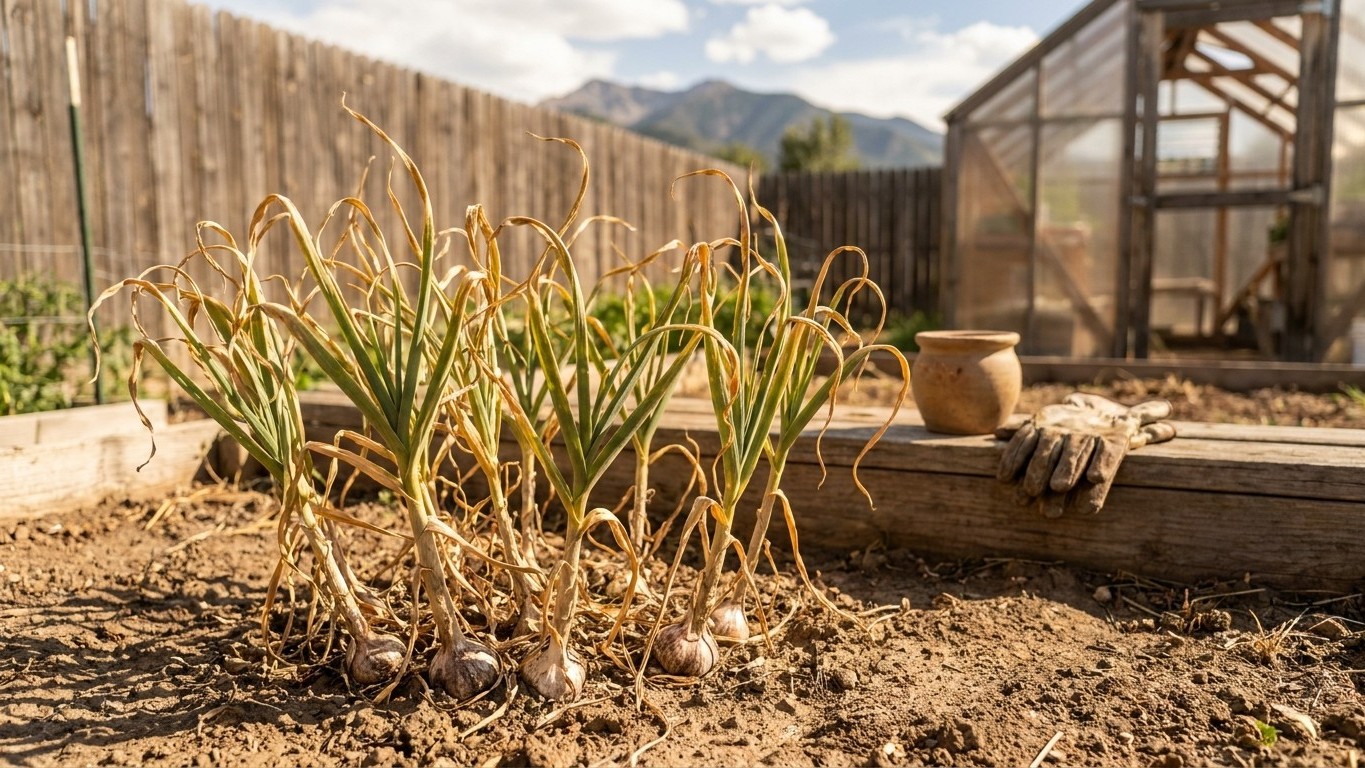

Garlic goes in the ground early September to late September, no matter which variety you’re holding. That’s the whole answer, but your yard still needs a specific week inside it, not the whole month. Start by figuring your own first-frost date, then count back from there: if you’re up in the foothills or anywhere above the Front Range plains, move your planting a week earlier than someone gardening down in Denver, because cold reaches you first and the clove needs those weeks of root growth before the ground shuts down for winter.
The short answer for Colorado

Plant garlic in Colorado between early September and late September, for softnecks like Inchelium Red and hardnecks like German Red alike. That window is not arbitrary. It is counted back from the average first fall frost, which NOAA’s National Centers for Environmental Information puts at September 30 to October 12 for the Denver-area station used in the 1991-2020 climate normals (USW00003017). Cloves set out in that September range get several weeks of root growth in cooling soil before the ground locks up, without pushing enough top growth to get bitten by an early hard freeze.
Every cultivar in the closed list below lands on the same September window, because the frost anchor used to calculate it is the same for all of them. What changes between varieties is not the calendar but storage life, clove count, and heat, covered in Garlic Varieties That Suit Colorado Winters.
| Variety | Neck type | Set-out window (Denver-area) |
|---|---|---|
| Early Red Italian | Softneck | Early September to late September |
| Inchelium Red | Softneck | Early September to late September |
| Italian Late | Softneck | Early September to late September |
| Lorz Italian | Softneck | Early September to late September |
| Bavarian Purple | Hardneck | Early September to late September |
| Blue Music | Hardneck | Early September to late September |
| Chesnok Red | Hardneck | Early September to late September |
| Duganski | Hardneck | Early September to late September |
| Fall Festival | Hardneck | Early September to late September |
| Georgian Crystal | Hardneck | Early September to late September |
| Georgian Fire | Hardneck | Early September to late September |
| German Red | Hardneck | Early September to late September |
| German White | Hardneck | Early September to late September |
| Ivan | Hardneck | Early September to late September |
Remember that a frost date is a midpoint. In roughly one year out of two, the first freeze at the Denver-area station arrives after October 12, and in the other half it arrives before September 30. Lean toward the later edge of the planting window if your fall is running warm, and the earlier edge if a cold snap is already showing up in the forecast.
Working it out for your own garden
The early-September-to-late-September planting window comes from lining up the catalog planting guidance for these cultivars against the Denver-area frost window. NOAA’s 1991-2020 normals put the first fall frost near Denver at September 30 to October 12. Measured from the start of the planting range to the start of the frost window, that gap runs about four weeks. Measured from the end of the planting range to the end of the frost window, the gap runs closer to two weeks. So the practical rule this territory works on is to set garlic out roughly two to six weeks ahead of your local first-frost window, not on a single fixed date.
Redoing the math for your district
That two-to-six-week span is the number to carry with you if you garden outside the Denver metro area, because the frost window itself moves once you leave the plains. If you already know your own first-frost range, from a nearby weather station or from your county extension office, subtract that same two to six weeks from the early edge of your own range to find your own planting window. A garden that sees its first frost three weeks ahead of the Denver-area station needs its garlic in the ground three weeks earlier too. This is arithmetic on a range, not a single day, so a two-week frost window still produces a two-week planting window once you shift it.
Before you get to counting dates, make sure the bed itself is ready. Garlic wants loose, well-drained soil and a full season without weed competition, which is worth sorting out before clove delivery rather than the week you plant. If you haven’t worked through bed prep, spacing, or where garlic fits in a rotation, the fundamentals are laid out in Growing Garlic in Colorado.
Elevation is the biggest single reason this arithmetic produces a different answer from one Colorado garden to the next. Air temperature drops as elevation climbs, and a garden a few thousand feet above the Denver-area station’s roughly 5,280 feet will typically see its first frost arrive earlier in the fall, sometimes by weeks rather than days. Cold air also pools in low mountain valleys and drainages on calm nights, so two gardens at similar elevation can still see different frost timing depending on whether cold air collects there or drains away.
What changes across Colorado
The September planting window above is built on one weather station near Denver, and Colorado’s terrain makes that a poor stand-in for the rest of the state. The Front Range plains, including Denver at roughly 5,280 feet, are the mildest and latest-frost part of the state covered by NOAA’s normals used here. Move into a mountain town and the growing season compresses fast, with frost arriving as early as July in some locations, months ahead of the Denver-area window.
Mountain towns and the western slope
The western slope runs on a different clock again. It sits on the far side of the Continental Divide from the Front Range station, under a different weather pattern, so a first-frost date pulled from the Denver normals tells a western-slope gardener very little about their own ground. Do not use the Denver-area window as a stand-in for a mountain or western-slope garden. It was measured on the plains, and it describes the plains.
Even within the eastern plains, local terrain matters. A garden sitting low in a drainage or a valley bottom collects cold air on calm, clear nights and can see frost noticeably earlier than a garden on a nearby rise, even a few miles apart at similar elevation. Wind exposure plays a role too. A site open to a steady fall wind loses heat differently than a sheltered backyard bed, which is part of why two gardeners in the same town can compare notes and still get different results from the same variety planted on the same day.
None of this changes the two-to-six-week arithmetic from the section above. It changes what you plug into it. A grower in a mountain valley or on the western slope needs their own first-frost figure, not the Denver-area one, before running that count backward.
The mistakes this climate punishes
Colorado’s high, dry, wide-swing climate does not forgive the same mistakes a milder state shrugs off. A few come up again and again.
- Planting too late for the window, so the cloves don’t root deeply before the ground locks up, since the first-frost date is a midpoint and half the years see frost arrive before October 12.
- Planting too shallow or skipping mulch, so the clove dries out fast in the wind and low humidity, or gets pushed toward the surface by repeated freezing and thawing over winter.
- Waiting out a warm September, which can push a clove into growing top growth instead of just roots before the first hard freeze arrives.
Disease pressure doesn’t take a season off
Cold winters do not sterilize the ground. According to UC ANR’s UC IPM Pest Management Guidelines for onion and garlic, white rot (Sclerotium cepivorum) is active across a published 50-75°F soil temperature range, and Colorado’s growing-season air temperature falls inside that range in five separate months, including one month at the pathogen’s published optimum. Fusarium basal rot (Fusarium oxysporum f. sp. cepae) has a published range of 59-90°F, and Colorado’s air temperature falls inside it in three months of the growing season.
Those are air-temperature counts measured against soil-temperature thresholds, and a monthly average hides plenty of day-to-day swing, so treat this as a reminder rather than a forecast. Southern blight (Sclerotium rolfsii) and pink root (Setophoma terrestris) have optimum ranges that no Colorado growing-season month reaches on average, but a mean temperature outside the optimum makes a disease less active, not impossible, and infected seed cloves carry these pathogens into any climate that grows garlic. Clean seed stock does more for you here than the calendar does.
Checking this against your county
Everything above is built on one NOAA station near Denver, and Colorado’s counties span plains, foothills, high mountain valleys, and the western slope. Before you commit to a planting date, check your own county’s frost data and local garlic guidance through Colorado State University Extension, which runs county offices across the state staffed by people who know their own local ground better than a single Front Range station can. If your county office publishes its own frost-date range, use that range and run the same two-to-six-week count backward from it rather than from the Denver-area figure used in this article.
Common questions
Is it too late to Plant Garlic if I miss the September window?
Not necessarily, but the margin for error shrinks fast. Garlic planted into October can still root before a hard freeze in a mild year, since the Denver-area frost window runs from September 30 to October 12 and frost sometimes arrives later than that. Get a clove in as soon as you can once you’re past the window, and mulch heavily to buy the roots more time.
Can I plant garlic in spring instead of fall in Colorado?
You can, but expect smaller bulbs. Garlic needs a period of cold to divide properly into cloves, and a fall planting gives it a full winter of chilling before spring growth starts. Spring-planted garlic skips most of that cold period and often bulbs up small, sometimes without dividing into cloves at all.
Do I need to mulch garlic beds over winter here?
Mulch helps more in Colorado than in wetter, milder states. Low humidity and freeze-thaw winters both work against a shallow-rooted clove, and a mulch layer over the row buffers moisture loss and reduces the heaving that pushes cloves toward the surface as the ground freezes and thaws.
Does elevation really change the planting date that much?
Yes, more than most other factors in this state. NOAA’s frost normals used in this article come from a station near Denver at roughly 5,280 feet, and mountain towns at higher elevation can see frost arrive weeks earlier, in some cases as early as July. If you garden well above the Front Range plains, treat the Denver-area window as a starting point to adjust, not a date to copy.
The Moon calendar is a separate, older custom: see when to plant garlic by the moon, written as tradition rather than fact.