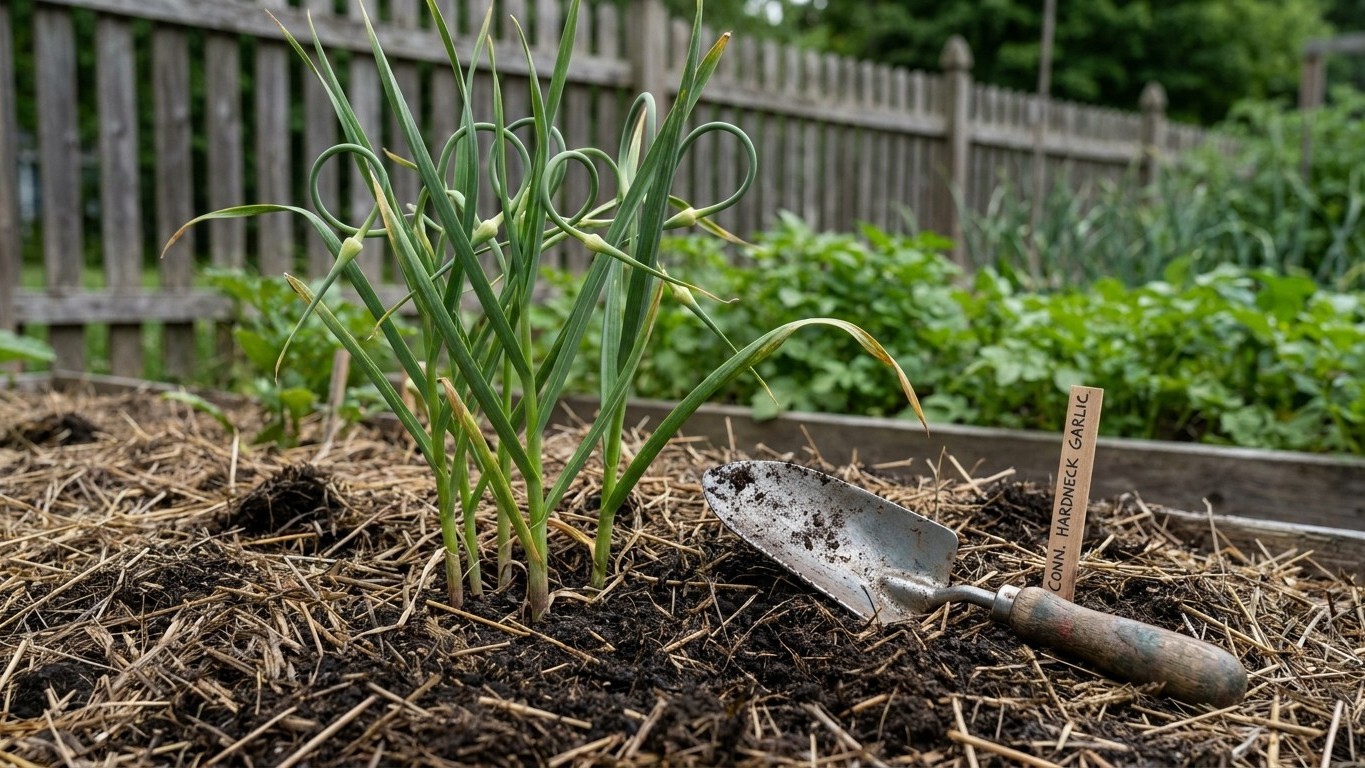

Bridgeport’s own freeze record refuses to sit still: half the time the first hard cold snaps in before October 28, half the time it waits past November 10. That’s a wider swing than gardeners in steadier climates ever have to plan around, and it’s why the usual “plant a month before frost” rule gets fuzzy here. Connecticut’s answer works backward from that unstable date instead of forward from it, landing on a window in early to mid-October regardless of whether you’re setting softneck or hardneck cloves.
The short answer for Connecticut

Plant garlic in Connecticut between early October and mid October. That window holds for softneck types like Inchelium Red and hardneck types like German Red alike, and it’s built backward from NOAA’s 1991-2020 climate normals for the Bridgeport station (USW00094702), which put the first fall freeze between October 28 and November 10. Garlic wants three to four weeks of root growth in unfrozen soil before the ground locks up for winter, so the planting date sits ahead of the frost window rather than on top of it.
That October 28 to November 10 span is a midpoint, not a guarantee. In roughly one year out of two, the first freeze at Bridgeport arrives later than November 10, and in the other half it arrives earlier than October 28. Treat the range as the center of the distribution, not a date you can circle on the calendar and trust.
All fourteen garlic cultivars sold for Connecticut gardens land in the same early-to-mid-October window once you cross their catalogue days-to-maturity figures with this frost range. Type doesn’t move the planting date. It moves which one survives a particular winter, which the later sections cover.
| Variety | Type | Set-out window |
|---|---|---|
| Early Red Italian | Softneck | Early to mid October |
| Inchelium Red | Softneck | Early to mid October |
| Italian Late | Softneck | Early to mid October |
| Lorz Italian | Softneck | Early to mid October |
| Bavarian Purple | Hardneck | Early to mid October |
| Blue Music | Hardneck | Early to mid October |
| Chesnok Red | Hardneck | Early to mid October |
| Duganski | Hardneck | Early to mid October |
| Fall Festival | Hardneck | Early to mid October |
| Georgian Crystal | Hardneck | Early to mid October |
| Georgian Fire | Hardneck | Early to mid October |
| German Red | Hardneck | Early to mid October |
| German White | Hardneck | Early to mid October |
| Ivan | Hardneck | Early to mid October |
Working it out for your own garden
The Bridgeport figures are useful only as a starting point. If you haven’t chosen a bed or worked compost into the soil yet, that step comes before this one: see Growing Garlic in Connecticut for how to prepare a bed that drains well over winter. Once the bed is ready, the planting date itself is arithmetic you can redo for your own yard.
The arithmetic
Start with NOAA’s Bridgeport normal: first fall freeze between October 28 and November 10. Garlic cloves need three to four weeks of root development before the soil freezes hard enough to stop root growth, though the shoot above ground can keep growing later and tolerates hard frost with no damage. Count back three to four weeks from the start of that window, October 28, and you land in late September to early October. Count back the same three to four weeks from the end of the window, November 10, and you land in mid to late October. Splitting the difference across both ends of the range is how the early-October-to-mid-October planting window above was built, and you can run the same exercise for your own town once you know its own normal first freeze.
Why your yard might differ
Three things move a site’s effective planting date away from the Bridgeport figure even within the same county: elevation, distance from open water, and how the ground drains overnight. A garden two hundred feet higher than the valley floor cools faster after sunset and holds frost pockets that a low-lying, water-adjacent yard never sees. A bed close to Long Island Sound or a large lake benefits from the water’s stored summer heat radiating back out through fall, which is part of why Bridgeport’s own reading skews late and mild compared with inland stations. None of this changes the arithmetic, only the date you plug into it.
Soil freezes later than the air above it, which is part of the reason garlic can go in even after a light frost has blackened the tomato vines. What matters is whether the ground is still workable and unfrozen, not whether the calendar has crossed the frost date. A soil thermometer pushed four inches down tells you more than a forecast does.
What changes across Connecticut
Connecticut runs from a warm coastline to hill country in the northwest, and garlic’s fall planting window moves with that terrain. The Litchfield Hills and the northwestern corner of the state sit at higher elevation and further from the moderating effect of open water, so frost typically arrives there well ahead of the coastal reading NOAA takes at Bridgeport. Gardeners in that region should plan to plant nearer the early end of the early-to-mid-October window, or earlier still, rather than assuming the Bridgeport range applies unchanged.
The immediate shoreline along Long Island Sound, from Greenwich through New London, runs in the other direction. Water retains summer heat and releases it slowly through autumn, which is why the Bridgeport station reads mild and late compared with inland Fairfield or New Haven county towns just a few miles back from the coast. Gardens right on the Sound can often push planting toward the later half of the window, or slightly beyond it, without losing the three to four weeks of root time garlic needs.
The Connecticut River valley, running north through Hartford and up toward Massachusetts, behaves differently again. Its lower ground pools cold air on still nights even though the latitude sits mid-state, so valley-floor gardens sometimes see frost closer to the inland pattern than to the coastal one despite being roughly the same distance from the shore as milder towns nearby. Local pattern matters more than latitude in a state this compressed: two towns at the same distance from the Sound can differ by a week or more depending on elevation and air drainage alone.
The mistakes this climate punishes
Connecticut’s winters vary enough from year to year that two opposite mistakes both show up in the same garden depending on the season. Planting a tender softneck in a harsh, exposed inland spot with no mulch invites winterkill in a cold year. Planting too late, or too shallow, is the mistake that costs a crop in almost any year no matter how mild the winter turns out.
Timing and depth
Cloves set in after mid-to-late October have less than the three to four weeks of root time garlic needs before the ground firms up. A clove that hasn’t rooted going into winter is far more likely to heave out of the soil during freeze-thaw cycles or fail to break dormancy strongly in spring. Shallow planting compounds the problem: a clove sitting two inches deep with a thin mulch layer sees far more temperature swing than one sitting four inches down under three or four inches of straw. If you’re deciding between a softneck like Italian Late or a hardneck like Duganski for a particularly exposed site, hardnecks generally tolerate harder winters better, though both need the same mulch protection here. The variety pages at Garlic Varieties That Suit Connecticut Winters break down which cultivars handle exposure best.
Soil-borne disease risk
Timing mistakes aren’t the only climate-linked risk. UC IPM’s guidelines for onion and garlic, UC ANR Publication 3453, put white rot‘s active soil temperature range at 50 to 75°F, a band Connecticut’s mean air temperatures fall inside during five months that overlap the garlic season: September, October, May, June and July. Fusarium basal rot‘s published range of 59 to 90°F overlaps four of those same months. Air temperature isn’t soil temperature, and a monthly average hides plenty of days on either side of it, but the overlap means neither disease is climatically excluded here in the way a grower might assume.
The real control is seed stock, not the calendar. Buy certified disease-free cloves rather than replanting from a bed of unknown history, since both pathogens travel in infected garlic far more reliably than they develop fresh from bare soil. Southern blight and pink root need soil temperatures Connecticut rarely sustains as a monthly average, but a single hot, wet stretch can still push a bed into their optimum range for days at a time. A zero-month count for those two is not a guarantee of absence, only a lower likelihood.
Checking this against your county
Bridgeport is one station on the Long Island Sound coast, and it’s the mildest reading you’ll find in the state. If you garden in Litchfield, Windham, or the higher parts of Hartford County, treat the October 28 to November 10 frost range as a floor to work backward from, not a figure to copy directly. UConn Extension tracks county-level growing conditions and can point you to a frost record closer to your own town than a coastal airport station. Check UConn Extension before locking in a planting date if you garden anywhere outside the immediate coastline.
Common questions
Is it too late to Plant Garlic if it’s already November?
Not necessarily, as long as the ground is still soft enough to work. Garlic planted with less than the usual three to four weeks of root time before hard freeze often survives, but expect smaller bulbs the following summer since the roots had less of a head start.
Does a hard frost kill newly planted garlic cloves?
No. Garlic is planted specifically to sit through winter cold, and established cloves tolerate freezing air without damage once mulched. The frost date matters for timing root growth before the ground freezes solid, not for protecting the clove itself from cold air.
Can I plant hardneck and softneck garlic on the same date?
Yes, both types go in during the same early-to-mid-October window. The difference between them shows up in winter survival on exposed, cold sites, not in when you set them out.
What if I don’t know my town’s frost date?
Bridgeport’s NOAA normal is a coastal, mild-end reference, and it will understate frost risk for most inland and northwestern towns. Ask your local extension office for a frost record closer to home rather than assuming the coastal figure applies to your garden.
If you follow the almanac, here is when to plant garlic by the moon. It is a tradition, not a proven method.