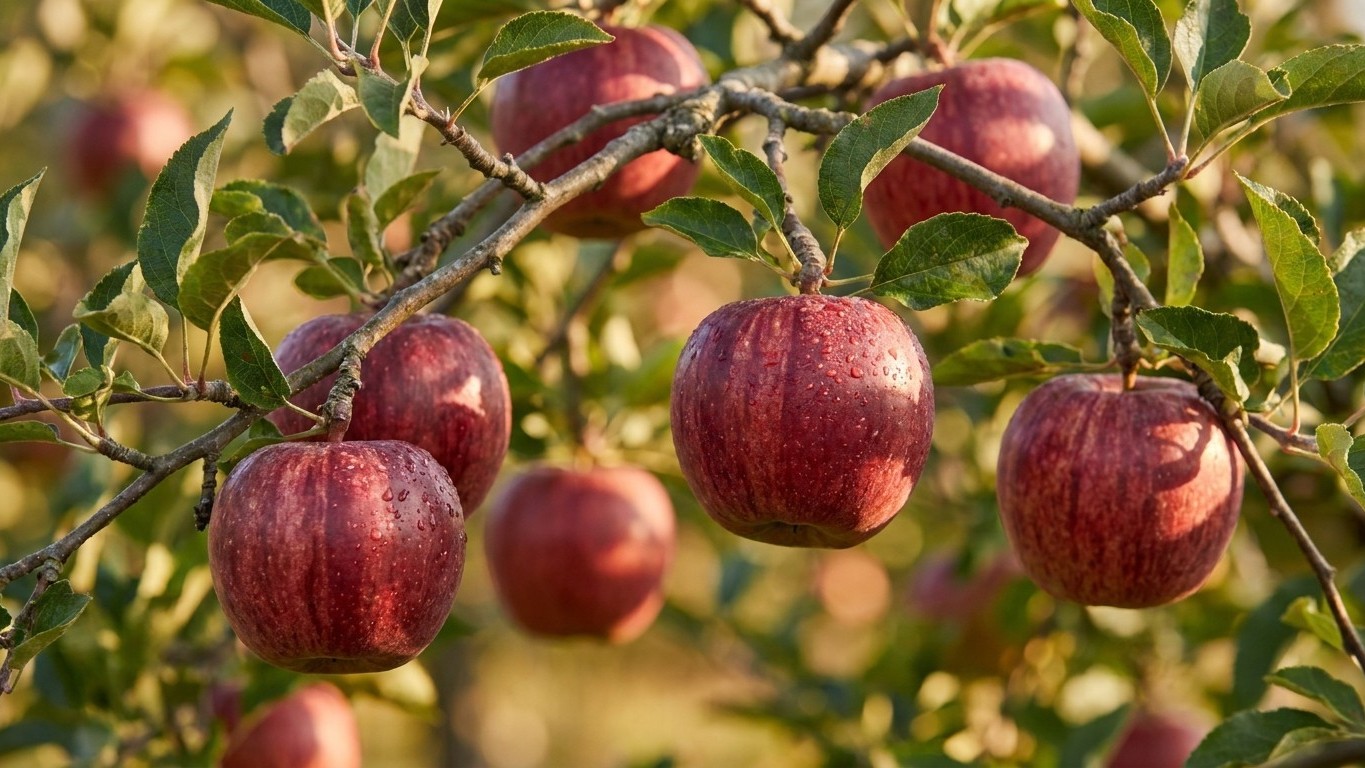

Because lowland Hawaii never gets a real winter, there is no frost date to build a harvest calendar around. Apples here are picked by watching the fruit itself, not the month, and once picked they don’t keep long in island heat unless you get them into a refrigerator fast. Growing them at all means working at elevation, and even then, expect a short storage window measured in weeks, not months.
When apples are ready to pick in Hawaii
Most of the mainland’s apple-timing advice starts with a frost date. That approach doesn’t work here. NOAA’s 1991-2020 Climate Normals for station USW00022521 flag every freeze percentile at 32°F and 36°F as not computable, with zero days per year at or below freezing. There is no spring frost to count forward from and no fall frost to count back from in any place people actually garden. Frost exists only on the summits of Mauna Kea, Mauna Loa, and Haleakala, thousands of feet above where a home orchard would sit.
That absence changes how you read a tree. Instead of counting weeks from a last-frost date, you watch the fruit’s own stage: does the background color under the blush shift from green to yellow, does the fruit separate from the spur with a gentle twist, has the flesh firmed up rather than staying starchy. Those signs move around by variety and by growing site, and in Hawaii they move around more than usual because bloom itself is irregular.
Why bloom timing is the real wildcard
The mean daily minimum temperature for the coldest month at the Honolulu reference station is 66.8°F, per NOAA NCEI’s 1991-2020 Climate Normals. Chill accumulation for deciduous fruit trees is typically counted in the range well below 45°F, so a coldest-month minimum sitting at 66.8°F tells you lowland Hawaii is not banking meaningful chill hours in an average year. Without that accumulated cold, dormancy release and bloom become uneven: some branches flower, others sit dormant, and fruit set follows whatever bloom did happen. That unevenness is the reason a fixed calendar date fails here more than it would in a climate with a defined winter.
Elevation is the workaround growers actually use. Higher-elevation garden areas on Maui and Hawaii Island run cooler nights than Honolulu, which is why home apple plantings tend to cluster there rather than at sea level. The University of Hawaii’s Cooperative Extension Service, run through CTAHR, is the land-grant extension body for the islands, but it does not publish a variety-by-variety apple harvest calendar for Hawaii the way corn-belt extension offices do for tree fruit. If you’re looking for a published pick-by date for a named elevation and variety, that document doesn’t appear to exist yet, and it’s more honest to say so than to invent one.
Which ones keep, and which must be eaten
Two separate questions get conflated when people ask if an apple variety “works” in Hawaii: will the tree survive, and will it flower and fruit properly. Hardiness, whether the wood tolerates the winter it’s given, is not a concern at all in lowland Hawaii, since the coldest month minimum of 66.8°F is nowhere near damaging for apple wood. Winter chill is the real filter. A variety bred for a cold climate may survive fine here and simply never bloom well, because it never receives the accumulated cold its dormancy is built around.
That’s why growers who succeed at all in Hawaii lean toward low-chill selections, developed for regions like the American South or parts of California that also fall short of classic apple-country winters. Here is the trade-off worth being blunt about: a low-chill variety breaks dormancy on a smaller amount of accumulated cold, which means it tends to flower earlier in its cycle than a high-chill variety would. On the mainland, that earlier bloom is a real gamble, because it can walk straight into a late spring frost. In Hawaii’s inhabited areas, that particular gamble doesn’t apply, since NOAA’s data shows no freeze occurs there at all. The risk you’re actually taking with a low-chill variety in Hawaii isn’t frost, it’s inconsistent fruit set from bloom that never fully synchronizes, since even low-chill types still need more cold than a 66.8°F coldest-month minimum reliably supplies.
What that means for the fruit in your hand
Variety selection also shapes how long the apple sits on a counter once it’s off the tree. As a general rule in apple growing, low-chill, softer-fleshed selections tend to be short-keepers, best eaten within days to a couple weeks, while firmer, high-chill types are the ones that store for months in cold storage. Since Hawaii’s climate pushes growers toward the low-chill end of that spectrum, most homegrown Hawaii apples fall into the eat-soon category by nature of the variety, not just the climate they’re stored in afterward.
| Trait | Low-chill variety | High-chill variety |
|---|---|---|
| Fits Hawaii’s near-zero chill accumulation | Better fit | Poor fit, bloom likely erratic |
| Bloom timing | Earlier in the cycle | Later, needs more accumulated cold first |
| Typical flesh and keeping quality | Softer, shorter shelf life | Firmer, longer shelf life |
| Frost exposure risk from early bloom | Not applicable in inhabited Hawaii (no freeze occurs) | Not applicable in inhabited Hawaii (no freeze occurs) |
Storing them through a Hawaii winter
There isn’t a Hawaii winter in the storage sense that matters for apples. Classic long-term apple storage relies on getting fruit into air that sits in the low-to-mid 30s Fahrenheit with high humidity, conditions a root cellar or unheated garage can approximate on the mainland once outdoor temperatures drop. With Honolulu’s coldest month averaging a daily minimum of 66.8°F, there is no season where island ambient air gets anywhere close to that range. A garage shelf or covered lanai in Hawaii stays warm year-round, which means fruit left out simply ripens and softens faster than it would where a real cold season exists.
Refrigeration does the job that a cold cellar would do elsewhere. A crisper drawer, kept as cold as the refrigerator allows without freezing the fruit, is the practical stand-in for the low-30s storage that long-keeping apples want. Wrapping fruit loosely or storing it in a perforated bag helps hold humidity, which slows the shriveling that happens fast in a dry refrigerator at island humidity extremes.
A shorter runway than mainland storage advice assumes
Because most fruit grown here skews toward low-chill, softer-textured varieties, don’t expect the months-long refrigerator life that a firm, high-chill apple gets on the mainland. Expect closer to a few weeks under good refrigeration, and days rather than weeks at room temperature. Picking a few apples at a time rather than stripping a tree all at once, and refrigerating them within a day of harvest, buys more usable time than any storage trick applied after the fruit has already sat out in island heat. Checking fruit every few days for soft spots or bruising also matters more here, since warm ambient air accelerates any decay that starts once the skin is broken.
What goes wrong here
The most common failure isn’t pest damage, it’s a tree that grows well and simply won’t fruit consistently. That traces straight back to chill: with the coldest month averaging a 66.8°F minimum, dormancy release is partial and scattered rather than a clean break followed by uniform bloom. The visible result is a tree that flowers sparsely, sets fruit unevenly, or drops young fruit before it sizes up, and the fix growers reach for is switching to a variety bred for lower chill requirements rather than fighting the climate a tree wasn’t suited for.
Humidity and warmth also favor fungal pressure and pest activity that a drier, cooler mainland orchard wouldn’t see at the same intensity. Warm, wet conditions generally push disease and insect pressure higher across tropical and subtropical fruit growing, and an apple tree grown outside its normal climate range doesn’t get a pass on that just because it’s a novelty planting. Consistent inspection matters more here than it would in a colder, drier apple region.
On the information side, the gap is real too. CTAHR runs Hawaii’s Cooperative Extension Service and covers the islands’ actual commercial and backyard crops in depth, but a published, variety-specific apple growing guide with local harvest windows and storage data doesn’t appear among what’s publicly available. Where this article can’t cite a Hawaii-specific figure, that’s because one hasn’t been published, not because the number was left out.
Common questions
Can apples actually be grown in Hawaii?
Yes, in scattered home gardens, mostly at higher elevations where nights run cooler than at sea level. Lowland areas like Honolulu, with a coldest month minimum of 66.8°F, make consistent fruiting difficult, but the tree itself isn’t at risk from cold, since there’s no freeze anywhere in inhabited Hawaii.
Why can’t I just use a mainland frost calendar for planting or picking?
Because there is no frost to count from. NOAA’s 1991-2020 Climate Normals for Hawaii mark every freeze percentile as not computable, with zero freeze days a year in populated areas. Timing here has to follow the fruit’s own ripening stage instead of a calendar date.
Do Hawaii-grown apples need to be refrigerated right after picking?
Yes, sooner than you would elsewhere. Without a cool storage season, ambient island air stays warm enough year-round that fruit softens quickly. Getting apples into a refrigerator crisper within a day of picking preserves quality far longer than leaving them on a counter.
Which part of Hawaii is best for trying to grow apples at home?
Higher-elevation garden areas, cooler than the Honolulu lowlands, give the best odds, since they come closer to the cold a tree needs to flower reliably. No published local dataset ranks specific elevations or towns for apple performance, so this remains a general elevation principle rather than a documented recommendation.