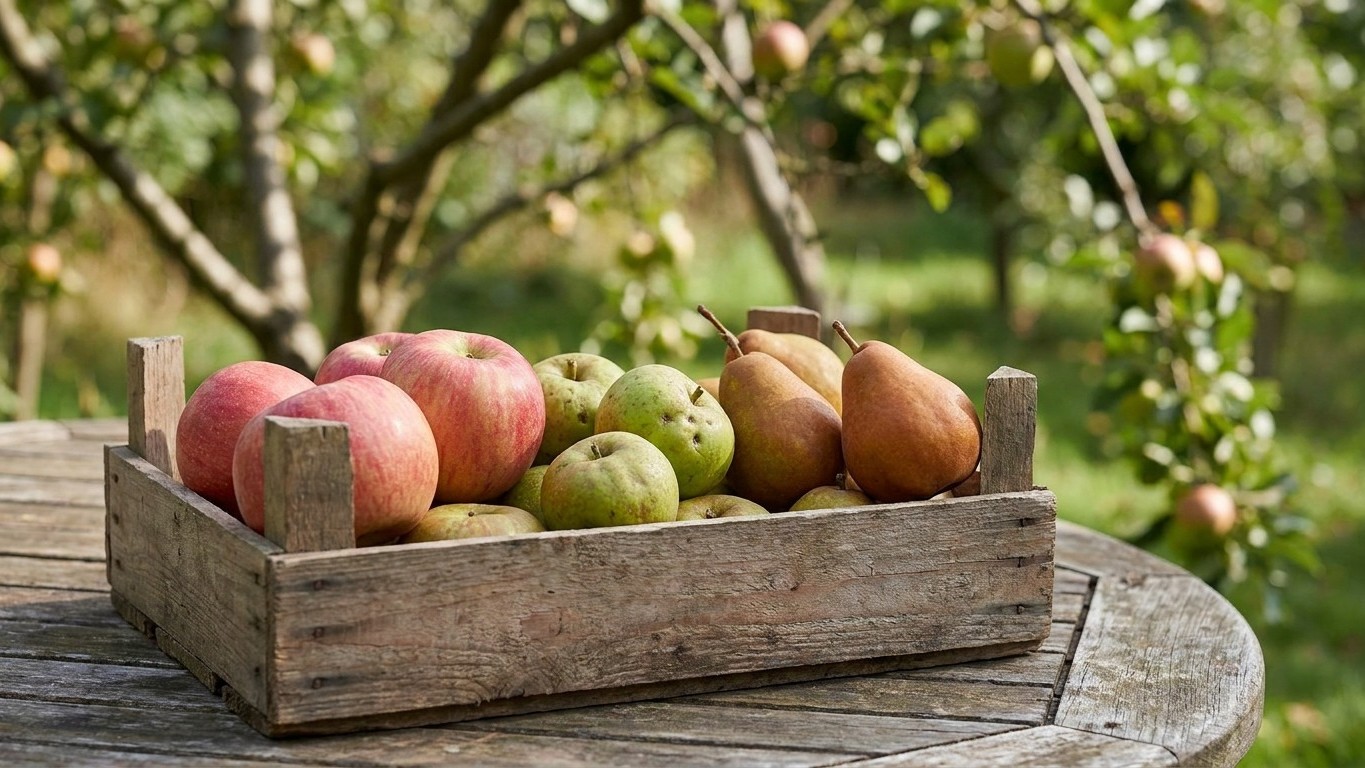

Idaho apple harvest and storage depends on where in the state you’re growing. In the Treasure Valley around Boise, most apples come off the tree between late August and mid-October, with the exact week set by variety, not the calendar. Properly stored, a good keeper variety can hold three to six months in a cold, humid space. Higher, colder parts of Idaho compress that whole window.
When apples are ready to pick in Idaho
Forget the date on the calendar. The tree tells you when it’s ready, and what it tells you depends on two anchor points: when the blossoms opened and how many days that variety needs afterward to ripen. In the Boise area, NOAA’s 1991-2020 Climate Normals put the last spring frost between April 23 and April 30 to May 7, based on station USW00024131. Bloom typically follows that window by one to three weeks, so most Treasure Valley apple trees are flowering sometime in May.
From there, count forward. Early-season varieties like Lodi, Duchess, or early Gala strains ripen in roughly 70 to 100 days after bloom, which lands them in late July through August. Midseason apples, the Galas, Jonathans, and standard McIntosh types, need closer to 110 to 130 days, putting harvest in September. Late-season keepers, the Fujis, Granny Smiths, Rome types, and Arkansas Blacks, can take 150 days or more and often aren’t ready until October.
That’s where the other frost date matters. The first fall freeze in the Boise area arrives between October 7 and October 21, per the same NOAA station data. Late apples need to be off the tree, or at least far enough along, before a hard freeze settles in. A light frost won’t ruin most apples still hanging, but a lot of growers don’t want to gamble a season’s crop on that.
Elevation changes everything
The Treasure Valley sits low, around 2,700 feet, which is exactly why its frost dates run milder than most of the state. Idaho’s panhandle around Coeur d’Alene, the higher benches of eastern Idaho near Idaho Falls and Rexburg, and mountain valleys like the Sun Valley and McCall areas all sit at higher elevation or higher latitude, and none of them share Boise’s frost window. No dataset in this article covers those stations specifically, so treat the Boise dates as a reference for the valley floor, not a statewide rule. If you’re growing apples in one of those colder pockets, expect bloom later and first frost earlier than what’s described here, and lean toward earlier-ripening varieties as a result.
The practical test, wherever you are: press a thumbnail into the flesh near the stem. If it resists and the skin colors fully for that variety, and a few windfalls have started dropping, you’re in the harvest window. Taste one. Starchy and sour usually means wait another week.
Which ones keep, and which must be eaten
Not every apple is built to sit in a box until January. Storage life comes down to skin thickness, sugar-acid balance, and how densely packed the flesh is, and it splits fairly cleanly between two groups.
Thin-skinned, early-season apples are built for eating within days or weeks, not months. Lodi, Duchess, Gravenstein, and early-strain Gala all soften quickly once picked. Their sugars are lower and their cell structure is looser, so they bruise easily and turn mealy fast in storage. These are the varieties for fresh eating, quick baking, or sauce made the same week they come off the tree.
On the other end, late-ripening, dense-fleshed varieties are the ones worth setting aside for winter. Granny Smith, Fuji, Rome, GoldRush, Arkansas Black, Northern Spy, and Pink Lady all have thicker skins and higher acid content, both of which slow the breakdown that eventually turns an apple soft and dull. These are the classic root cellar apples, the ones a grandparent would have wrapped individually and checked on through February.
Midseason varieties fall in between. A standard McIntosh or Jonathan will hold a month or two in good cold storage but starts to lose its snap after that. Treat these as the middle tier: fine for a few weeks in the fridge or an unheated but insulated space, not something to bank on for the whole winter.
A quick sorting guide
- Eat within days: Lodi, Duchess, Gravenstein, early Gala
- Good for a month or two: McIntosh, Jonathan, standard Gala
- Built for winter storage: Fuji, Granny Smith, Rome, GoldRush, Arkansas Black, Northern Spy, Pink Lady
One more sorting rule that matters more than variety alone: condition at picking. A bruised late-season apple rots just as fast as a delicate early one. Sort by hand as you pick, and set aside anything with a soft spot, a puncture, or broken skin for immediate use rather than the storage pile. One bad apple really does speed up decay in the whole box, since damaged fruit releases more ethylene gas and moisture that hasten softening in its neighbors.
Storing them through a Idaho winter
Good storage comes down to three variables: temperature, humidity, and air movement, and Idaho’s outdoor cold makes at least one of those easier than in milder states. NOAA’s 1991-2020 data puts the mean daily minimum for Boise’s coldest month at 25.4°F, which is cold enough that an unheated garage or shed will often dip below freezing on its own during January nights. That’s colder than apples want. The target for long-term storage is closer to 30 to 40°F with high humidity, not a hard freeze, so an uninsulated outbuilding needs some buffering, whether that’s an interior room, an insulated cabinet, or a partly underground root cellar that stays a few degrees warmer than open air.
A basement corner, an unheated but insulated pantry, or a real root cellar all work if the temperature stays consistently cold without freezing solid. Wrapping apples individually in newspaper and setting them in single layers in shallow boxes cuts down on bruising and slows moisture loss. Some growers add a shallow pan of water nearby to keep humidity up, since dry winter air (common across most of Idaho once the furnace kicks on indoors) is what causes apples to shrivel long before they actually rot.
Keep them away from certain neighbors
Apples give off ethylene gas as they age, which speeds ripening in whatever sits near them. Potatoes stored in the same bin can sprout early, and other fruit can spoil faster than it should. Keep the apple box separate from root vegetables if space allows, or at least give it its own corner with some airflow around it.
Check the stash every couple of weeks. One apple that starts breaking down can pass rot to its neighbors fast, so pull anything soft or discolored the moment you spot it. Growers who check often and cull ruthlessly are the ones still eating good apples from the same batch in March; the ones who don’t check often lose half the box to a spot they missed in November.
What goes wrong here
The single biggest risk in this part of Idaho isn’t the depth of winter cold, since 25.4°F as a mean daily minimum is mild enough that nearly every common apple variety survives it without hardiness trouble. The real risk sits at the other end of the season: a late spring frost catching blossoms that opened too early.
Here’s the trade-off worth understanding. A low-chill variety, one bred to break dormancy after relatively little accumulated winter cold, blooms earlier in spring than a standard variety does. In a place where the last frost can land as late as May 7 per NOAA’s Boise data, an early bloomer is exposed to exactly the frost that a later-blooming variety would have avoided. Given that window, standard or higher-chill varieties that hold their bloom until closer to mid-May are the safer bet in the Boise area. Trading early bloom for a shot at dodging the frost isn’t a close call here; the frost date is documented, the early bloom risk isn’t worth it.
Picking too early is the second common mistake. Apples don’t ripen further once off the tree the way some fruits do, so a batch picked while starchy and hard stays that way. Waiting even a week longer, and checking sugar development by taste rather than by color alone, avoids a whole box of apples nobody wants to eat.
Storage failures usually trace back to temperature swings, an unheated shed that freezes hard on the coldest nights then warms during a thaw, cycling the fruit through stress it wasn’t built for. And a handful of bruised or punctured apples mixed into a storage box will take down far more of the batch than their number suggests. Sorting carefully at harvest, not just at the moment of storage, is the cheapest insurance available.
For pest, disease, and variety guidance specific to Idaho growing conditions, the University of Idaho Extension is the relevant local resource; no other figures beyond what’s cited above are documented in this article.
Common questions
What month should I pick apples in the Boise area?
There’s no single month that fits every variety. Early types often ripen in late July to August, midseason varieties through September, and late keepers sometimes not until October. The safer marker is bloom timing plus the variety’s typical days-to-ripen, not a fixed date on the calendar.
Do apples ripen further after picking?
Not meaningfully. An apple picked while starchy and sour stays that way. Test with a taste before committing to a full harvest, since color alone can be misleading depending on variety.
Can I store apples in an unheated Idaho garage all winter?
Only if the space stays consistently cold without freezing solid. With Boise’s coldest month averaging a daily low of 25.4°F, an uninsulated garage will often dip below freezing on its own, which damages fruit. An insulated space, root cellar, or interior room that holds close to 30 to 40°F works better.
Why did my apple blossoms get killed by frost this spring?
Likely an early-flowering variety caught by a late freeze. NOAA’s data for the Boise area shows the last spring frost can land as late as May 7, so any variety that blooms before mid-May is taking on real risk in this location.