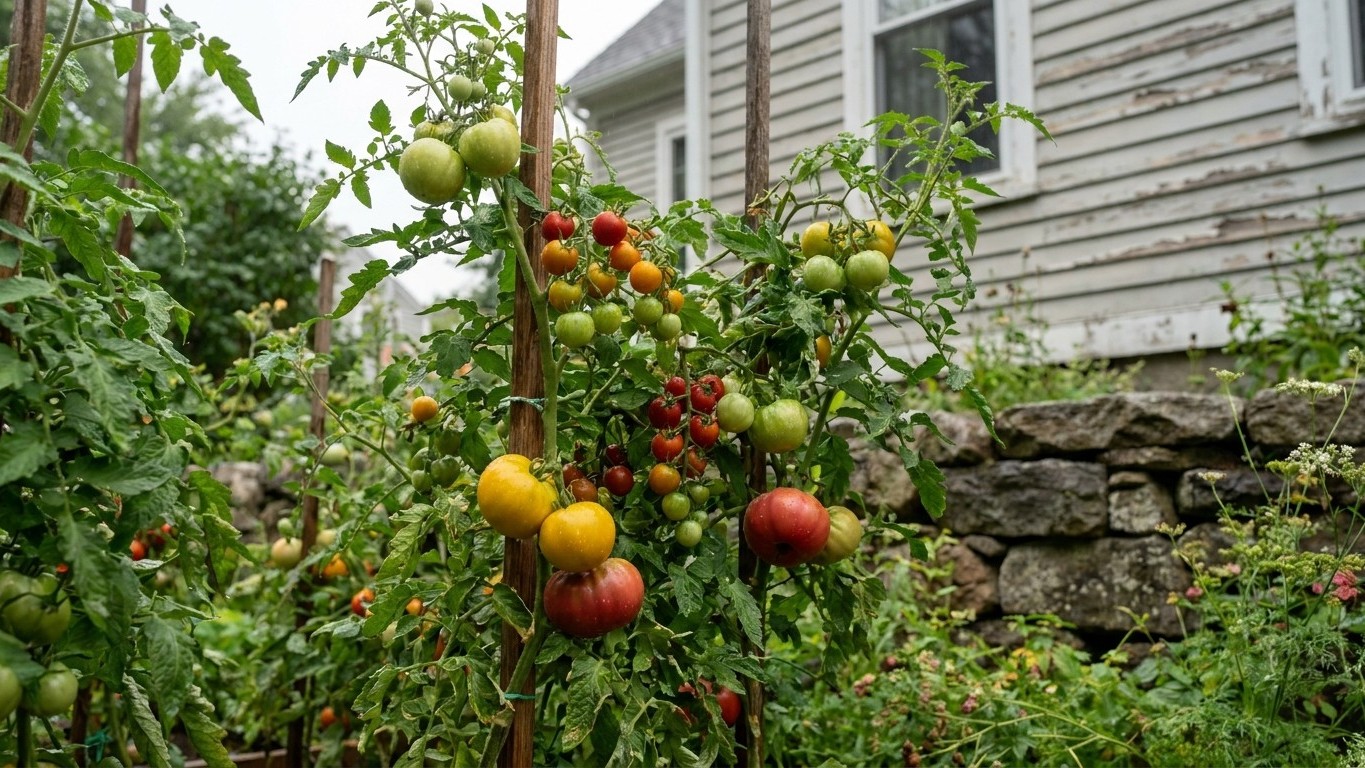

The safest rule beats the calendar: pick before the first fall frost, not on a fixed date. Any tomato showing a blush of color will keep ripening once it’s off the vine. Full green fruit can still be saved, but it needs sorting and a little patience. Since frost arrives at different times across Massachusetts, your local forecast matters more than any date printed in a gardening guide. For region-specific planting and care questions, UMass Amherst’s extension service (ag.umass.edu) is the reference point.
When to pick tomatoes in Massachusetts
The decision to pick isn’t really about ripeness. It’s about frost. Once nighttime temperatures drop to 32°F, tomato plants and their fruit are damaged, and any tomato left on the vine through a hard frost turns to mush within a day or two. That’s the trigger that should drive your harvest timing at the end of the season, more than the tomato’s color or size.
At Boston’s Logan Airport, the reference station used for statewide climate normals, the first fall frost falls in a window between November 3 and November 14, based on NOAA’s 1991-2020 Climate Normals for 32°F freeze probability. That’s a range, not a single date, and it reflects the years where frost risk crosses the 30 to 70 percent threshold at that location.
Logan sits right on the water in a dense urban setting, which makes it the mildest spot in the entire state. Inland suburbs, the Connecticut River Valley, and especially the Berkshires see frost show up earlier in the fall and linger later in spring. If you garden outside the immediate Boston area, treat the Logan window as the late end of your range, not the expected date for your own yard.
Why the hardiness zone doesn’t answer this question
Massachusetts spans USDA Hardiness Zones 5a to 7b, a system built entirely around the average annual extreme minimum winter temperature. It’s useful for deciding which perennials survive a Massachusetts winter, but it says nothing about when your first fall frost will land or when tomatoes need to come off the vine. A gardener in a 7a pocket near the coast and a gardener in a 5a valley in the Berkshires are working with very different fall timelines, even though both statements about “Massachusetts hardiness zones” are technically true.
Practically, this means the calendar is a planning tool, not a trigger. Start checking the extended forecast seriously once you’re two to three weeks out from your area’s typical first frost window. When a frost warning actually gets issued, that’s the day to strip the plant, not the day frost is merely possible.
What to do with the green ones
Not every green tomato is equal, and sorting them correctly is what determines whether your harvest turns into ripe fruit or a bowl of hard, flavorless duds. The tomatoes worth saving are at the mature green stage: full size for their variety, with a pale, whitish-green color and a slight give when pressed. Slice one open and you’ll see gel starting to form around the seeds, a sign the fruit has finished its growth cycle even though the color hasn’t turned.
Small, hard, dark-green tomatoes that haven’t reached full size are a different story. They lack the internal structure to ripen properly off the vine, and holding onto them rarely produces anything better than a mealy, bland tomato. Those are better used the way cooks have always used unripe fruit, sliced and fried, or pickled, rather than saved for the windowsill.
Harvesting ahead of frost
When a hard frost is imminent, two approaches work. You can pick individual mature green fruit by hand, twisting gently at the stem. Or, if the plant is loaded, you can pull the entire plant by the roots and hang it upside down in a garage, shed, or basement, letting the fruit ripen while still attached to the vine. This second method tends to produce better texture, since the tomato keeps drawing a small amount of sugar and moisture from the plant as it colors up.
Either way, avoid rinsing the fruit before storage. Excess moisture on the skin encourages rot long before ripening finishes. Wipe off garden soil with a dry cloth instead, and inspect each tomato for splits, soft spots, or insect damage. A single damaged fruit tucked in with healthy ones can spread mold through the whole batch within days, so damaged or blemished tomatoes should be used immediately rather than stored.
Ripening indoors, and how long they keep
Once green tomatoes are inside, temperature does most of the work. A spot that stays in the mid-60s to mid-70s Fahrenheit, out of direct sunlight, ripens fruit steadily without cooking or scorching the skin. A single layer in a cardboard box, a paper bag, or wrapped individually in newspaper works better than a bowl or basket, since the fruit needs airflow and shouldn’t be touching for long stretches.
Tomatoes produce their own ethylene gas as they ripen, and that gas triggers more ripening in whatever fruit sits nearby. Tucking a ripening banana or apple into the same paper bag as green tomatoes speeds the process along, a trick that works for the same reason avocados ripen faster next to bananas on a countertop.
How long the whole batch takes depends on the fruit’s stage when picked and the room’s temperature, and there isn’t a single published figure that applies to every tomato and every kitchen. What’s consistent is the pattern: check the stored fruit every couple of days, pull out anything that’s ripened or started to soften unevenly, and keep the rest going. Sorting frequently prevents one softening tomato from accelerating rot in the ones around it.
Where not to put them
Ripe or ripening tomatoes don’t belong in the refrigerator. Cold temperatures halt the enzymatic process that builds flavor and softens texture, and tomatoes chilled before they’re fully ripe often stay mealy even after they warm back up and finish coloring. Keep them on a counter or in a pantry at room temperature instead, and only refrigerate a tomato once it’s fully ripe and you need to buy it an extra day or two before eating.
What goes wrong here
The most common mistake is refrigerating green or partially ripe tomatoes straight out of the garden. It feels like the responsible move, the way you’d store any produce, but it stalls ripening and often leaves the fruit permanently mealy. Room temperature, not cold storage, is what green tomatoes need.
Another frequent misstep is assuming sunlight speeds up ripening. It doesn’t. Warmth ripens tomatoes; direct sun on a windowsill just heats one side of the fruit unevenly, which can lead to soft spots and rot rather than faster, even coloring. A warm room out of direct light works better than a sunny sill.
Gardeners outside the immediate Boston area sometimes get caught off guard by relying on a coastal frost date that doesn’t match their own conditions. Because Logan Airport is a waterfront, urban station, and the mildest location in the state, its November frost window runs later than what inland towns and the Berkshires typically experience. Treating that window as a statewide guarantee, rather than a Boston-area reference point, is how gardeners lose a whole bed of tomatoes to a surprise early frost.
Finally, storing green tomatoes crowded together, stacked in a bin or piled in a bowl, invites the same problem as leaving one bruised apple in a full bag: a single soft or split tomato spreads mold to everything touching it. A single layer, checked regularly, with damaged fruit removed on sight, is the difference between a slow steady ripening and losing half the harvest to rot in the back of a box nobody checked for a week.
Common questions
Should I pick every tomato before frost hits?
Pick any fruit at mature green stage or beyond. Tiny, hard, immature green tomatoes rarely ripen well and are better used fried or pickled than saved for the windowsill.
Do green tomatoes ripen faster on a sunny windowsill?
No. Warmth drives ripening, not light. Direct sun tends to heat fruit unevenly and can cause soft spots rather than speeding up the process.
Can I put ripening tomatoes in the refrigerator to slow them down?
Avoid it. Cold temperatures stop the ripening process and often leave the fruit mealy, even after it’s returned to room temperature. Only refrigerate tomatoes that are already fully ripe.
Is the USDA hardiness zone useful for figuring out when to pick?
Not directly. Massachusetts spans Zones 5a to 7b under the USDA Plant Hardiness Zone Map, but that system measures average extreme winter minimum temperatures, not fall frost timing. Local frost forecasts are the more useful tool for harvest decisions.