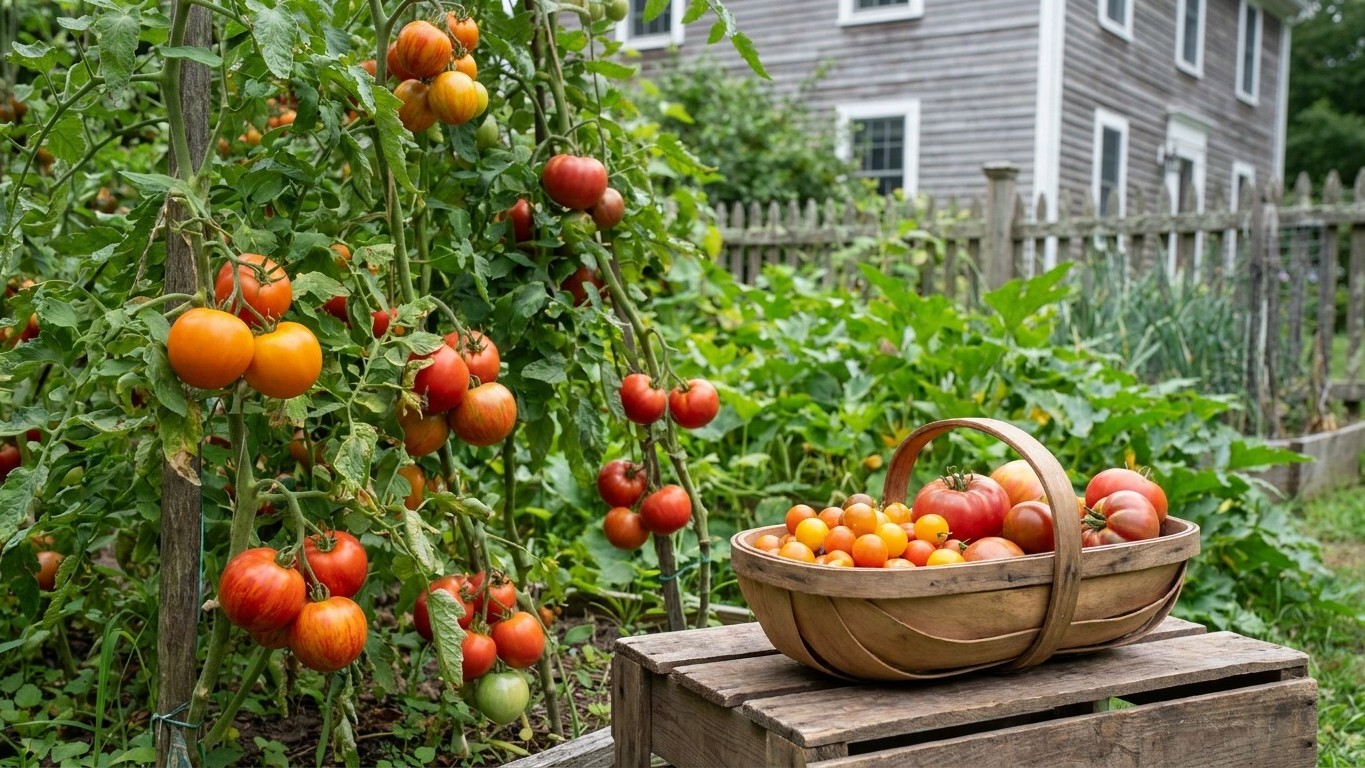

Logan Airport’s frost dates bookend the Massachusetts tomato season at roughly April 1 to November 14, but that window looks a lot narrower once you’re in the Berkshires instead of the Cape, and it barely matters anyway if you’ve planted a variety that needs 85 days to ripen after a cool, late spring. Every seedling goes into the ground during that same mid to late April stretch. What separates a red tomato in June from green fruit still on the vine at first frost is the cultivar itself.
What this comes down to in Massachusetts

Massachusetts spans USDA Hardiness Zones 5a to 7b on the USDA Plant Hardiness Zone Map, with the coldest zones in the Berkshires and the mildest near Boston and the Cape. Near Boston, NOAA’s 1991-2020 climate normals put the last spring freeze at April 1 to April 8 and the first fall freeze at November 3 to November 14, measured at Logan Airport, the mildest and most urban station in the state. Within that window, the deciding factor is which cultivar you choose, since every variety below goes into the ground during roughly the same mid to late April stretch, once you’ve hardened off seedlings the way growing tomatoes in Massachusetts describes, but reaches its first ripe fruit anywhere from mid June to mid July depending on how many days it needs.
Sakura

Sakura reaches its first ripe fruit around 55 days from transplant, the fastest cherry tomato on this list. Set out in mid to late April, it typically starts producing by mid June and finishes with about 140 days of margin before Boston’s first fall frost, more cushion than any other variety here. It resists nematodes, tomato mosaic virus, and two races of fusarium wilt, useful in a bed that has grown tomatoes for several years running.
Sun Gold

Sun Gold ripens almost as fast, at 57 days from transplant, with fruit ready by mid June from the same mid to late April planting window. It carries high resistance to tobacco mosaic virus and one race of fusarium wilt. The small fruit splits easily after heavy rain, so it rewards a gardener who can pick every day or two once it starts.
Supersweet 100

Supersweet 100 needs 60 days from transplant and follows a similar early-summer schedule, ripening by late June with about 135 days of margin. It resists verticillium wilt and fusarium wilt race 1, useful in soil that has run tomatoes before. Expect long clusters of small fruit That Keep Coming Until Frost.
Juliet

Juliet also matures at 60 days but produces oblong, grape-shaped fruit instead of round cherries, useful for drying or roasting whole. It carries intermediate resistance to both late blight and early blight, two diseases that show up during the state’s humid Augusts. For the fuller pest and disease picture, see Tomato Pests in Massachusetts: Which Ones Actually Show Up Here. First fruit lands in late June, with about 135 days of margin before frost.
Amalfi

Amalfi is a determinate paste tomato at 68 days from transplant, ripening in late June with roughly 127 days to spare. Its intermediate resistance to both early and late blight helps it hold up through a wet Massachusetts summer better than most paste types on this list. Because it’s determinate, the plant sets most of its fruit in one flush, which suits a gardener who wants a single canning batch rather than a trickle all season.
Cherokee Purple

Cherokee Purple takes 72 days from transplant and ripens in early July, leaving about 123 days of margin, plenty for an heirloom slicer with no listed disease resistance. The fruit is prized for flavor, not for toughness, so give it a warm, well-drained spot rather than relying on the calendar alone. It’s an indeterminate vine that keeps growing and fruiting until frost, so it needs sturdy staking.
San Marzano II
San Marzano II needs 78 days from transplant, ripening in early July with about 117 days of margin, still comfortable but noticeably tighter than the cherry types above. It has no listed disease resistance, so site selection and airflow matter more than they do for the hybrids on this list. The fruit is bred for sauce, not for slicing.
Amish Paste
Amish Paste is the longest-season variety on this list at 85 days from transplant, ripening in mid July with about 110 days of margin before Boston’s first fall frost. That’s still a comfortable finish near Boston, but it’s the cultivar most likely to run into trouble in a cool, cloudy summer or in a garden farther inland where the season runs shorter. The fruit is meaty and low in seeds, good for canning whole or making paste.
| Variety | Days to maturity | Type | First ripe (Boston-area estimate) | Margin before first fall frost |
|---|---|---|---|---|
| Sakura | 55 | Indeterminate | Mid June | About 140 days |
| Sun Gold | 57 | Indeterminate | Mid June | About 138 days |
| Supersweet 100 | 60 | Indeterminate | Late June | About 135 days |
| Juliet | 60 | Indeterminate | Late June | About 135 days |
| Amalfi | 68 | Determinate | Late June | About 127 days |
| Cherokee Purple | 72 | Indeterminate | Early July | About 123 days |
| San Marzano II | 78 | Indeterminate | Early July | About 117 days |
| Amish Paste | 85 | Indeterminate | Mid July | About 110 days |
Working it out for your own garden
To work this out for your own yard rather than trusting a preset list, start with NOAA’s last spring frost range for Boston, April 1 to April 8, and add the two to three weeks most Massachusetts growers wait for nighttime soil temperatures to climb before tomatoes go in the ground. That arithmetic is what lands the transplant window in mid to late April, the same range used for every cultivar in the table above. The full method, including how to adjust it for a colder microclimate, is laid out in Tomato Planting Dates in Massachusetts: Counting Back From Your Frost Window.
A worked example, start to finish
Take Amish Paste, the longest-season cultivar on this list, as a full example. Transplant it mid to late April, add its 85 days to maturity, and the first ripe fruit lands in mid July. Compare that to NOAA’s first fall frost range for Boston, November 3 to November 14, and the gap comes out to roughly 110 days, the tightest margin of any variety here but still comfortable in a normal year.
The line falls somewhere past 100 to 110 days from transplant for a Massachusetts garden, at least near Boston. A large heirloom beefsteak that needed that many days, more than anything in this list, would still ripen most years near the coast. Push the same plant into a Berkshire garden with a shorter, higher-elevation season and a cool, cloudy summer, and it could run past the first frost before it colors up. That’s the point at which a gardener should trade a long-season heirloom for one of the 55- to 68-day cultivars above instead of gambling on the calendar.
What changes across the state
The NOAA figures above come from Logan Airport, a waterfront station in Boston and the mildest spot in Massachusetts. Every number in this article should be read as a starting point measured there, not as a fact about the whole state.
Elevation moves the frost dates the most. The Berkshires, in the western part of the state, sit several hundred feet higher than Boston and typically see their last spring frost later and their first fall frost earlier, which shortens the whole growing season on both ends. A gardener there should lean toward the shorter end of this list, the 55- to 68-day cultivars, rather than the 78- to 85-day types.
Coastal areas, including Cape Cod and the Islands, sit closer to Logan’s conditions than inland towns do, because the surrounding ocean water moderates temperature swings in both directions. Inland valleys and low-lying yards tend to collect cold air overnight and can see frost on nights when a garden a few miles away, closer to the water, stays clear. A frost-prone hollow ten minutes from the coast can behave more like the Berkshires than like Boston.
North-to-south differences matter less than elevation and distance from open water, but the far northern edge of the state still tends to warm up slower in spring than the south shore or the Cape. None of that changes which cultivars exist, only how much margin each one actually has once it’s growing in your yard rather than in Boston’s.
The mistakes this state punishes

Three mistakes account for most of the tomato disappointments reported in a typical Massachusetts season, and all three trace back to the frost data above.
- Transplanting into cold soil right after a warm early-spring stretch
- Choosing a 78- to 85-day heirloom for a short-season or inland site
- Leaving ripe fruit on the vine past the point the season can finish it
A warm week in early April does not mean the soil has caught up. Air temperature climbs faster than soil temperature, and tomato roots planted into cold ground simply stop growing for a stretch, which quietly erodes the very margin this article calculates in days. Wait for the soil itself to warm, not just the forecast, even though NOAA’s April 1 to April 8 frost range near Boston can tempt an early start.
The second mistake is picking a long-season heirloom, Amish Paste or San Marzano II among them, for a garden that does not have the margin to spare. Near Boston that margin runs comfortably past 100 days, but the same variety planted in a shaded yard, a low spot that collects cold air, or an inland town with a shorter season can run out of days before it runs out of green fruit.
The third is refusing to pick green fruit once the season is clearly ending. Every cultivar on this list ripens on the vine well before Boston’s typical frost window, but a cold, wet stretch in September or October can slow ripening on any tomato, and fruit left on a heavily loaded plant past that point is better harvested green and ripened indoors than left to gamble on the weather.
Checking this against your county
Every figure above comes from one station near Boston. Your own county extension office can tell you how much earlier or later your local frost dates actually run, and the University of Massachusetts Extension (ag.umass.edu) publishes state-specific tomato guidance that goes beyond what a single weather station can tell you. Check their site or call before betting a full bed on an 85-day heirloom in a spot you haven’t grown tomatoes in before, especially if you garden west of the Connecticut River or at any real elevation.
Common questions
Can I still grow a 90-day tomato in Massachusetts?
Not from this catalogue list, since the longest cultivar named here, Amish Paste, needs 85 days from transplant. If you already have a longer-season variety on hand, count 90 to 100 days forward from a mid to late April transplant and compare it against NOAA’s November 3 to November 14 first fall frost range for Boston. Near the coast it will likely still finish, but the margin shrinks fast the farther inland or higher in elevation your garden sits.
Do determinate tomatoes ripen faster than indeterminate ones here?
Not necessarily. Amalfi is determinate and matures at 68 days, while Sakura is indeterminate and matures faster, at 55 days. Days to maturity depends on the individual cultivar, not on whether the plant is determinate or indeterminate, though determinate plants do tend to ripen most of their fruit in one shorter window rather than trickling in all season.
Should I start seeds indoors earlier to beat the frost?
Starting seeds earlier indoors does not move your outdoor transplant date, since that date is set by soil and air temperature outside, not by how big the seedling is. A seedling started too early just sits in its pot getting leggy and stressed while it waits for the ground to warm to the mid to late April window this article uses.
What happens if a late frost hits after I’ve already transplanted?
A light frost can kill unprotected tomato seedlings outright, since they have no cold tolerance at any stage. Keep a frost cloth or bucket on hand through the end of NOAA’s April 1 to April 8 last-frost range for Boston, later if you garden inland or at elevation, and cover plants any night a frost is forecast.