
Boston’s frost-free window — April to November, give or take a week on either end — is the whole reason a pest list built for Georgia or Ohio doesn’t hold up here. Southern growers fight hornworms all summer; ours barely get a second generation going before frost cuts them off. What actually shows up in a Massachusetts garden follows the flea beetles first, then a narrow middle stretch, then a fall scramble — not the free-for-all most pest charts assume.
What this comes down to in Massachusetts

Boston’s frost-free window, measured by NOAA’s 1991-2020 climate normals at Logan Airport, runs from the last spring frost of April 1 to April 8 to the first fall frost of November 3 to November 14. That gives the state’s tomato pests roughly seven months to work through their life cycles, and each one has a fairly narrow slot when it actually does damage. Knowing which slot you’re in narrows the identification down fast, before you’ve even looked closely at the insect.
Flea Beetles

These show up first, usually within days of setting out transplants in the mid-April to late-April window covered on the Tomato Planting Dates in Massachusetts: Counting Back From Your Frost Window page. The adult beetle does all the damage, chewing small round holes across young leaves. Seedlings are small enough that a heavy attack can outpace new growth, so treat as soon as the shot-hole pattern appears rather than waiting to see how bad it gets.
Four-Lined Plant Bug

This one has a short fuse. It feeds for about three weeks in late spring, leaving round, sunken brown spots with pale centers on leaves, then disappears for the rest of the season. If you see this damage pattern in June and then it stops spreading, you’re not dealing with an ongoing problem and don’t need to keep treating for it.
Colorado Potato Beetle

Adults overwinter in the soil and turn up on tomato foliage in late spring, laying clusters of orange eggs on the underside of leaves. It’s the larval stage, not the adult, that does the bulk of the defoliation, stripping leaves down to the veins. Handpicking both stages works well in a home garden because generations overlap through summer.
Aphids

Aphids build up steadily from late spring through summer, clustering on new growth and the undersides of leaves where they curl and yellow. Both nymphs and adults feed by piercing the plant and excreting sticky honeydew, which then grows sooty mold on lower leaves. Outdoor populations in Massachusetts gardens are usually kept in check by ladybugs and lacewings before they need direct treatment.
Tomato Hornworm

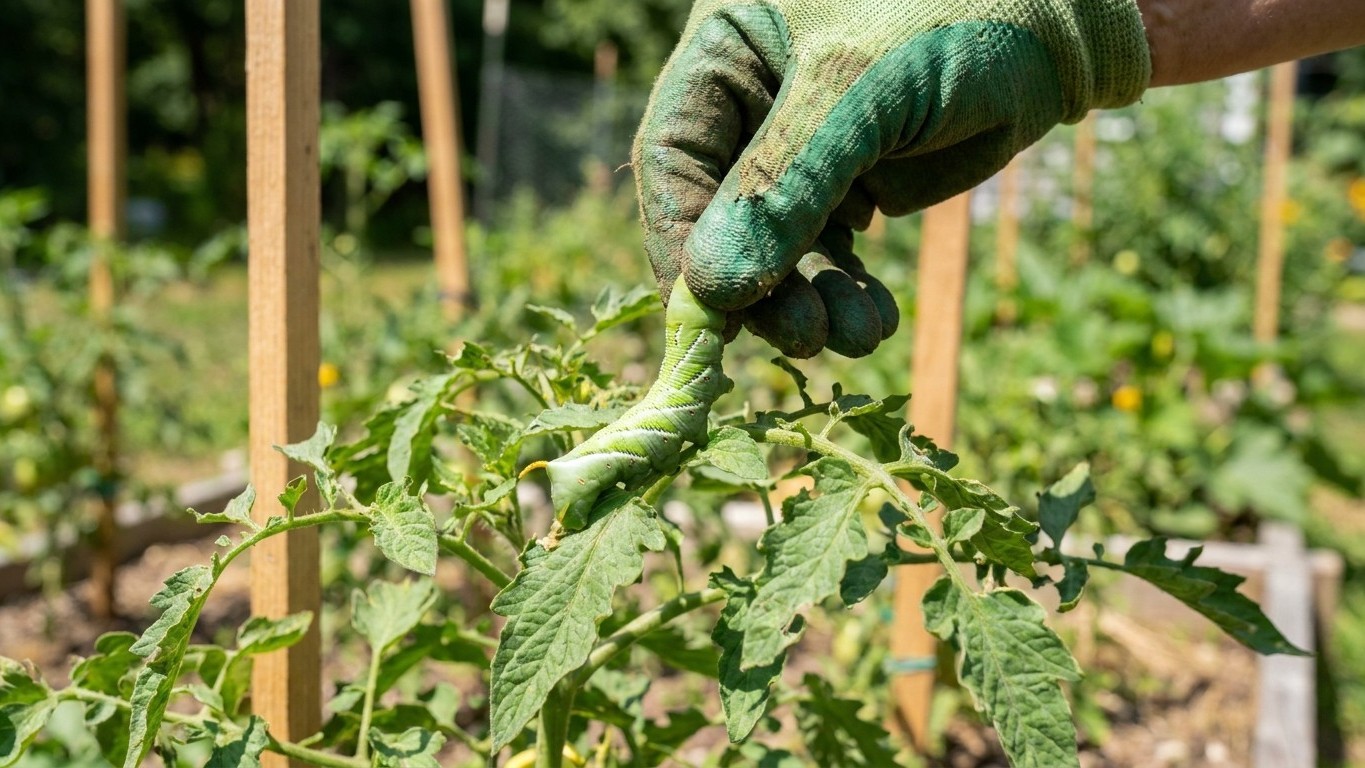
This is the pest most gardeners actually see, usually from mid to late summer. The caterpillar can strip a branch bare overnight and is often spotted first by its dark, pellet-like droppings on the leaves beneath it rather than by the insect itself. If you find one carrying small white rice-shaped cocoons on its back, leave it alone. Those are parasitic wasp larvae that are already killing it.
Brown Marmorated Stink Bug

This one arrives latest, from August into fall, and targets ripening fruit rather than foliage. Feeding leaves cloudy, pithy spots beneath the skin that often aren’t visible until you cut the tomato open. Because the damage is hidden, start checking ripening fruit for tiny puncture marks once you’re into August.
Working it out for your own garden
With six pests active across a seven-month season, the fastest way to identify what’s on your plants is to work through three questions in order: what time of year is it, what part of the plant is damaged, and what life stage is present. That sequence eliminates most of the list before you’ve even pulled out a hand lens.
A quick sorting method
- Small round holes in leaves within days of transplanting: flea beetles, not a caterpillar or a beetle larva.
- Sunken brown spots on leaves in a short burst during late spring, then nothing: four-lined plant bug.
- Full skeletonized leaves with a soft-bodied, spotted larva present: Colorado potato beetle larva, not the adult.
- Sticky residue and curled new growth with clusters of tiny insects: aphids.
- Stripped branches in midsummer with a large green caterpillar or dark droppings below: tomato hornworm.
- Cloudy spots inside ripe fruit picked in late summer with no visible feeding on leaves: brown marmorated stink bug.
Timing does most of the work here because these pests rarely overlap in the damage they cause. A gardener who finds skeletonized leaves in May is looking at Colorado potato beetle larvae, not hornworms, since hornworms haven’t hatched yet at that point in the season. If you’re still working out when to set out transplants at all, the state’s general timeline is on growing tomatoes in Massachusetts, and pest pressure tracks that same calendar closely.
What changes across the state
Boston, where NOAA’s Logan Airport station takes its readings, is the mildest and earliest-warming spot in Massachusetts. It sits on the water, so its frost dates and soil-warming timeline run ahead of most of the state. Inland towns and especially the Berkshires warm up later in spring and cool off earlier in fall, which pushes every pest’s first appearance back by a noticeable stretch and shortens the tail end of the season for the ones, like the brown marmorated stink bug, that show up late.
Elevation matters more than distance from the coast for this. A garden a few hundred feet higher in the Berkshires or the central highlands can lag a lowland garden an hour away by a real margin in when soil temperature crosses the threshold that gets flea beetles and Colorado potato beetles moving. Coastal counties on the South Shore and Cape Cod, by contrast, tend to track closer to the Boston pattern because ocean proximity moderates both spring warmup and fall cooldown the same way it does at Logan.
The brown marmorated stink bug also skews toward denser, more built-up areas, since it overwinters in buildings as readily as in leaf litter and hedgerows. A garden near an urban or suburban edge is more likely to see it than a rural field bordered only by woods and open land. None of this changes which pests are possible in your yard, but it changes when you should expect to start looking for each one relative to a gardener across town or across the state.
The mistakes this state punishes

The biggest one is transplanting into cold soil after an early warm spell, which stresses seedlings right as flea beetles are most likely to find them. A stressed transplant with slow new growth can’t outrun even light flea beetle feeding, so it’s worth confirming the transplant window on the planting calendar rather than going by a few warm days in the forecast.
The second is treating every leaf spot as an emergency. Four-lined plant bug damage looks alarming but runs its course in about three weeks and doesn’t need repeat spraying, while true disease symptoms keep spreading. Confusing the two leads gardeners to spray for an insect that’s already gone, which wastes effort and kills off the aphid predators you actually want around.
Missing the late-season window
The third mistake is assuming the season is over once tomatoes start ripening, which is exactly when the brown marmorated stink bug does its damage. Because the injury hides inside the fruit, gardeners who stop checking plants once harvest starts often don’t find out until they’re slicing a tomato at the counter. Keep checking ripening fruit through the end of the season rather than only the foliage, and if fruit rot or cracking becomes a bigger issue than insects, the Tomato Varieties That Ripen in Time in Massachusetts page covers cultivars bred with some disease resistance built in.
Checking this against your county
Every figure here is a Boston-area starting point, not a rule for the whole state. Before you act on a borderline case, especially timing questions near the edges of these windows, check with the state extension service at the University of Massachusetts, reachable through ag.umass.edu, and with your own county’s extension office. They track pest emergence locally each year and can tell you whether a given insect is running early or late in your specific area.
Common questions
Is a tomato hornworm the same thing as a tobacco hornworm?
They’re closely related and often confused, and both can turn up on tomato plants. The tobacco hornworm has a red horn and diagonal white stripes with black borders, while the tomato hornworm’s horn is more blue-black and its stripes lack the black edging. Control is the same for both, so the distinction matters more for curiosity than for treatment.
Will floating row cover keep all of these pests off my plants?
It works well against flea beetles right after transplanting, since it physically blocks the adult beetle from reaching the leaves. It has to come off once flowers appear so pollinators can reach the plant, and it does nothing for pests like the brown marmorated stink bug that arrive after the cover is gone anyway.
Do ladybugs actually eat enough aphids to matter, or is that overstated?
They matter more than most gardeners expect, particularly the larval stage, which looks like a small orange-and-black alligator and eats far more aphids per day than the adult beetle. A patch with an established ladybug population often never needs a spray for aphids at all. Spraying broadly for aphids tends to knock the ladybugs back along with them, which can make the problem worse the following week.
I found beetle larvae on my plants that don’t match any description here. What are they?
If they’re small, dark, and spiny rather than reddish-orange and humpbacked, they’re likely ladybug larvae, which are a benefit, not a pest, and should be left alone. Colorado potato beetle larvae are specifically reddish-orange with two rows of black spots and a soft, rounded body. Getting this one wrong is the most common way gardeners accidentally kill off their own aphid control.