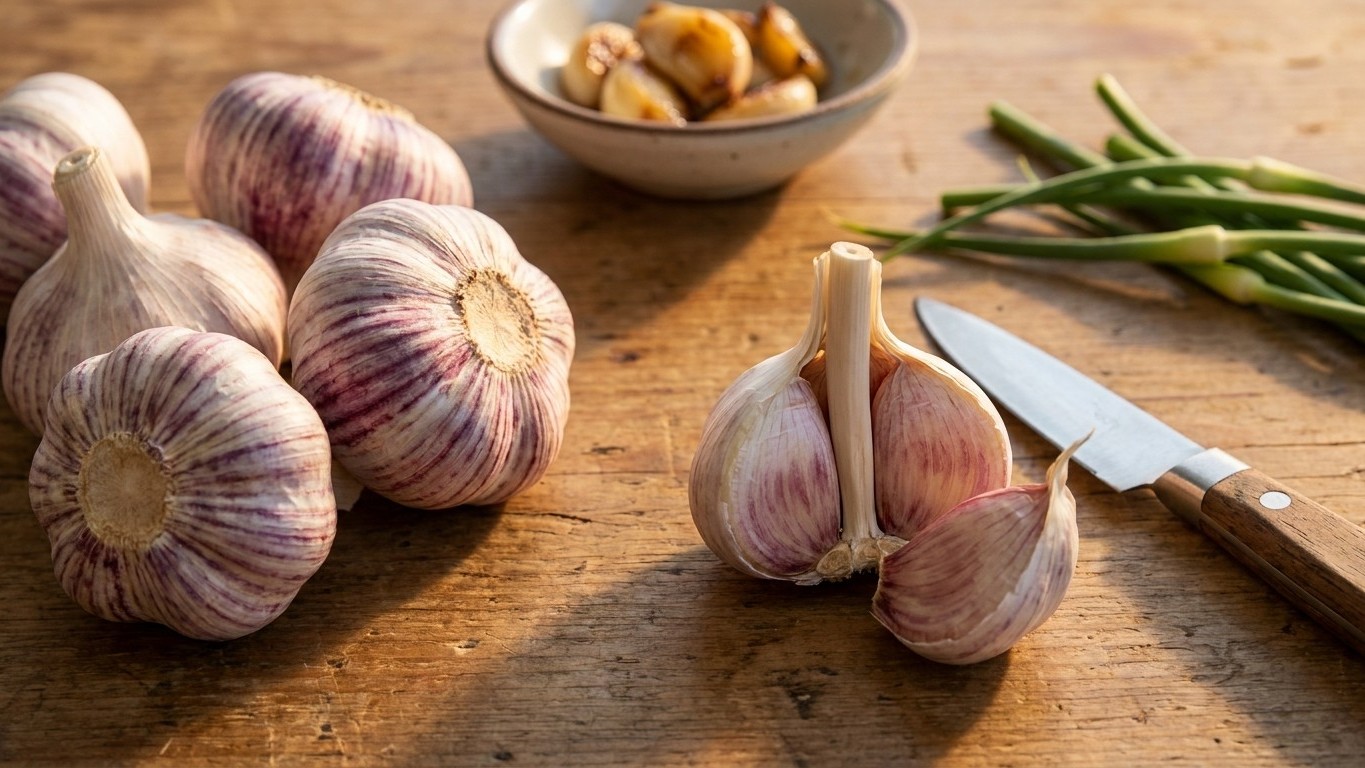

Garlic in Nevada gets lifted the summer after it’s planted, not on a fixed calendar date, and it’s the leaves, not the month, that tell you it’s time. Once the lower third to half of the plant has browned while the top stays green, you dig. From there, curing takes two to four weeks in a dry, shaded, ventilated spot, and storage runs cool, dark, and dry through the winter that follows.
When garlic is ready to lift in Nevada
The plant doesn’t check a calendar, and neither should you. Garlic bulbs finish sizing when the leaves start dying back from the bottom up, a process that can land anywhere from late spring to late summer depending on where in Nevada you’re growing. The state runs from low desert basins around 2,000 feet to high desert valleys near 5,000 feet to mountain country well above that, and each band pushes the harvest window in a different direction.
That spread traces straight back to fall, when the crop went into the ground. Garlic needs a real cold period to divide properly into cloves, and the date the ground actually freezes swings wildly across the state. NOAA NCEI’s 1991-2020 Climate Normals put the first fall freeze at the Las Vegas airport station somewhere between December 8 and December 23, the window where freeze probability sits between 30 and 70 percent. That’s a genuinely late date, and it reflects an urban desert floor holding heat longer than almost anywhere else in the state. It is not a number you can borrow for Reno, Carson City, or any elevation planting, where frost can arrive months earlier in fall and linger months later in spring. Treat that Las Vegas figure as a description of one extreme corner of Nevada, not as guidance for the state as a whole, and check your own county’s typical freeze dates through the University of Nevada, Reno Extension before you plan a fall planting date. And even where a date is known, remember it’s a midpoint: in roughly half of all years, the actual frost lands later than that.
Reading the plant instead of the calendar
| Nevada region | General elevation feel | Bulbs typically finish |
|---|---|---|
| Low desert valleys (Las Vegas area) | Around 2,000 ft, hot early in the season | Late spring to early summer |
| High desert valleys (Reno, Carson City) | Roughly 4,500 to 5,000 ft | Mid to late summer |
| Mountain and higher valleys | 5,500 ft and above | Late summer |
Stop watering about two weeks before you expect to dig. Wet soil at harvest softens the wrapper leaves and invites staining, and Nevada’s dry air recovers fast once irrigation stops. Loosen the soil with a fork rather than yanking by the stalk, since a snapped neck ruins a bulb’s storage life before curing even starts.
Curing it, and where to hang it here
Curing is where a lot of Nevada gardeners lose bulbs they worked hard to grow, usually by getting the light and airflow backward. The goal is slow, even drying in shade, not a fast bake in direct sun. Nevada’s low humidity is genuinely an advantage for this step, but the same dry air comes paired with summer heat that can climb well past what a curing bulb wants to sit in, so shade matters more here than in a milder climate.
Lay or hang bulbs, leaves still attached, somewhere shaded with a steady breath of air moving through, for two to four weeks. A covered porch, an open carport, or a garage with the door cracked for airflow all work better than a closed shed, which can turn into an oven under a Nevada summer sun even with the door shut. Avoid rooms cooled by an evaporative cooler during this stage; swamp coolers add moisture to the air by design, and that humidity is exactly what slows curing and invites mold on the necks.
Signs it’s actually done
- The neck above the bulb feels tight and papery, not soft or rubbery
- Outer wrapper layers rustle and look dry, not glossy
- Roots have shrunk and dried rather than staying plump
Once cured, trim the roots close and cut the tops down to an inch or two if you’re not braiding softneck varieties. Brush off loose dirt by hand rather than washing the bulbs; water at this stage undoes weeks of drying in a single afternoon.
Storing it through a Nevada winter
Cured garlic wants three things through the cold months: cool temperatures, low light, and moderate humidity, roughly in the 45 to 60 percent range. That last part is the trickiest one to hit in Nevada. Many homes here, especially in the Las Vegas valley, are built slab-on-grade with no basement, which removes the naturally cool, stable storage spot that gardeners in other regions lean on without thinking about it.
An unheated garage, a mudroom, or an interior closet on an exterior wall tends to work better than a kitchen pantry warmed by forced-air heating. Central heat dries indoor air aggressively through a Nevada winter, and while garlic tolerates dry conditions far better than most stored produce, months of very low humidity will eventually shrivel cloves faster than you’d like. A mesh bag, a loosely woven basket, or a cardboard box with holes punched in the sides all beat a sealed plastic container, which traps the little moisture the bulbs give off and encourages rot from the inside.
What to check periodically
Walk through stored bulbs every few weeks and pull anything that’s gone soft or started sprouting before it spreads to its neighbors. A single bulb breaking down in a bag can dampen and spoil the ones pressed against it, so isolation is the cheapest insurance you have. Bulbs held back for next fall’s planting should be kept separate from the ones destined for the kitchen, since you’ll want to pick your largest, cleanest cloves for seed stock and it’s easier to do that before storage than after.
What goes wrong here
University of Nevada, Reno Extension documents a specific set of pests for the state, and it’s worth knowing which ones actually show up around garlic beds and curing areas: aphids, cabbage moth, earwigs, elm leaf beetle, Japanese beetle, Mormon cricket (Anabrus simplex), shield bugs (stink bugs), squash bug (Anasa tristis), and tomato hornworm. Garlic isn’t the preferred target for most of this list, but earwigs in particular will tuck themselves into loose bulb wrappers during curing if bulbs are laid directly on damp ground or dense mulch, and aphids working over neighboring vegetable plants can weaken overall garden vigor in a bed that includes garlic.
The bigger failure mode in Nevada isn’t a pest at all, though. It’s heat mismanagement at curing time. Bulbs left drying in direct summer sun can effectively cook inside their wrappers, turning cloves soft and off-flavored well before any mold shows up. The fix is simple and already covered above: shade, airflow, no direct sun, full stop.
The second common mistake is pulling bulbs too early because the calendar says “summer” and the gardener assumes that means done. A bulb dug while most of its leaves are still green hasn’t finished sizing and won’t develop the tight wrapper layers that make for good storage. The third is storage humidity swinging the wrong direction, either too dry from months of forced-air heat causing shriveling, or too damp from a garage that shares air with an evaporative cooler, which invites the rot that undoes a good harvest and a careful cure in a matter of weeks.
Common questions
Can you harvest garlic early if the leaves haven’t yellowed yet?
You can, but the bulbs won’t have finished dividing into full-sized cloves, and the wrapper layers will be thinner and more prone to bruising. Waiting for the lower leaves to brown while the top stays green gives the bulb its best shot at a firm cure.
How long does cured garlic actually last in Nevada storage?
That depends heavily on how dry your storage spot runs and how consistently you check bulbs for soft spots, and no single figure applies evenly across the state’s range of home types. Checking stored bulbs every few weeks and pulling anything soft is the most reliable way to extend what you’ve got.
Should you wash garlic bulbs before curing them?
No. Brush off loose soil by hand and let the bulbs cure with their dirt intact rather than rinsing them, since added moisture at this stage slows drying and can trigger mold on the neck and wrapper layers.
Does curing differ for hardneck versus softneck garlic in Nevada’s dry heat?
The core process, shade, airflow, two to four weeks, is the same for both. Softneck varieties lend themselves to braiding once cured, since their necks stay flexible, while hardneck varieties are usually better cut and stored loose or in mesh bags because their stiff central stalk doesn’t braid well.