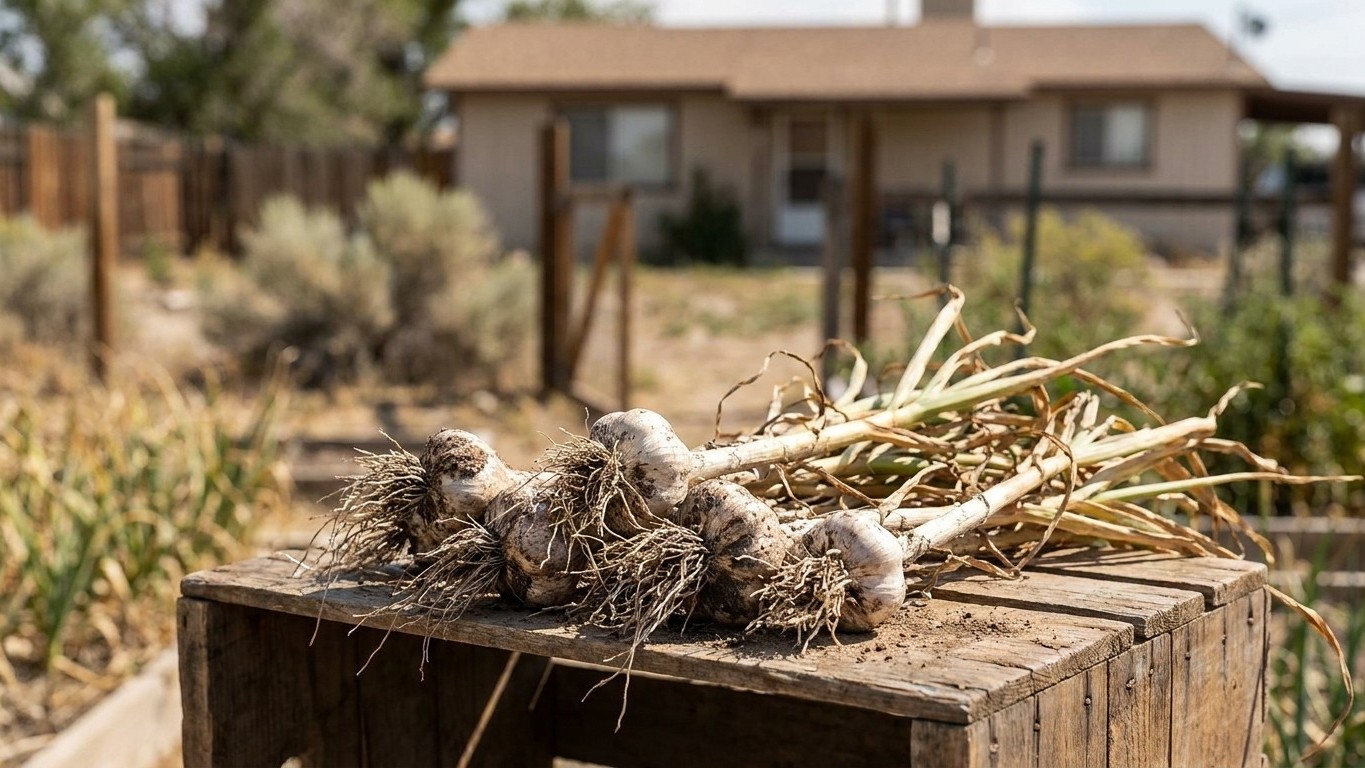

Garlic gets more than enough winter cold across Nevada, even in the low desert around Las Vegas, where NOAA’s 1991-2020 climate normals show winters holding roughly 8.7 weeks below 40°F, well past the six to eight weeks University of Georgia Extension says a clove needs to split into a full head. The harder question in this state is not whether it gets cold enough, but when to plant, since Nevada runs from low, hot desert valleys to high, cold basins where the first freeze can land months apart. Call your county’s UNR Extension office before you buy cloves, check the Garlic Varieties That Suit Nevada Winters guide, and set your date off the ground’s cooling, not the calendar.
Will garlic get the cold it needs in Nevada

Garlic does not divide into cloves just because you plant it. A clove needs a real stretch of cold after it goes into the ground, or it grows into one round, undivided bulb that looks more like a shallot than a head of garlic. University of Georgia Extension, publication C854, puts that requirement at six to eight weeks with temperatures below 40°F.
NOAA’s 1991-2020 climate normals for the Las Vegas reference station show close to 8.7 weeks a year with mean temperatures below that mark, measured at the same low-desert airport station used for the frost figures below. That station sits in Nevada’s hottest, driest valley floor, and it still clears the requirement with room to spare.
What this means for the rest of the state
Reno, Carson City, and the high desert basins across the middle of the state sit at far higher elevation and see winters that run colder and longer than the Las Vegas valley. If the mildest corner of Nevada already banks enough chilling hours, the rest of the state is not in question. Garlic planted anywhere in Nevada gets its cold.
Compare that to a state like New Brunswick, where a reliably harsh winter does the vernalizing work without any help from the grower. Nevada’s climate is far more varied, but growers here do not need the trick some warm-climate gardeners use of refrigerating cloves for a few weeks before planting to fake a cold snap. That step is unnecessary in open ground anywhere in this state, winter or valley floor, the chilling gets done on its own.
When to put the cloves in
Garlic wants to go into the ground late enough that it does not push much leaf growth before a hard freeze locks up the soil, but early enough to grow real roots first. That makes the first fall freeze the anchor date, not a month on the calendar.
Reading the only frost figure available
The only frost figure on record for Nevada comes from NOAA NCEI’s 1991-2020 climate normals for the airport station in Las Vegas, which puts the first fall freeze in a window from December 8 to December 23. That is about as late and as mild as a Nevada winter gets, so check When to Plant Garlic in Nevada for your own area before settling on a date. Las Vegas sits low in the desert, and its airport reading carries a strong urban heat-island effect on top of that. It is not a planting date for the state. Reno and Carson City, and any garden with real elevation gain, see their first freeze months earlier in the fall and their last freeze months later in spring.
Working from a Las Vegas-style freeze
For a low desert valley on the Las Vegas pattern, growers typically set cloves in the weeks before that freeze window closes, which lands in mid-November to early December for the varieties listed below. That timing gives roots several weeks to establish in soil that is cooling but not yet frozen solid.
Anywhere else in Nevada, don’t borrow that date. Watch the soil instead of the calendar: once nighttime lows are routinely biting and the topsoil has cooled but is still workable, cloves should go in within the next couple of weeks. States with a single, reliable cold season, like Wyoming, can hang a planting date on one frost figure. Nevada’s elevation range, from around 2,000 feet in the low desert to well over a mile high in the Great Basin, means no single date does that job here. Local growers and your county extension office read that moment far better than any statewide average.
Which types suit Nevada
Nevada’s winters are cold enough almost everywhere to satisfy either type of garlic. The choice between hardneck and softneck here comes down to summer heat and how long the crop needs to keep, not whether the ground gets cold enough to split a clove.
Hardneck for the high, cold basins
Hardneck garlic sends up a stiff central stalk, called a scape, and tends to produce fewer, larger cloves arranged around it. It generally wants a real winter to perform well and struggles through prolonged, extreme summer heat. That fits the mountain valleys and high desert basins around Reno, Carson City, and the rest of the Great Basin, where summer heat runs milder than in the low desert. Catalogue hardnecks worth trying in these cooler parts of the state include Bavarian Purple, Blue Music, Chesnok Red, Duganski, Fall Festival, Georgian Crystal, Georgian Fire, German Red, German White, and Ivan.
Softneck for the low desert valleys
Softneck garlic skips the scape, braids well, and packs tighter, more numerous cloves around the stem. It shrugs off heat and drought better than most hardnecks and, just as important for a desert grower, it stores for months longer after curing. That makes it the safer bet for Las Vegas, Pahrump, and the rest of the low, hot desert valleys in the southern part of the state. Softneck options on the approved list here include Early Red Italian, Inchelium Red, Italian Late, and Lorz Italian.
| Trait | Hardneck | Softneck |
|---|---|---|
| Winter cold needed to divide | Wants a real cold season | Tolerates mild winters too |
| Summer heat and drought | Stresses under prolonged extreme heat | Handles heat and dry spells well |
| Storage life after curing | Several months | Many months longer |
| Scape | Sends up a scape to cut | No scape |
Soil and bed preparation
Garlic sits in the same bed for eight or nine months, through the coldest, wettest stretch of the year and then into the heat of early summer. Drainage matters more than fertility at planting time, because a clove sitting in saturated soil through winter rots before any disease organism even gets involved.
Building the bed
Work compost into the top several inches of soil a few weeks before planting, and raise the bed above the surrounding grade if your soil is heavy clay or if water tends to pool anywhere nearby during a wet spell. Nevada’s soils run from sandy in the low desert valleys to heavier, alkaline ground in some of the agricultural valleys further north, and either extreme benefits from organic matter worked in ahead of planting.
Test pH and salinity before you plant a bed that hasn’t grown garlic or onions before. Desert soils can run alkaline and sometimes carry enough salt to stunt young roots, and a soil test through your county extension office is the only way to know what you’re dealing with rather than guessing.
Clear the bed of the summer’s crop residue and weeds well ahead of planting, since garlic’s low canopy does not compete with weeds trying to get started around it over winter. A layer of finished compost worked in now feeds the crop through spring without pushing the soft, salt-sensitive new roots into contact with anything stronger.
What the climate here favours, and what it does not
The thresholds below come from UC IPM’s Pest Management Guidelines for Onion and Garlic, UC ANR Publication 3453, and they’re published as soil temperatures, while the figures here are monthly mean air temperatures measured at one reference station. Soil lags air by weeks and swings far less within a single day, so treat these as a tendency toward risk in a given month, not a forecast of infection. A monthly average sitting inside a disease’s range does not mean every day that month was inside it, and one station does not describe the whole state.
Where the risk concentrates
- Fusarium basal rot (Fusarium oxysporum f. sp. cepae): mean air temperature falls in the published 59-90°F range in six months of the growing season, September, October, March, April, May and June, including one at the published optimum.
- White rot (Sclerotium cepivorum): falls in the published 50-75°F range in five months, October, November, February, March and April.
- Southern blight (Sclerotium rolfsii): reaches the published 86-95°F optimum in two months, June and July.
- Pink root (Setophoma terrestris): reaches the published 75-85°F optimum in two months, September and May.
Basal rot and white rot have the widest windows here, six and five months respectively, spanning most of the planting-to-harvest calendar rather than a single season. That does not mean either disease is guaranteed to show up. It means Nevada’s air temperatures don’t rule them out at any point most growers have garlic in the ground, so the real defense is planting clean, disease-free seed stock rather than replanting from a bulb that showed soft or discolored rings the year before.
Southern blight and pink root only line up with their optimum in the hottest two months of summer, by which point most Nevada garlic is already lifted and curing, so neither gets much of a run at a living crop most years. None of these four is off the table entirely, though. Infected planting stock or contaminated soil can bring any of them in regardless of what the thermometer says, which is why seed source matters more than any spray program.
Getting it through the winter
Mulch is what turns a clove planted at the right depth into a clove that actually survives to spring intact. Straw, shredded leaves, or clean grass clippings laid over the bed after planting insulate the soil against sharp temperature swings, which a desert climate delivers even on a day that felt warm.
Depth, timing, and heaving
Plant cloves root-down at a depth that leaves the tip covered by a couple of inches of soil, then add mulch once the ground has started to cool but before a hard freeze locks it up. A clove set too shallow, or left under a thin mulch layer in a valley with a real freeze-thaw cycle, risks frost heaving, where repeated freezing and thawing pushes the clove partway out of the ground and exposes it to drying air and cold it was never meant to face directly.
In the colder basins around Reno and Carson City, where the ground freezes and thaws repeatedly through winter, a generous mulch layer left in place through the cold months does the most good, since it buffers exactly the freeze-thaw swings that cause heaving. In the low desert valleys around Las Vegas, winters run milder and mulch mostly conserves soil moisture and blocks winter weeds rather than preventing heaving.
Pull the mulch back partway once new green growth pushes up in spring, so the shoots aren’t smothered and the soil can warm, but leave a thin layer in place to suppress weeds and hold moisture through the dry months ahead. Do not strip the bed bare the moment you see green. A late cold snap can still nip exposed new growth back before the plant recovers the lost time.
Harvest and curing here
Pull garlic by the state of the leaves, not by a date on the calendar. Once the lower third to half of the leaves have browned and dried back while several upper leaves are still green, the bulb has usually stopped filling out and wrapper skins are set enough to hold through curing. Pull too early and the bulb won’t have separated into full-size cloves. Wait until every leaf browns and the wrapper skins may already have split, letting soil and rot organisms straight into the cloves.
Curing in a dry, hot climate
Nevada’s summer air is dry almost everywhere in the state, which helps with curing garlic: mold and soft rot, the two things that ruin a curing crop in a humid climate, have a harder time getting started here. The risk runs the other way instead. Direct summer sun on a curing bulb can scald the outer cloves before the wrapper skins finish sealing, so cure in a shaded, well-ventilated space, a carport, covered porch, or open shed with a fan running, rather than laid out on open ground in full sun.
Leave the whole plant, leaves and roots attached, hanging or laid out in single layers with air moving around it for several weeks until the neck is fully dry and tight and the outer wrapper feels papery rather than damp. Only then trim roots and tops and move the bulbs to storage. Rushing this step in the name of a dry climate is a common way growers lose a Nevada garlic crop after the hard part, getting it through winter, is already behind them.
Local help
County-level planting dates, soil test results, and disease pressure vary enormously across a state that runs from low desert to high mountain valley, and no statewide date fits all of it. UNR Extension is the source to check before finalizing a planting date or variety list, since its county offices track local frost patterns and soil conditions no national database captures at this resolution. Find your county office through UNR Extension before cloves go in the ground.
Common questions
Can I Plant Garlic in spring instead of fall in Nevada?
You can, but expect small, undivided or poorly divided bulbs, since garlic needs that long cold stretch after planting to split properly. Fall planting ahead of the local freeze window is what lets the clove vernalize and size up through the following season.
Do I need to refrigerate my garlic cloves before planting in Las Vegas?
No. Even the Las Vegas area, Nevada’s mildest and driest corner, clears the chilling hours garlic needs according to NOAA’s climate normals. Refrigerating cloves before planting is a workaround for climates that don’t get reliably cold, and that isn’t the case anywhere in Nevada.
Can I plant garlic from the grocery store?
You can try it, but it carries more risk than buying certified seed garlic. Grocery bulbs are sometimes treated to slow sprouting, are rarely labeled by variety, and can carry basal rot or white rot pathogens into a bed where those diseases can then persist for years.
How much water does garlic need over a Nevada winter?
Enough to keep the soil from drying out completely, since Nevada’s winters bring little natural precipitation compared to wetter states. Check soil moisture under the mulch every few weeks during dry stretches and water if it’s gone powder-dry, but don’t keep it soggy.
Do I have to cut the scapes on my hardneck garlic?
Cutting the scape once it curls redirects the plant’s energy into the bulb instead of the flower stalk, and most growers find it produces larger bulbs at harvest. Softneck varieties don’t send up a scape at all, so this only applies to the hardneck types on this list.