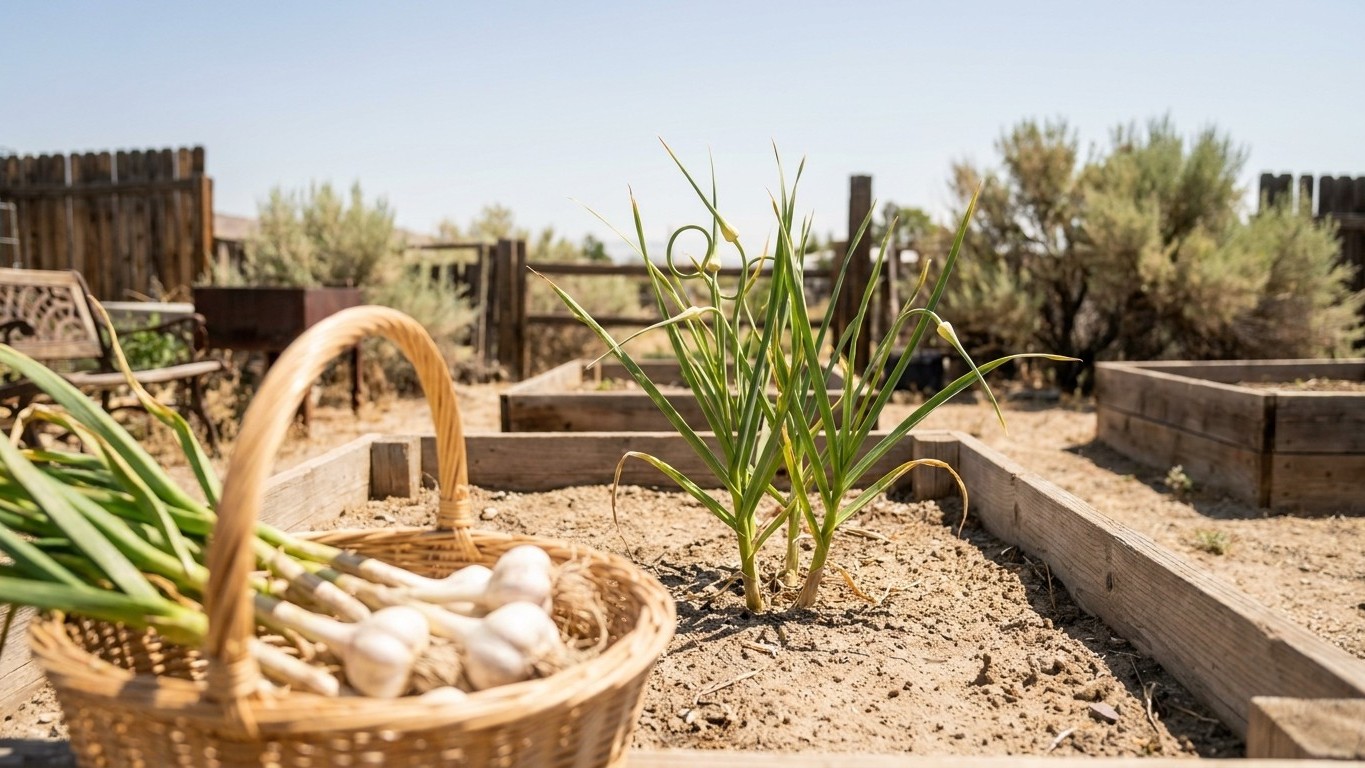

Mid-November to early December is when garlic goes in the ground almost anywhere in Nevada, cloves need six to eight weeks of root growth before the soil locks up for winter, and that stretch of weeks is what actually sets the date, not the calendar itself. Frost arrives on its own schedule depending on where you sit in the state, so before you dig, find your own county’s average first frost date and count back six to eight weeks from it. That’s the date to plant, whatever the general window says.
The short answer for Nevada

For most Nevada gardens, garlic goes into the ground mid-November to early December, for both a softneck such as Early Red Italian and a hardneck such as Fall Festival. That window isn’t tied to a single frost date. It’s built around the six to eight weeks garlic needs after planting to grow enough root before the ground freezes solid and top growth stops for the winter.
Where does frost actually fit into that math? NOAA’s 1991-2020 U.S. Climate Normals put Las Vegas’s first fall freeze (32°F) at a 30 to 70 percent probability window between December 8 and December 23. That’s a probability band, not a guarantee. Since it marks roughly the midpoint of the freeze-risk curve, frost falls later than this window in about half of all years, and earlier in the other half. Las Vegas is also the mildest, latest-frosting corner of Nevada by a wide margin. Its number describes the valley floor around the airport, not the state. Reno, Carson City and anywhere with real elevation freeze months earlier in the fall.
One figure is worth keeping regardless of where in Nevada you garden. University of Georgia Extension research (bulletin C854) puts garlic’s post-planting chilling requirement at six to eight weeks below 40°F for the clove to split properly into a bulb the following summer. Even Las Vegas, the mildest possible reading of Nevada’s winter, logs about 8.7 weeks below 40°F, comfortably past that threshold. Anywhere colder in the state clears it with room to spare. Chilling isn’t the variable that decides your planting date in Nevada. Frost timing and planting depth are.
Working it out for your own garden
The six-to-eight-week rule only works if you start from a frost date that actually applies to your yard. Nevada spans low desert valleys, high desert basins and mountain-fringed towns, and a single number from one reporting station won’t cover all of them.
The arithmetic, shown
Start with your county’s average first fall frost, which UNR Extension can point you to at the county level. Count back six to eight weeks from that date. For Las Vegas, NOAA’s 1991-2020 normals put that freeze between December 8 and December 23. Counting back eight weeks from the earlier end lands in mid-October; counting back six weeks from the later end lands in early November, which is earlier than the mid-November to early-December window most Nevada gardeners actually use.
That gap between the calculation and the general window is the point. The mid-November to early-December range works for the bulk of Nevada’s populated valleys, where frost lands well before Las Vegas’s does, but it isn’t a fixed law. If your own county extension figures put your first frost earlier than Las Vegas’s, which is true almost everywhere else in the state, move your planting date earlier by roughly the same number of weeks you’re short.
Elevation is the biggest single factor. Every rise in elevation pushes the first frost earlier and the ground-freeze date closer behind it, shortening the runway cloves get to root before dormancy. A large body of water works the other way. The Lake Tahoe basin and other sizeable lakes moderate the immediate shoreline, delaying frost there even while the surrounding high desert has already frozen. Neither effect is uniform, so a date from a neighboring town ten miles away and a thousand feet higher is not your date.
The varieties available for Nevada planting all carry the same set-out window because the constraint is regional, not varietal. Days-to-maturity differences among them show up next summer at harvest, not this fall at planting.
| Variety | Type | Set-out window |
|---|---|---|
| Early Red Italian | Softneck | Mid-November to early December |
| Inchelium Red | Softneck | Mid-November to early December |
| Italian Late | Softneck | Mid-November to early December |
| Lorz Italian | Softneck | Mid-November to early December |
| Bavarian Purple | Hardneck | Mid-November to early December |
| Blue Music | Hardneck | Mid-November to early December |
| Chesnok Red | Hardneck | Mid-November to early December |
| Duganski | Hardneck | Mid-November to early December |
| Fall Festival | Hardneck | Mid-November to early December |
| Georgian Crystal | Hardneck | Mid-November to early December |
| Georgian Fire | Hardneck | Mid-November to early December |
| German Red | Hardneck | Mid-November to early December |
| German White | Hardneck | Mid-November to early December |
| Ivan | Hardneck | Mid-November to early December |
For a rundown of how these varieties differ once they’re in the ground, Garlic Varieties That Suit Nevada Winters covers the harvest-end differences that this planting-date math doesn’t touch.
What changes across Nevada
Nevada’s frost calendar runs on elevation more than on latitude. Reno and Carson City sit thousands of feet higher than Las Vegas, and both freeze months earlier in the fall and stay frozen months later into spring than the Las Vegas figures above describe. A planting window built around Las Vegas’s December frost simply doesn’t reach growers in the Truckee Meadows or the Carson Valley, who need cloves in the ground and rooting well before that.
The Las Vegas Valley itself is a special case even within the low desert. Its pavement and urban mass hold heat long after sunset, pushing the first freeze later than the surrounding open desert. NOAA’s own figures come from the airport, in the thick of that urban heat island, so even other towns in Clark County can see frost arrive noticeably earlier than the Las Vegas number implies.
High desert and mountain-fringe towns
Away from the valleys, Nevada’s high desert basins, where much of the rural population gardens, cool faster once the sun starts setting earlier in the fall, and clear night skies at elevation let heat radiate away quickly. That combination means an earlier, harder freeze than a Las Vegas-based calculation would predict, and less margin for a garlic bed that goes in late.
Large water bodies push in the opposite direction. The Lake Tahoe basin’s climate is shaped as much by the lake as by its elevation. Water holds heat longer than dry ground, so shoreline gardens there can lag the surrounding mountain terrain’s freeze by real time, even while sitting at an elevation that would otherwise argue for planting weeks earlier than the valley floor.
None of these effects are numbers you can borrow from one town and apply to the next. Check your own county’s frost record rather than assuming Reno’s timeline, Las Vegas’s, or Tahoe’s applies to your garden.
The mistakes this climate punishes
Planting too late for the ground you’ve got is the most expensive mistake in Nevada. Garlic needs those six to eight weeks of root growth before real dormancy sets in, and in the state’s colder basins the soil can lock up hard well before Las Vegas even sees its first light frost. A clove tucked in during a warm spell in early December, at elevation, may not have rooted at all before the ground freezes around it, and a shallow-planted, unrooted clove is a clove that heaves right out of the soil over winter.
Disease risk that survives any winter
The opposite assumption, that Nevada’s cold winters make garlic disease a non-issue, doesn’t hold up either. According to UC IPM’s Pest Management Guidelines for onion and garlic (UC ANR Publication 3453), Fusarium basal rot occurs across a 59-90°F range, and the mean air temperature in Nevada’s growing season falls inside that range in six separate months, including one at the pathogen’s own optimum. White rot‘s range, 50-75°F, overlaps five months of the growing season. These are air-temperature averages from one reference station standing in for soil conditions that lag and swing less, and a monthly average hides plenty of days on either side of it, but the overlap is wide enough that neither disease should be treated as unlikely just because Nevada is a cold-winter state.
- Buying uncertified seed garlic, including grocery-store bulbs, which can carry both fungi into a bed that would otherwise never see them
- Replanting cloves from a bed that showed stunted or yellowing plants the previous year
- Keeping soil consistently wet through the cool months, the exact condition white rot favors
Southern blight and pink root need real heat to get going, 86-95°F and 75-85°F respectively, which in Nevada’s growing season shows up mainly in early fall and again as summer returns before harvest. That’s a reminder that climate only sets the odds. Infected seed stock can bring any of these four diseases into a garden regardless of how many months the thermometer spends outside their preferred range.
Checking this against your county
Everything above is built from one reporting station in the warmest corner of the state. Your county’s average first frost, and the planting window that follows from it, can differ by weeks. The University of Nevada, Reno Extension maintains county-level offices across the state and is the right place to ask for a frost date specific to your area, rather than adjusting the Las Vegas figures yourself and hoping the guess holds.
Once you have that number, the six-to-eight-week count-back described above still applies. It’s the frost date that needs to change, not the arithmetic. For a fuller run-through of soil prep, spacing and how to handle these varieties once they’re in the ground, Growing Garlic in Nevada covers those details.
Common questions
Can I still Plant Garlic in January if I missed the fall window?
You can, but don’t expect a full-size crop. Garlic planted that late misses most of its six-to-eight-week rooting period and much of its winter chilling, so it tends to come up as a small, single, unclustered bulb rather than a properly divided head. If you’ve missed the window, it’s usually better to hold the seed stock and plant it on the next fall’s schedule.
Does it matter if I plant hardneck or softneck for Nevada’s cold?
Not for winter survival. Both types get more than enough chilling anywhere in Nevada, since even the mildest part of the state clears the threshold garlic needs to split into cloves. The choice between hardneck and softneck comes down to flavor, storage life and clove count, not whether your winter is cold enough.
Where do I find my county’s actual frost date instead of Las Vegas’s?
Your county extension office is the right source, since it can give you figures specific to your town rather than one airport reading from the far end of the state. Ask specifically for average first and last frost dates, since those are what the planting math above depends on.
What happens if I plant too shallow or too deep?
Too shallow and a clove sitting near the surface is more exposed to a freeze-thaw cycle that can push it up and out of loose soil over winter. Too deep, and it spends extra energy pushing through soil before it reaches light in spring, which can delay and weaken emergence. Neither ruins the crop outright, but both cut into yield.
Some gardeners also time this by the Moon: when to plant garlic by the moon, as almanac tradition rather than fact.