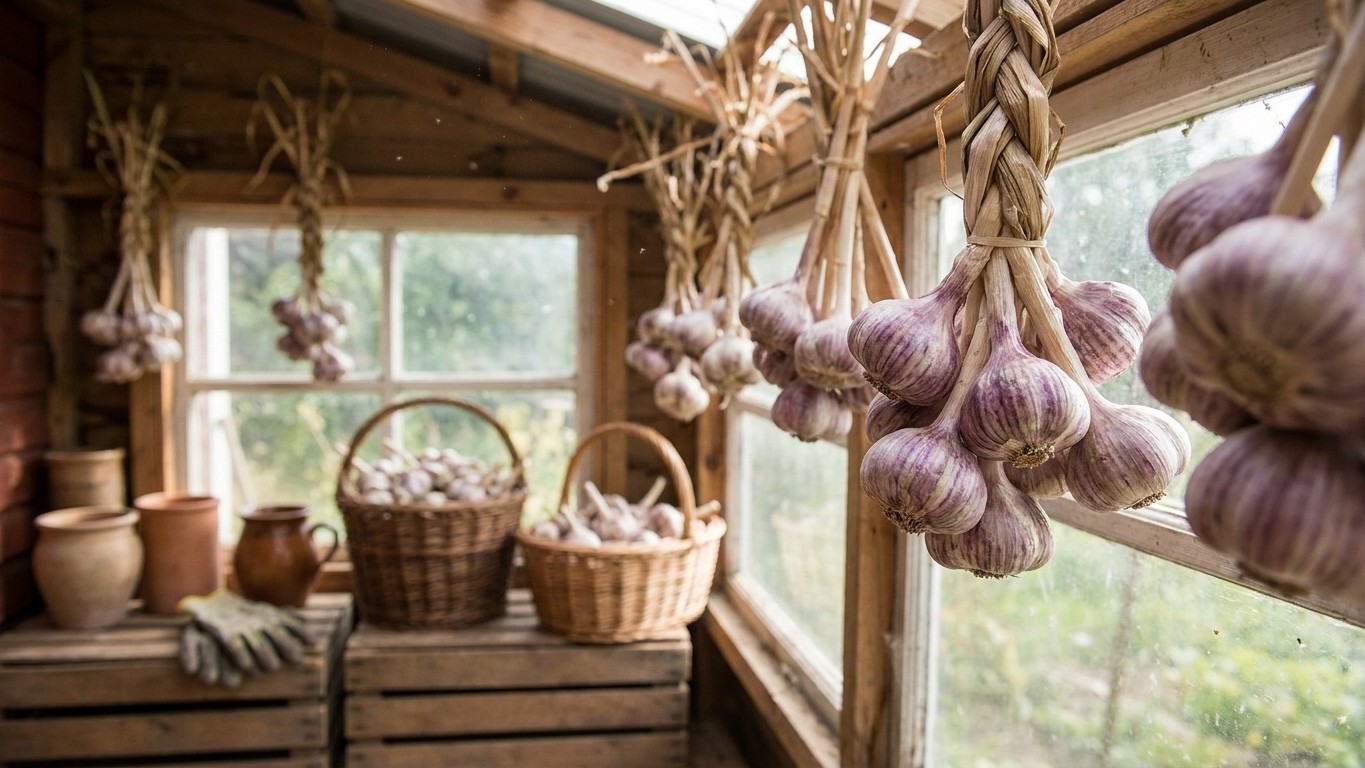

Garlic in Newfoundland and Labrador goes in the ground in autumn and comes out the following summer, once the bottom leaves have browned off and the top few are still green. Curing needs a dry, shaded, breezy spot, because the province’s coastal damp draws out the process longer than growers see inland. Storage after that means cool, dark, and dry, not a damp basement.
When garlic is ready to lift in Newfoundland and Labrador
The clock on a garlic bulb actually starts the autumn before, when cloves go into the ground ahead of the ground locking up for winter. Environment and Climate Change Canada’s climate normals put the average first fall frost at the ST JOHN’S A station at October 17, drawn from the 1981-2010 normals period. That date is a mean, not a guarantee: in one year out of two, frost actually arrives later than October 17. Growers who plant by that date alone can get caught out, and it’s worth remembering that this figure comes from one weather station in St. John’s. Labrador and the island’s interior and western districts run their own clock, often weeks behind the Avalon Peninsula.
Once the cloves have wintered over and pushed up leaves in spring, the countdown to harvest is measured in leaf color, not a fixed number of days on a calendar. A garlic plant carries roughly the same number of leaves as it will carry wrapper layers around the finished bulb, and each leaf that browns off from the bottom up costs the bulb one of those protective layers. The commonly used signal, used by garlic growers across cool climates, is to lift when the bottom third to half of the leaves have died back and gone brown, while several leaves up top are still green. Pull too early and the bulb hasn’t filled its cloves. Wait too long and the wrapper splits, the cloves separate in the ground, and the bulb won’t keep.
Because the island’s growing conditions shift so much from the Avalon to the west coast to Labrador, the safest approach is a test dig rather than a date on the wall. Pulling one bulb from the end of a row and slicing it in half shows whether the cloves have formed distinct segments with intact skins. If they have, and the outer wrappers are still whole rather than papery and thin, the rest of the row is likely ready within a few days. Checking a plant beats trusting a calendar, especially in a province where one weather station’s frost date can’t speak for every garden bed from Corner Brook to Happy Valley-Goose Bay.
Curing it, and where to hang it here
Curing is what turns a freshly pulled bulb, still damp from the soil, into something that will keep through a Newfoundland winter without rotting from the inside. The bulb needs weeks of airflow in a shaded, dry space before the outer skins fully seal and the neck tightens down. Skipping this step, or rushing it, is the single biggest reason home-grown garlic goes soft in storage by December.
The process itself is simple. Brush off loose soil but don’t wash the bulbs, and don’t trim the tops or roots yet. Hang the plants in loose bunches, or lay them on a screen or a length of hardware cloth so air moves underneath as well as around them. What matters most is airflow and shade, not warmth. Direct sun on curing garlic can scald the outer wrappers, and a damp, still space (a closed-up shed with no cross-breeze) will grow mold on the necks before the bulbs finish drying.
Picking a curing spot in a damp climate
Newfoundland and Labrador’s coastal fog and rain push humidity higher, for longer stretches, than growers deal with in drier inland regions, which is exactly why the choice of curing space matters more here than it would in a dry climate. A few common options, compared on the things that actually cause failures:
| Space | Airflow | Light | Humidity risk |
|---|---|---|---|
| Attached garage | Good with door cracked | Low | Moderate |
| Unheated shed | Depends on venting | Low to moderate | High in fog |
| Screened porch | Very good | Moderate, needs shade | Low |
| Barn or outbuilding | Usually good | Low | Low to moderate |
A screened porch out of direct sun, or a shed with vents open and a small fan running on the foggiest days, tends to outperform a sealed garage where moisture just sits. The bulbs are ready to move to storage once the outer skins are papery, the necks have tightened and gone dry, and there’s no green or give left when you squeeze near the top.
Storing it through a Newfoundland and Labrador winter
Once cured, garlic wants three things for the rest of the season: cool, dark, and dry, with steady air movement around the bulbs rather than a sealed container. That combination is harder to find in a province where indoor humidity runs high for months and where root cellars, common as they are here, can swing damp depending on the season.
After curing, trim the roots close and cut the tops down, leaving an inch or so of neck if you’re not braiding, or leave the tops long if you are. Store the bulbs loose in mesh bags, open crates, or braided into ropes and hung, anywhere air can pass through the pile rather than pool inside a sealed bag or bin. A closed plastic bag is one of the fastest ways to turn cured garlic into mush, because trapped moisture has nowhere to go.
Root cellars, cold porches, unheated back entries, and garages that don’t freeze solid all work, provided the space stays dry rather than damp. That’s the catch in a coastal climate: a root cellar dug into wet ground, or a basement near a sump pump, tends to run humid enough to bring mold back even on well-cured bulbs. Checking the stored garlic every few weeks through the winter, and pulling any bulb that’s gone soft or sprouted, keeps one bad bulb from spreading rot to its neighbors in a crate. Garlic that’s sprouting green shoots from the top is telling you the storage spot is running too warm, too damp, or both.
What goes wrong here
Rot is the most common failure, and it almost always traces back to curing in a space that stayed too damp for too long. Bulbs that go into storage with any moisture still trapped at the neck will mold from the inside, often not showing on the outer wrapper until the bulb is already soft. The fix isn’t a fungicide, it’s giving the curing process more time and better airflow before storage, especially after a wet fall.
Pests are a smaller factor for garlic than they are for other garden crops, but they’re not absent. University of Maine Cooperative Extension, whose documented pest list covers this region, names seedcorn maggot (Delia platura) as a pest that attacks seeds and germinating shoots in cool, wet soil, conditions that describe an autumn-planted garlic bed reasonably well. The same extension’s list also documents cabbage maggot, Colorado potato beetle, striped cucumber beetle, squash vine borer, spotted wing drosophila, lily leaf beetle (Lilioceris lilii), browntail moth, winter moth, and emerald ash borer, though those are mostly pests of other garden crops sharing the same yard rather than garlic itself. None of them are a routine problem for a garlic bed the way seedcorn maggot can be right after fall planting.
The other recurring mistake is timing the harvest off a calendar date rather than off the plant. Given how much the growing season shifts across this province, from the Avalon Peninsula to Labrador, a fixed date that worked in one garden can be two or three weeks off in another. Checking leaf color and doing a test dig costs a few minutes and avoids pulling a bulb too early, when it hasn’t filled out, or too late, when the cloves have already separated in the ground and the wrapper won’t hold through curing.
Growers looking for planting and variety guidance specific to the province can check the Newfoundland and Labrador Forestry and Agrifoods Agency for current recommendations.
Common questions
Can I use the October 17 frost date to plan my harvest?
No. That date, from Environment and Climate Change Canada’s normals for the ST JOHN’S A station, marks the average first fall frost, which matters for timing when cloves go into the ground the autumn before. Harvest the following summer is judged by leaf die-back and a test dig, not by counting forward from a frost date.
Should I wash garlic before curing it?
No. Brush off loose soil by hand and leave the bulb dry. Washing adds moisture right before the curing process is meant to remove it, which slows drying and raises the risk of mold at the neck.
Is a root cellar always a good storage spot in this province?
Only if it stays dry. Root cellars are common here, but ones dug into wet ground or sitting near groundwater can run humid enough to bring back rot in bulbs that were cured properly. Cool, dark, and dry matters more than the label “cellar.”
What does a sprouting bulb in storage actually mean?
It usually means the storage spot is too warm, too damp, or both. Garlic kept cool, dark, and well-ventilated stays dormant much longer than garlic left somewhere that swings warm or holds moisture, which is the condition that pushes a bulb to send up a green shoot early.
Related guides
- When to Plant Garlic in New Hampshire: Counting Back From the First Frost
- Garlic Varieties That Suit New Hampshire Winters
- When to Sow Autumn Spinach in Newfoundland and Labrador
- What to Plant in Newfoundland and Labrador in November
- Growing Parsnips in Newfoundland and Labrador
- Growing Garlic in Newfoundland and Labrador
- When to Plant Garlic in Newfoundland and Labrador: Counting Back From the First Frost
- What Eats Garlic in Newfoundland and Labrador, and When