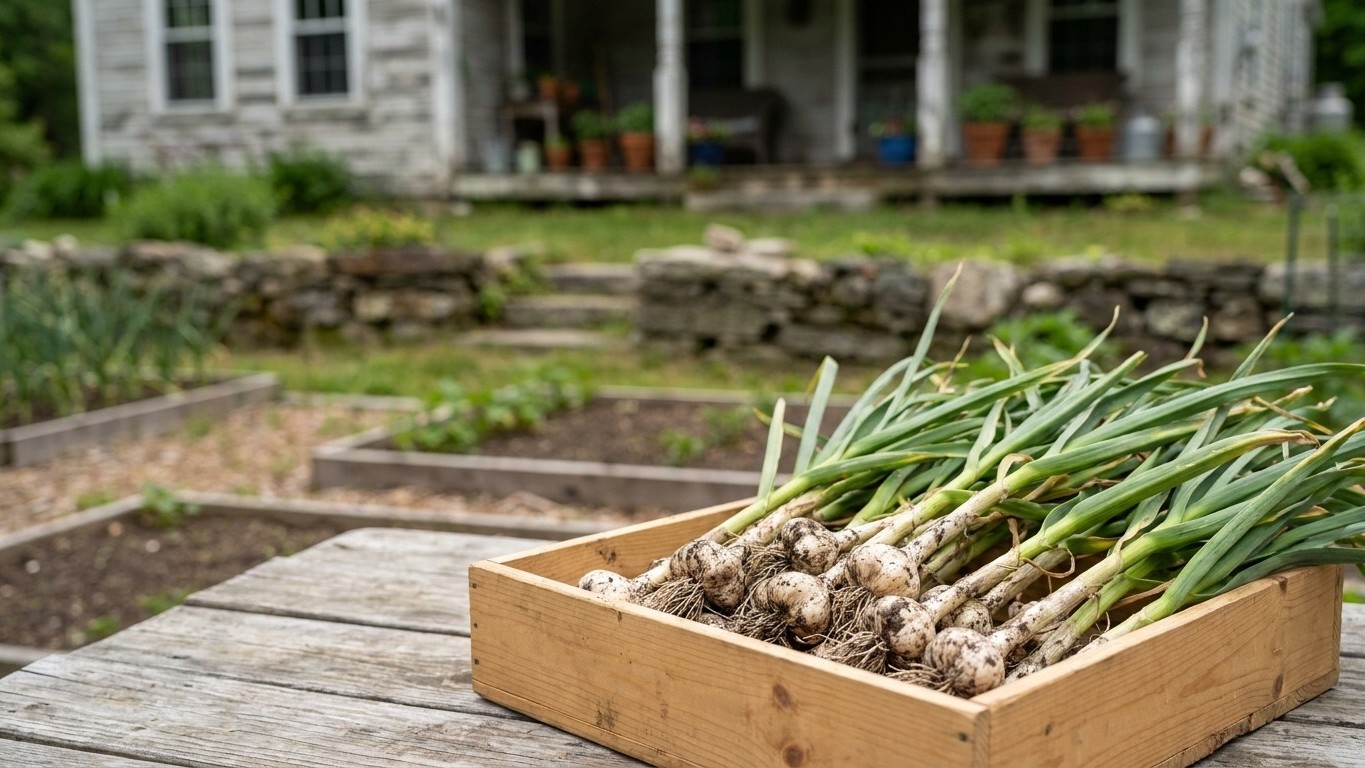

Cold isn’t the question here — nearly every garlic variety survives a New Hampshire winter just fine, hardneck or softneck. What actually decides how your harvest turns out is which one you choose to put in the ground, since that’s the piece that changes garden to garden while the planting window itself doesn’t. So before you order seed garlic, figure out whether you want the bold flavor and easy peeling of a hardneck like German White, or the longer shelf life a softneck like Inchelium Red gives you in storage — that’s the real decision waiting for you this fall.
The short answer for New Hampshire

Plant garlic in New Hampshire from late September to early October. That is the set-out window that applies across the varieties suited to this climate, hardneck and softneck alike, and it holds regardless of which one you pick.
That window is anchored on getting cloves rooted before the ground shuts down for winter, not on the frost date itself. NOAA’s 1991-2020 climate normals put the first fall freeze near Manchester at October 13 to October 26, using the 30-70% freeze-probability band from the agency’s climate normals dataset. Planting in late September to early October gives roots two to four weeks of relatively open soil before that freeze risk climbs, enough time to anchor the clove without pushing much top growth before winter.
| Variety | Type | Set-out window |
|---|---|---|
| Early Red Italian | Softneck | Late Sept to early Oct |
| Inchelium Red | Softneck | Late Sept to early Oct |
| Italian Late | Softneck | Late Sept to early Oct |
| Lorz Italian | Softneck | Late Sept to early Oct |
| Bavarian Purple | Hardneck | Late Sept to early Oct |
| Blue Music | Hardneck | Late Sept to early Oct |
| Chesnok Red | Hardneck | Late Sept to early Oct |
| Duganski | Hardneck | Late Sept to early Oct |
| Fall Festival | Hardneck | Late Sept to early Oct |
| Georgian Crystal | Hardneck | Late Sept to early Oct |
| Georgian Fire | Hardneck | Late Sept to early Oct |
| German Red | Hardneck | Late Sept to early Oct |
| German White | Hardneck | Late Sept to early Oct |
| Ivan | Hardneck | Late Sept to early Oct |
Why the winter itself isn’t the limiting factor
Garlic needs a stretch of cold below 40°F to trigger clove division, a process called vernalization. University of Georgia Extension publication C854 puts that requirement at six to eight weeks. New Hampshire’s own cold record, measured at the same reference station, holds air temperatures below 40°F for 26.1 weeks across the growing season, more than three times what garlic actually needs. The choice between a hardneck like German White or Duganski and a softneck like Inchelium Red or Lorz Italian is not about whether the winter is cold enough. It comes down to storage life and flavor: hardnecks are generally prized for more complex flavor and larger, easier-to-peel cloves, while softnecks such as Inchelium Red and Lorz Italian keep longer in storage.
Working it out for your own garden
The late September to early October window is not something you recalculate fresh each year. It comes from how garlic roots establish: cloves need several weeks of soil above freezing to grow roots before winter shuts growth down, and that timing barely shifts with the weather in a given season. What does shift, garden to garden, is how much runway sits between that planting window and the first hard freeze.
NOAA’s 1991-2020 climate normals put the first fall freeze near Manchester at October 13 to October 26, a range rather than a single date because freeze risk climbs gradually rather than arriving on a fixed day. Planting in late September leaves close to a month before the early end of that range. Planting in early October leaves closer to two weeks. Both work in most years, but the earlier end of the window buys you a wider margin if a cold snap arrives ahead of schedule, which happens in roughly one year out of two by definition, since a frost date is a midpoint, not a guaranteed line.
Reading your own frost record
To work this out for your own ground, start with the nearest weather station’s freeze record rather than assuming Manchester’s applies. The full mechanics of counting backward from a frost date to a planting date, including how to read a station’s freeze probability data, are laid out in When to Plant Garlic in New Hampshire: Counting Back From the First Frost. The short version: if your local frost record runs a week or two earlier than Manchester’s, which is common away from the Merrimack Valley, move your planting toward the early end of the late September to early October window rather than the late end.
Elevation, a large lake, or a coastline pull that local record in different directions. A garden sitting several hundred feet higher than Manchester’s airport station cools faster each autumn and should treat the early end of the frost range as the more likely one. A garden near a large body of water, or close to the coast, tends to hold heat longer into fall and can lean toward the later end. None of this changes the planting window itself, since that is fixed by the catalog figures for these varieties, but it changes how much margin you are working with once cloves go in the ground.
What changes across New Hampshire
Where it runs colder
The North Country, the higher terrain around the White Mountains and Coos County, cools first each autumn and typically sees frost arrive earlier than the Manchester record, sometimes by more than the one to two weeks that separates most rural gardens from an airport station, especially at elevation.
Where it runs milder
The Lakes Region, around Winnipesaukee and Squam, runs behind that pattern. Large bodies of water release stored summer heat slowly through fall, which delays the first hard freeze in gardens close to the shoreline compared with inland ground at the same elevation. The Seacoast, around Rockingham County and the Portsmouth area, gets a similar delay from the Atlantic and is generally the last part of the state to freeze in a given year.
Where terrain overrides latitude
The Connecticut River Valley along the western border sits lower than the surrounding hill country and can run warmer through the growing season, but valley floors also collect cold air on still nights, so frost pockets there can arrive earlier than the elevation alone would suggest. The Monadnock region and the interior hill towns of Cheshire and Hillsborough counties fall somewhere between the valley and the mountains, with local terrain doing more to set the frost date than latitude does.
None of this changes which varieties will vernalize. Every cultivar on the list above gets enough cold anywhere in the state to split into cloves. What changes is the safe planting date and how much margin a grower has before the ground freezes solid, which is why the reference figure from Manchester should be treated as a starting point, not a fixed instruction.
The mistakes this climate punishes
New Hampshire’s winters make vernalization close to automatic, so the mistakes that cost a crop here are rarely about the cold being insufficient. They are almost always about timing, depth, or what disease risk gets carried into the ground along with the seed cloves.
Planting too late for roots to establish
The late September to early October window exists because cloves need several weeks of workable soil to grow roots before the ground locks up. Planting in mid-October, especially in a colder pocket like the North Country or a low frost hollow in the Connecticut River Valley, can leave cloves with barely any root system heading into winter. A clove that hasn’t rooted is far more likely to heave out of the ground during freeze-thaw cycles or fail to resume growth in spring.
Planting too shallow
New Hampshire’s freeze-thaw cycles, not just the depth of winter cold, are what damage a shallow-planted crop. A clove planted at typical shallow depth without a mulch layer is at real risk of frost heave once the ground starts alternating between freezing and thawing in late fall and again in early spring. A layer of straw or chopped leaves, applied after the ground first cools but before it freezes solid, does more to protect a planting here than any change in variety would.
Trusting the winter to sterilize the soil
A hard winter kills exactly nothing where garlic disease is concerned. White rot, caused by the fungus Sclerotium cepivorum, survives as dormant sclerotia in soil for years regardless of how cold the winter gets, and according to UC IPM’s guidelines for onion and garlic (UC ANR Publication 3453), the fungus becomes active across a 50 to 75°F range. At a reference station in this state, the mean air temperature falls inside that range in five months of the growing season, September, October, May, June and July, including one month at the fungus’s published optimum. That figure describes air temperature, not the soil temperature the fungus actually responds to, and soil lags air by weeks and swings less, so treat it as a general signal rather than a forecast. It also comes from one reference station, not the whole state.
Fusarium basal rot follows similar logic: its published range of 59 to 90°F is met in three months of the growing season here, September, June and July, by the same reference-station accounting. Neither figure means the disease is guaranteed, and neither means it is impossible outside those months.
| Disease | Pathogen | Published range | Months in range here |
|---|---|---|---|
| White rot | Sclerotium cepivorum | 50-75°F | 5 of 11 (1 at optimum) |
| Fusarium basal rot | Fusarium oxysporum f. sp. cepae | 59-90°F | 3 of 11 |
| Southern blight | Sclerotium rolfsii | 86-95°F (optimum) | 0 of 11 |
| Pink root | Setophoma terrestris | 75-85°F (optimum) | 0 of 11 |
Zero months at optimum does not mean southern blight or pink root can’t show up. It means the published optimum for those two pathogens sits above what this climate’s mean air temperatures reach across the growing season, so they run less active here than in a hot southern soil, not absent from it. The single largest risk factor for all four is planting infected seed stock, not the weather, which is why growing garlic in New Hampshire starts with clean, certified seed rather than cloves saved from a grocery store bulb of unknown origin.
Checking this against your county
Every figure in this piece comes from one reference station near Manchester, and NOAA builds its climate normals from that station’s own record, not a statewide average. Coos County, Cheshire County, and the Seacoast towns all have their own frost histories that can run a week or two earlier or later than what’s quoted here, more at elevation.
UNH Extension is the place to check county-level planting guidance and local frost data before you commit a bed to garlic. Reach the county office nearest you through the UNH Extension directory, and ask for the frost record closest to your own town, not the nearest city.
Common questions
Can I plant garlic in New Hampshire in November if I missed the fall window?
You can try, but rooting is the risk, not vernalization. Cloves need several weeks of soil above freezing to grow roots before winter, and by November the ground near Manchester is close to or inside NOAA’s first fall frost range of October 13 to October 26. A late-planted clove that hasn’t rooted is more likely to heave out of the ground or die back before spring than one planted on schedule.
Do I need to pick a hardneck variety for a cold New Hampshire winter?
No. The state’s winters clear the cold requirement for both hardneck and softneck types by a wide margin, so a softneck like Inchelium Red or Lorz Italian will vernalize just as reliably as a hardneck like German Red or Duganski. The choice comes down to storage life and flavor, not winter survival.
What happens if my garlic sprouts before winter?
Some top growth before hard freeze is normal and not a sign of a problem, since the late September to early October window is meant to let roots establish while soil is still workable. A thick mulch layer protects any exposed growth once temperatures start dropping consistently, and the plant resumes growth from the same point in spring.
Can I save my own garlic to replant next year?
You can, but check the crop for disease first, since seed-borne fungal problems like white rot or Fusarium basal rot carry over in cloves regardless of how cold the winter was. If a bed showed stunted growth, yellowing, or soft rot at the base during the growing season, do not replant cloves from it. Start over with certified, disease-free seed stock instead.