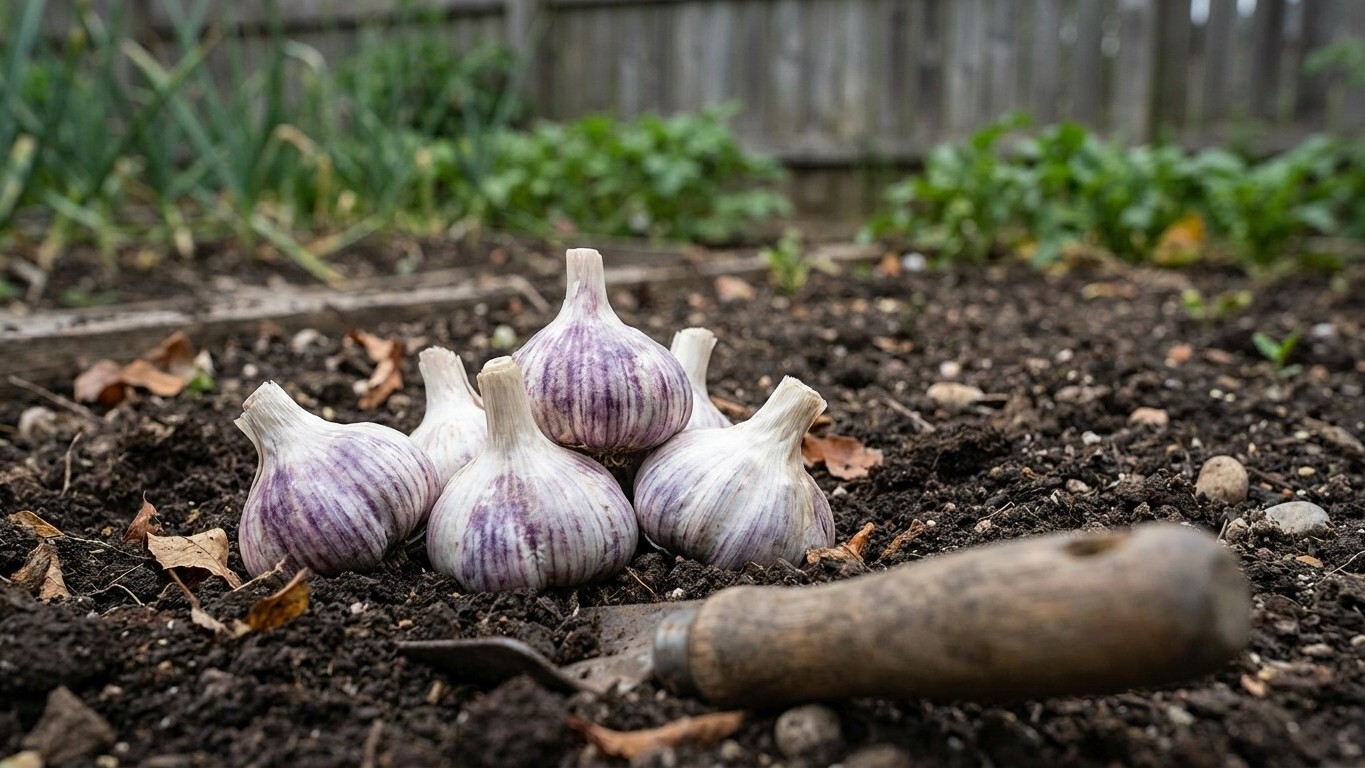

Garlic planted in the fall is lifted the following summer once the lower leaves start browning and roughly five or six leaves up top are still green. There’s no single calendar date that works province-wide. In Nova Scotia, the harvest window depends on when you planted, how wet the spring was, and the microclimate of your particular garden bed.
When garlic is ready to lift in Nova Scotia
The leaves tell the story better than any calendar. Garlic dies back from the bottom up, and the rule most growers use is to pull the bulbs when the bottom third to half of the leaves have browned but five or six leaves above are still green. Pull too early and the cloves haven’t filled out. Wait too long, past the point where nearly all the foliage has collapsed, and the papery wrappers around each bulb start splitting, which means the garlic won’t cure or store well.
Working backward from harvest, the planting date matters just as much. Garlic goes into the ground in autumn, weeks before the soil locks up for winter, so the cloves can root before frost without pushing green growth that gets damaged by cold. That’s where the region’s frost timing becomes useful, even though it’s not a harvest date at all.
Why the frost date is a midpoint, not a deadline
Environment and Climate Change Canada’s Canadian Climate Normals (1981-2010) put the average first fall frost at the Halifax Stanfield International Airport station at October 18. That’s a mean date, not a guarantee. In one year out of two, frost actually arrives later than October 18 at that station. Treat it as the midpoint of a window, not a safe cutoff, and build in a buffer rather than planting right up against it.
The airport reading also only describes one location. Nova Scotia isn’t a single climate zone. Coastal spots warmed by the Atlantic often see frost arrive later than the Halifax Stanfield figure, while inland valleys and higher ground in the interior can run weeks behind, with frost showing up well before mid-October. If your garden sits in a low-lying inland spot or higher elevation, plan your fall planting around an earlier expected frost than the airport average, and give yourself a wider cushion either way.
None of this changes the summer harvest signal. Whatever the fall planting date ends up being, the following summer’s readiness still comes down to watching the leaves, not counting days on a calendar.
Curing it, and where to hang it here
Curing is what turns a freshly pulled bulb, still damp and dirt-streaked, into garlic that will actually keep. The process is simple in principle: dry the whole plant, tops and roots still attached, in a spot with airflow and no direct sun, until the outer wrappers turn papery and the neck above the bulb tightens down. Rushing this step, or skipping it because the garlic looks fine, is one of the most common reasons homegrown garlic goes soft in storage a few months later.
Bundle a handful of plants together by the stems and hang them, or lay them in a single layer on a screen or wire rack so air moves underneath as well as over the top. Bulbs stacked in a bucket or piled on a tarp will sweat and rot from the inside before the outer layers ever dry.
Finding the right spot in a maritime climate
Nova Scotia’s coastal, moisture-heavy air makes the curing location more important than it might be somewhere drier. A covered porch, an open-sided shed, or a garage with the door cracked for airflow all work, as long as rain and direct sun stay out and there’s some cross-breeze. A closed, humid basement or a damp cellar is the wrong place to cure, even if it feels cool and out of the weather, because stagnant humid air is exactly what curing is meant to avoid.
If the summer stretch after harvest turns unusually wet, which happens often enough in this region, a small fan aimed at the hanging bundles (not directly at the bulbs, just moving air through the space) helps prevent the mold and soft spots that show up when humidity sits high for days on end. Give the crop time. Rushed curing shows up later as garlic that shrivels or turns soft well before winter is over.
Storing it through a Nova Scotia winter
Once the wrappers are papery and the necks have tightened, trim the roots close and cut the stems down, leaving an inch or so above the bulb if you’re not braiding. Brush off loose dirt without scrubbing or washing the bulbs, since moisture reintroduced at this stage undoes the curing work. From there, storage is about holding a narrow band of conditions: cool, dark, dry, and with some airflow, for as long as the winter runs.
Where storage goes right, and where it goes wrong
An unheated but frost-protected space, like an insulated porch, a mudroom, or a cool pantry away from a furnace or wood stove, tends to work better than either extreme. A heated kitchen cupboard is too warm and dry, and bulbs sprout early. A garage or shed that swings below freezing for stretches of a Nova Scotia winter can damage the cloves outright, since hard freezing breaks down the internal tissue even if the bulb looks fine from outside.
Basements are the trickiest call in this region. Many older Nova Scotia homes have basements that run cool, which is good for garlic, but also damp, which isn’t. If that’s the only realistic storage spot, keep bulbs in mesh bags or loosely woven baskets rather than sealed plastic containers, and check on them through the winter for any that are softening or sprouting, pulling those out before they affect the rest.
For growing and storage guidance specific to the province, Nova Scotia’s provincial agriculture department maintains a resource at Nova Scotia Department of Agriculture.
What goes wrong here
Most storage failures trace back to moisture, not cold. Garlic that wasn’t fully cured, or that’s stored somewhere humid, softens and molds well before spring. The fix isn’t complicated: cure fully, store dry, and check the bulbs periodically rather than tucking them away and forgetting them until March.
Pests in the region
Specific pest data for Nova Scotia gardens isn’t published on this site. The closest regional reference available is the University of Maine Cooperative Extension, which documents a range of pests affecting garden and field crops in this broader region, including seedcorn maggot (Delia platura) and cabbage maggot, both of which target roots and bulbs of onion-family crops and can affect garlic planted in cool, wet spring soil. The same extension service also documents Colorado potato beetle, striped cucumber beetle, squash vine borer, spotted wing drosophila, lily leaf beetle, emerald ash borer, browntail moth, and winter moth, though those affect other garden crops and trees rather than garlic specifically.
Beyond pests, the other recurring problem is planting into soil that’s still waterlogged from fall rain. Garlic cloves sitting in saturated, heavy clay over winter rot before they ever root properly. Raised beds or amending heavy soil with compost before planting reduces that risk, and it matters more in a maritime climate where fall rain can linger for weeks before the ground finally firms up ahead of frost.
Common questions
Can I just wait for October 18 to plant garlic outdoors in Nova Scotia?
No. October 18 is the average first fall frost date at the Halifax Stanfield airport station, and in one year out of two, frost actually arrives later than that. It’s a midpoint for reference, not a safe planting deadline, and it doesn’t apply evenly across the province.
How do I know for sure if my garlic is ready to harvest and not just stressed from dry weather?
Check the pattern of browning rather than the overall look of the bed. Ready garlic shows even browning working up from the bottom leaves, with five or six green leaves left at the top. Drought stress tends to show up as scattered yellowing or tip burn across the whole plant instead of that bottom-up progression.
Is a garage safe for curing garlic in a Nova Scotia summer?
It can work if there’s airflow and no direct sun hitting the bulbs, but a closed garage that traps heat and humidity on a still, damp day isn’t ideal. Cracking the door or adding a small fan for air movement helps.
Where can I find more localized growing advice for Nova Scotia gardens?
The Nova Scotia Department of Agriculture is the relevant resource for this territory.