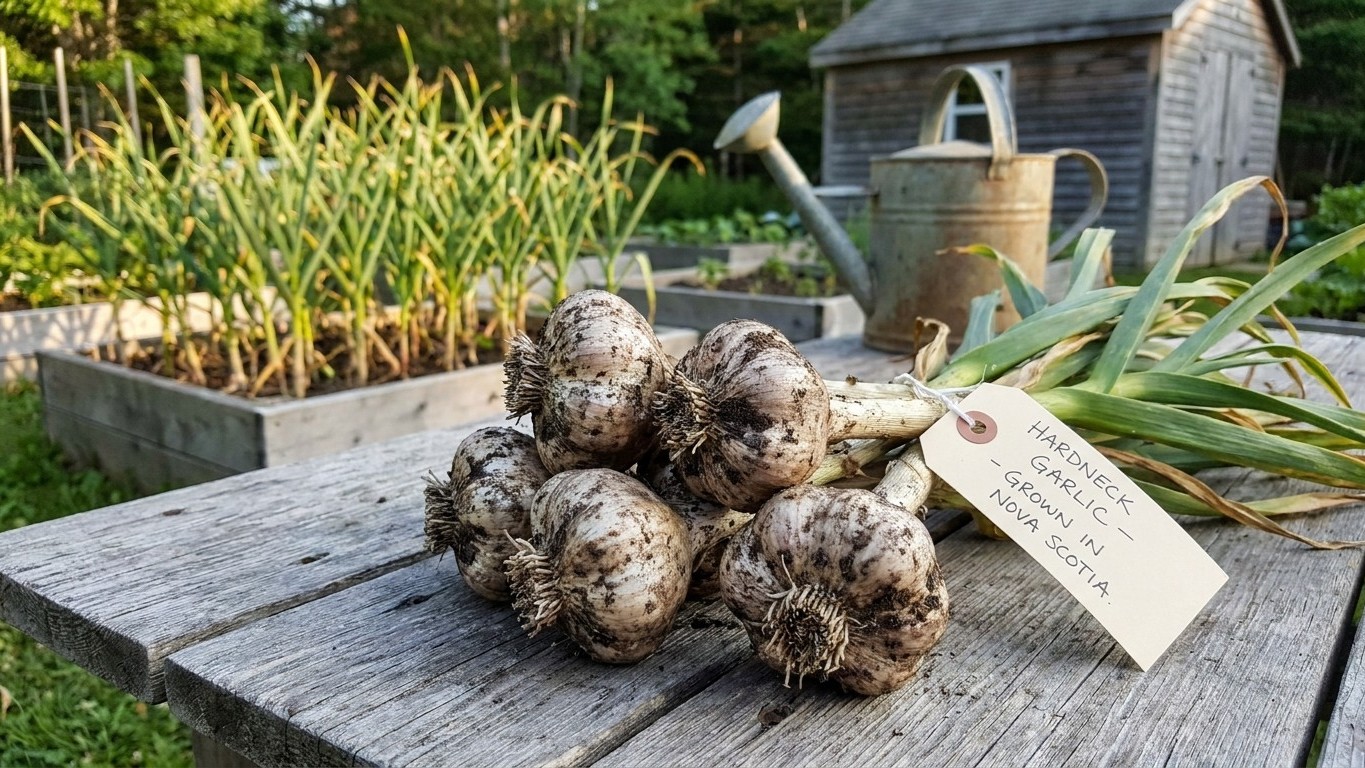

Late September is the week Nova Scotia growers put garlic in the ground, full stop, and hardneck or softneck, every variety follows that same catalogue instruction. Garlic isn’t timed toward a harvest date like a tomato; it’s timed backward from the region’s average frost arrival in mid-October, so the clove gets three or four weeks to root in warm soil before winter shuts things down. That average is a middle point, not a guarantee, which changes how you should plan.
The short answer for Nova Scotia

Plant Garlic in Nova Scotia in the last week of September. That holds for every cultivar, hardneck or softneck: the catalogue direction for each one reads “set out late September,” because the clove is planted for root establishment, not counted forward toward a harvest day the way a tomato is.
What the date is anchored on
The window is set against Environment and Climate Change Canada’s 1981-2010 climate normals for Halifax Stanfield International Airport, which put the mean first fall frost at October 18. A clove planted in late September gets roughly three to four weeks of soil still warm enough to grow roots before that frost typically arrives, and those roots are what carry the plant through winter and get it moving again in spring. Plant later than that window and the clove may not root deeply enough before the ground cools for good.
Why October 18 is a midpoint, not a deadline
Treat October 18 as a midpoint, not a safe date. A mean frost date means the real frost falls later than the mean in roughly half of all years and earlier in the other half. Some years give you into November before the first hard frost; others bring one in the first week of October. Planting in late September, well ahead of the mean, buys margin against a year that turns cold early. Waiting for a frost forecast before you plant gives the clove far less time to root, whatever the calendar says.
Working it out for your own garden
The arithmetic behind that late-September date is simple enough to redo for your own site. Start from the Halifax Stanfield mean first fall frost of October 18, then count back three to four weeks for root establishment: October 18 minus three weeks lands around September 27, and minus four weeks lands around September 20. That span is the whole basis for “late September” as a planting window, and it’s why every cultivar in the catalogue, from Inchelium Red to Duganski, carries the same instruction.
Why the window moves for your yard
Halifax Stanfield’s normals describe one station on one part of the Atlantic coast. Move inland, uphill, or away from open water and the mean frost date shifts, sometimes by two weeks in either direction. Elevation is the biggest single factor: cold air is heavier than warm air and drains downhill, so a garden in a low hollow can see frost two weeks before a garden on a nearby ridge, even one only a few hundred feet higher. Coastal exposure works the other way. A garden close to open ocean water is buffered by the sea’s stored summer heat and tends to stay frost-free later into fall than one a short distance inland.
A large lake or a wide river has a smaller version of that same moderating effect, holding warmth into the season and delaying frost nearby. If your garden sits in a valley bottom where cold air can pool overnight, treat your own frost date as earlier than October 18, not later, and shift your planting window into mid-September rather than the last week.
None of these adjustments are numbers you can look up for your street. They come from watching your own garden over a season or two, noting when frost actually blackens tender foliage like basil or dahlias in your own yard rather than relying on a station reading many kilometres away.
Matching the date to your cultivar
Whichever cultivar you’ve chosen, the set-out date doesn’t shift with days-to-maturity the way it would for a spring vegetable. Garlic is planted in autumn and lifted the following summer, so the planting date is fixed by soil temperature and available root time, not by counting forward to a harvest day. The table below shows the spread across hardneck and softneck types carried in the catalogue, and every one of them lands on the same late-September window.
| Variety | Type | Set out |
|---|---|---|
| Inchelium Red | Softneck | Late September |
| Lorz Italian | Softneck | Late September |
| Bavarian Purple | Hardneck | Late September |
| Chesnok Red | Hardneck | Late September |
| German Red | Hardneck | Late September |
| Duganski | Hardneck | Late September |
If you haven’t settled on a variety yet, that’s worth deciding before the planting window opens rather than during it. See Garlic Varieties That Suit Nova Scotia Winters for how the hardneck and softneck types differ in storage life and cold hardiness.
What changes across Nova Scotia
The Halifax Stanfield figure describes the Halifax area and the immediate coastal strip around it. Move to other parts of the province and the causes behind the date, not the date itself, are what carry over.
Where elevation and the coast pull the date apart
The Annapolis Valley, inland and sheltered by the North and South Mountain ridges, is prone to cold air pooling on still nights, so low-lying valley floor gardens there can see frost earlier than a coastal garden at the same latitude. The Cape Breton Highlands and other upland districts run colder simply from elevation. Higher ground loses heat faster after sunset, and a garden there should plan on an earlier fall frost than one at sea level, whatever a province-wide normal reads.
Coastal districts along the Atlantic shore, including the South Shore and much of the Halifax fringe itself, benefit from the ocean’s slow release of summer heat and tend to stay frost-free later into the season than inland districts at the same latitude. The Bay of Fundy shoreline sees a similar moderating effect from the tidal water, though how strong it is depends on how directly a given garden faces the bay.
Why no single number covers the province
Environment and Climate Change Canada keeps stations at other airports around the province, and a grower in Yarmouth, Sydney or the Annapolis Valley will get a more useful figure by checking the normals for a station near them rather than applying the Halifax Stanfield date directly. Local topography matters too: a garden bordered by dense trees that block early morning sun can run a week or two behind a garden of the same town on open, well-drained ground. The only real way to know which side of the average your own plot falls on is to track when frost actually shows up on tender plants in your own yard over a few seasons.
The mistakes this climate punishes
Nova Scotia’s winters bring plenty of cold, and that’s one thing this climate does for garlic without you doing anything. Sitting through 30.4 weeks a year with air temperatures below 40°F comfortably clears the six to eight weeks of chilling a hardneck clove needs to split into cloves, according to the University of Georgia Extension’s guidance on garlic, publication C854. The mistake here isn’t picking a hardneck for lack of cold. It’s the opposite kind of error.
Planting too shallow or too late
A clove that goes in during the first half of October instead of late September, or that gets planted an inch deep instead of properly buried and mulched, is the clove that hasn’t rooted enough by freeze-up. A shallow-planted clove is also more prone to heaving out of the ground during freeze-thaw cycles, especially in a season with little snow cover to insulate it. Mulch with straw after planting. It does more to protect a shallow-rooted clove than an extra week of “safer” planting ever will.
Disease pressure to watch, not fear
The UC IPM Pest Management Guidelines for onion and garlic, UC ANR Publication 3453, give published temperature ranges for the fungal diseases that affect garlic. Measured against Nova Scotia’s own growing-season air temperatures, white rot (Sclerotium cepivorum) falls inside its published 50-75°F range in three months of the growing season, September, June and July, and Fusarium basal rot (Fusarium oxysporum f. sp. cepae) falls inside its 59-90°F range in two, June and July. Those are air-temperature months measured against soil-temperature thresholds, so they describe a possibility, not a forecast, and a single month’s average includes plenty of days on both sides of the range. Neither disease is ruled out by this climate, and both travel most often on infected seed garlic rather than arriving from the soil on their own, so the real defence is buying clean seed stock and never replanting a clove from a bulb that showed rot.
- Planting after the first week of October without extra mulch
- Setting cloves less than two inches deep in loose soil
- Skipping mulch in a low-snow winter
- Replanting cloves from a bulb that showed soft or discoloured tissue
Checking this against your county
Halifax Stanfield’s normals describe one station, not the whole province. For a figure closer to your own county, the Nova Scotia Department of Agriculture is the place to check, along with any county-level bulletins it publishes on planting dates and frost risk. A county figure will usually shift the late-September window by days rather than weeks, but in a marginal year those days can be the difference between a rooted clove and one caught by early frost. If you’re still preparing the bed or choosing a variety, Growing Garlic in Nova Scotia covers the groundwork.
Common questions
Can I still Plant Garlic in October if I missed late September?
Yes, but plant as soon as you can and go slightly deeper with heavier mulch than usual. A clove going in during the first half of October has less time to root before Halifax Stanfield’s mean frost date of October 18, let alone in a year when frost runs later than that, so the extra mulch is compensating for a shorter root-growing period rather than improving on anything.
What happens if I plant garlic too early, like early September?
The roots aren’t the problem. A clove planted too early can push up green top growth before winter, and that growth gets damaged by hard frost and cold wind over the following months. Late September is early enough to build roots and late enough to hold back visible top growth in most years.
Does hardneck garlic need a colder winter than softneck to grow well here?
No. Both types get more than enough winter cold in Nova Scotia to trigger clove formation, so the choice between a hardneck like Chesnok Red or Duganski and a softneck like Inchelium Red or Lorz Italian comes down to flavor, storage life and scapes, not whether the winter is cold enough.
Can I Plant Garlic in spring instead if I miss fall entirely?
You can, but expect smaller bulbs. Garlic forms its biggest bulbs after a real cold period splits the clove, followed by a long root-growing season, and a spring-planted clove misses most of that fall and winter root time. If you miss the window, it’s worth checking current seed stock availability rather than assuming you have to wait a full year.
If you follow the almanac, here is when to plant garlic by the moon. It is a tradition, not a proven method.