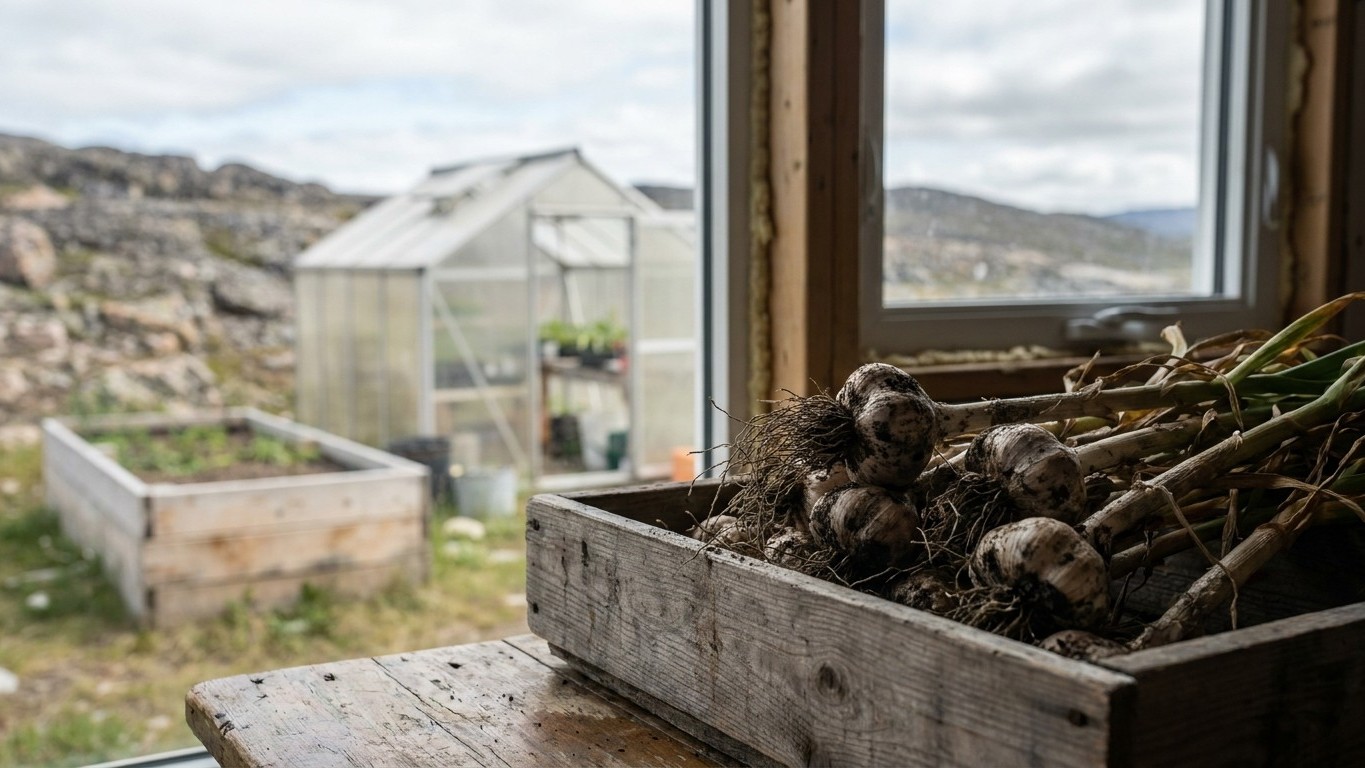

Garlic goes into Nunavut soil in late August, roughly two to three weeks ahead of the region’s mean first fall frost of September 13, recorded at Rankin Inlet A by Environment and Climate Change Canada’s Canadian Climate Normals for 1981-2010. That date is a midpoint, not a guarantee: frost lands later than September 13 in half the years on record, and earlier in the other half. The action that follows is simple. Get cloves in the ground during the last week of August, and don’t wait for a frost warning to tell you the window has already closed.
The short answer for Nunavut

Every cultivar in the standard seed-garlic catalogue, softneck or hardneck, shares the same late August set-out window across Nunavut. That’s not a coincidence of the catalogue. It reflects the fact that the planting date isn’t chosen by how many days a bulb needs to bulk up next summer. It’s chosen by how many weeks a clove needs to grow roots before the ground freezes solid for the winter.
Why the date holds for every variety
The days-to-maturity figure printed on a seed packet, whether it’s a hardneck like Duganski or a softneck like Inchelium Red, counts forward from spring regrowth to next summer’s harvest. It says nothing about when to plant in fall. The fall planting date is anchored to a different clock: the first hard frost and, more precisely, the point at which the soil itself stops being workable. At Rankin Inlet, Environment and Climate Change Canada’s 1981-2010 normals put the mean date of that first fall frost at September 13. Counting back from that mean by roughly two to three weeks lands squarely in late August, which is why the catalogue collapses every variety into a single planting window here rather than spreading them across September the way it might in a milder province.
The caution worth repeating: a mean date sits in the middle of a spread, not at the safe edge of it. In one year out of two, the first frost at Rankin Inlet arrives after September 13. In the other, it arrives before. Nunavut’s growing season is already short enough that an early frost year punishes a grower who waited until early September to plant, even though the mean date would have suggested there was time to spare. If you’re still deciding which cultivars to grow before you commit to a date, the fuller rundown at Garlic Varieties That Suit Nunavut Winters is worth reading first.
Working it out for your own garden
The arithmetic behind “late August” is worth showing so you can rework it for your own plot rather than trusting a single number. Start with Rankin Inlet’s mean first fall frost of September 13, from Environment and Climate Change Canada’s Canadian Climate Normals, 1981-2010. Garlic cloves need several weeks of active root growth in the soil before that soil locks up for the winter. Back that requirement up from the mean frost date and you land in the last third of August, not a single day but a stretch of roughly a week and a half.
What actually shifts the number
That arithmetic assumes a garden that behaves like the ground around the Rankin Inlet weather station. Almost none does exactly. A handful of local features can shift the real planting window by up to two weeks in either direction, and they’re worth checking before you trust the calendar over your own soil:
- Elevation: higher ground cools faster in fall and holds less residual warmth overnight, which tends to pull the safe window earlier.
- A large lake or river nearby: open water releases stored heat into the surrounding air well into fall, which can push the local frost date later than the regional mean.
- Coastal exposure: proximity to open sea moderates temperature swings compared with inland ground at the same latitude, again tending to buy extra days.
- Wind exposure and slope: a site that drains cold air well avoids the frost pockets that settle in low, sheltered hollows first.
None of these factors comes with a published local number for Nunavut in the way the Rankin Inlet frost date does, so treat them as reasons to nudge your own planting date by days, not as a new fixed date to plant by. The safest habit is to watch your own soil rather than the calendar exclusively: if the top few inches are still loose and workable in early September, you have not necessarily missed the window, but you are working with less margin than the mean date implies.
What changes across Nunavut
Rankin Inlet sits on the Kivalliq mainland coast, on the west side of Hudson Bay, and its frost normals describe that specific piece of ground, not the whole territory. Nunavut spans three regions with genuinely different growing conditions, and lumping them together is the fastest way to plant at the wrong time.
Kivalliq and the Hudson Bay coast
Communities along the Hudson Bay coast, Rankin Inlet among them, get some benefit from open water lingering into early fall, which is part of why the mean frost date sits as late as September 13 here in the first place. Inland Kivalliq ground, away from that moderating water, loses the benefit and should be expected to freeze earlier, not later.
Qikiqtaaluk and Baffin Island
Iqaluit and the rest of the Qikiqtaaluk region sit on Baffin Island, further from the Kivalliq mainland and shaped by their own coastal geography rather than Hudson Bay’s. A grower there is working from a genuinely different climate record and should look for a station-specific normal rather than borrowing Rankin Inlet’s date outright.
Kitikmeot and the High Arctic
The Kitikmeot region, including Cambridge Bay, sits west and inland of Hudson Bay’s influence, and communities there should expect their own safe planting window to run earlier than late August, not later. Further north still, High Arctic settlements like Resolute Bay and Grise Fiord face a shorter, colder season on every measure, and a grower there needs to treat “late August” as an outside limit rather than a target, planting earlier wherever the ground allows it.
The mistakes this climate punishes
Nunavut’s winter cold is not the weak link in the system. Rankin Inlet logs an average of 43.5 weeks a year below 40°F, which comfortably clears the six to eight weeks of chilling a garlic clove needs after planting to split properly into cloves the following summer, according to the University of Georgia Extension’s publication on garlic production (C854). The mistakes that actually cost a crop here are timing and depth, not a lack of cold.
Planting too late
Because the September 13 mean frost date is a midpoint rather than a floor, treating it as the deadline is the single most common error. In an early-frost year, a grower who planted in early September instead of late August can lose most of the root-establishment window before the ground locks up, leaving cloves poorly anchored and prone to frost heave over winter.
Planting too shallow or skipping mulch
A clove planted at a shallow depth, or left without a mulch layer, is exposed to the freeze-thaw cycling that heaves it out of the ground over winter, which kills it as surely as any amount of raw cold. This is a moisture and insulation problem, not a temperature problem, and it’s the mistake that a mild early winter tends to hide until the following spring, when the missing plants show up as gaps in the row.
Trusting seed stock without checking it
Cold does not sterilize planting stock. White rot, caused by the soil fungus Sclerotium cepivorum, has a published optimum air temperature range of 50 to 75°F, and by the University of California’s Integrated Pest Management guidelines for onion and garlic (UC ANR Publication 3453), that range only overlaps Nunavut’s growing-season air temperatures during one month, July. That single month of overlap does not mean the disease can’t take hold. Its resting bodies survive in soil for years regardless of the current season’s temperature, so the real defense is planting certified, disease-free cloves rather than counting on a cold climate to do the job.
Checking this against your county
Nunavut is organized into regions and hamlets rather than counties, and the Rankin Inlet figures used above describe one station in the Kivalliq region, not the territory as a whole. Before you commit to a planting date, check your own community’s climate data and any current planting guidance through Agriculture and Agri-Food Canada at agriculture.canada.ca, since a hamlet on Baffin Island or in the Kitikmeot will not share Rankin Inlet’s exact frost timing even if the general late-August principle still applies.
Common questions
Can I still plant garlic if I missed late August?
You can try into early September in a year that turns out mild, but you are trading away the margin the mean frost date already implies. If the ground is still soft enough to work, get cloves in immediately and mulch heavily rather than waiting any longer.
Does hardneck garlic need a colder winter than softneck to grow in Nunavut?
No. Rankin Inlet’s winter cold, at an average of 43.5 weeks a year below 40°F, is well beyond what either type needs to vernalize, per the University of Georgia Extension’s C854 publication. The choice between hardneck types like Chesnok Red or German Red and softnecks like Lorz Italian or Italian Late comes down to flavor, storage life and scape production, not cold tolerance.
Should I plant deeper in Nunavut than a warmer province would?
A deeper planting depth combined with a thick mulch layer is the standard response to a harsh freeze-thaw cycle, since the real risk here is frost heave rather than the cold itself killing the clove outright. Exact depth recommendations vary by source, so check current guidance through Agriculture and Agri-Food Canada rather than assuming one figure applies everywhere in the territory.
Is it too late to Plant Garlic if the ground has already frozen?
Yes, effectively. Once the top few inches of soil are frozen hard, cloves can no longer put down the roots they need before the true cold arrives, and holding them over to spring planting instead usually gives a smaller, less developed bulb by the following summer.
Some gardeners also time this by the Moon: when to plant garlic by the moon, as almanac tradition rather than fact.