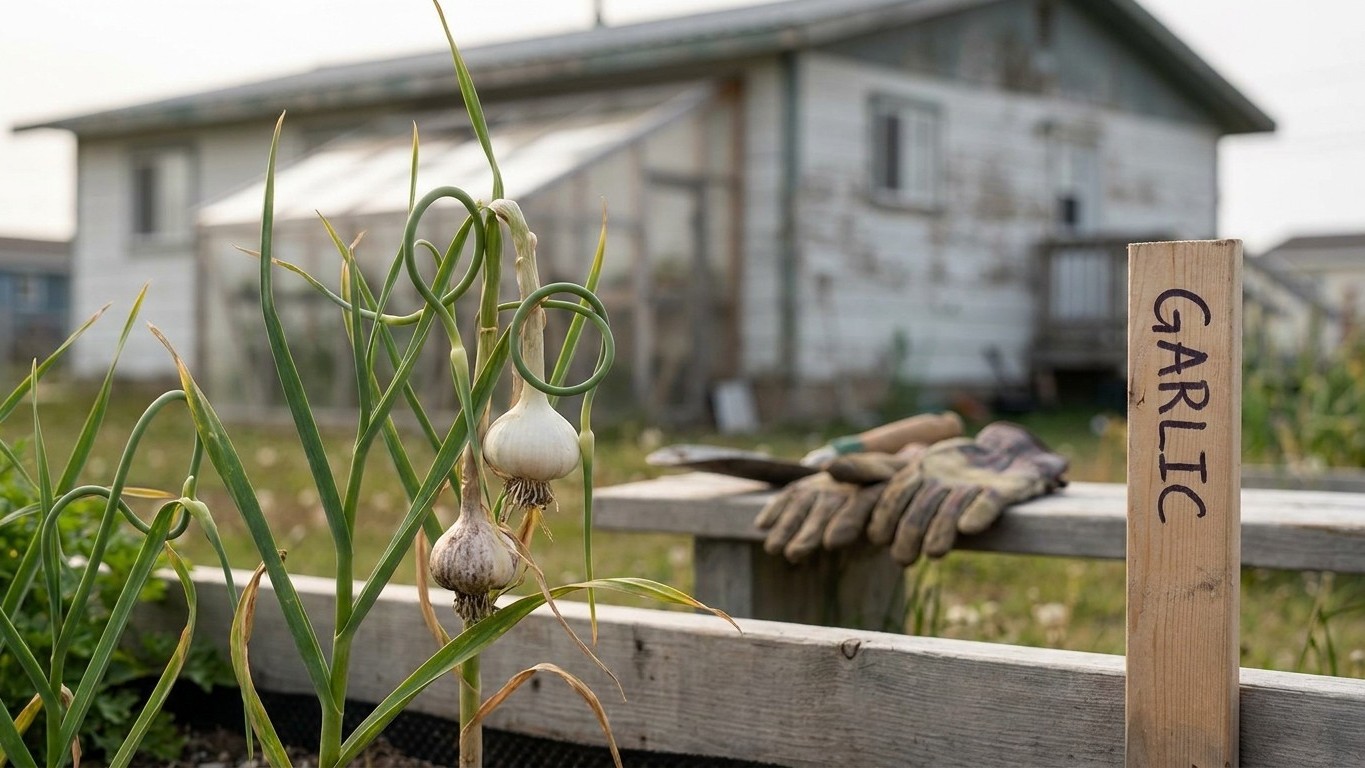

Rankin Inlet doesn’t care which variety you picked. Most garlic advice sorts hardneck from softneck as if that choice decides your fate up north, but here the calendar overrules the catalog: everything goes into the ground in late August, full stop. The mean first frost lands around September 13, and it swings both directions from there, so waiting for surer footing is the losing move. What actually saves this crop isn’t cold tolerance bred into a bulb — it’s weeks of frozen ground still ahead once planting’s done.
The short answer for Nunavut

Every garlic variety worth planting in Nunavut goes into the ground in late August, hardneck and softneck both. That timing is anchored to the mean first fall frost date for the Rankin Inlet area, which Environment and Climate Change Canada’s 1981-2010 climate normals put at September 13 for the Rankin Inlet A station. That is a mean, not a guarantee. In one year out of two, the first frost arrives later than September 13, and in the other half it arrives earlier. Planting as though the frost will hold off is the riskier bet, not the safer one.
The reason garlic tolerates this climate at all has little to do with variety selection and everything to do with how long the cold lasts once it arrives. Around Rankin Inlet, mean air temperature sits below 40°F for roughly 43.5 weeks of the year, which comfortably outlasts the six to eight weeks a planted clove needs to complete the split into a full bulb of cloves, a figure University of Georgia Extension credits to publication C854. Cold duration is not the limiting factor in this territory. Getting the crop planted and rooted before the ground locks up is.
Below is the closed list of garlic worth ordering for a Nunavut garden, all timed to the same late-August window.
| Variety | Type | Set out |
|---|---|---|
| Early Red Italian | Softneck | Late August |
| Inchelium Red | Softneck | Late August |
| Italian Late | Softneck | Late August |
| Lorz Italian | Softneck | Late August |
| Bavarian Purple | Hardneck | Late August |
| Blue Music | Hardneck | Late August |
| Chesnok Red | Hardneck | Late August |
| Duganski | Hardneck | Late August |
| Fall Festival | Hardneck | Late August |
| Georgian Crystal | Hardneck | Late August |
| Georgian Fire | Hardneck | Late August |
| German Red | Hardneck | Late August |
| German White | Hardneck | Late August |
| Ivan | Hardneck | Late August |
Working it out for your own garden
Start from the same anchor everyone in the region should use: the mean first fall frost at Rankin Inlet A, September 13 per Environment and Climate Change Canada’s 1981-2010 normals. Count back two to three weeks from that date and you land in late August, which is why every variety on the list above shares the same window. The logic is simple. A clove needs three to four weeks of soil contact to grow a working root system before the ground freezes solid, and pushing planting any closer to the frost date leaves roots too short to anchor the bulb through the winter’s freeze-thaw heaving.
Adjust for your own site before you trust the calendar
Rankin Inlet is one weather station on a territory the size of Western Europe. A garden with different elevation, a large lake nearby, or a stretch of open coastline can run roughly two weeks ahead of or behind that station’s normals, purely from local air drainage and water’s slower heat release. If your garden sits in a low frost pocket that collects cold air on still nights, treat September 13 as optimistic and plant in mid-August instead of the last week of the month. If it sits on a slope with good air drainage, or close to open water that keeps fall air a little warmer, the standard late-August window still applies, and you gain a little slack rather than losing it.
Because September 13 is a mean rather than a safe date, treat it as the midpoint of a range rather than a deadline. In the years frost arrives early, a clove planted right at the mean date gets caught with almost no root growth at all. Planting in the last third of August rather than waiting for the calendar to tick over into September gives every clove the same three or four weeks of rooting time regardless of which side of the mean the actual frost lands on.
Keep a simple log for two or three seasons: the date of your own garden’s first hard frost, and the date you actually planted. That local record tells you more than any territory-wide normal, because it captures your own drainage, wind exposure, and snow cover pattern rather than a single station’s average. Before you fix a date, work backward using the arithmetic laid out specifically for this territory in When to Plant Garlic in Nunavut: Counting Back From the First Frost.
What changes across Nunavut
Rankin Inlet sits on the west coast of Hudson Bay, roughly at the territory’s climatic middle. Communities farther north and at higher latitude run colder and shorter in every direction: freeze-up starts earlier in the fall and the ground stays locked longer in spring. No Environment and Climate Change Canada normals station in those high-latitude communities is cited in this guide, so any date used there should come from that community’s own weather record rather than borrowed from Rankin Inlet.
Coastline and elevation move the date in both directions
Coastal communities that sit directly on open water, rather than on a bay that freezes early, get a small buffer from the sea’s slower heat loss. Water holds warmth into the fall and releases it gradually, which can push the first hard frost a little later than an inland site at the same latitude would see. Inland communities away from any large body of water lose that buffer and tend to cool faster once the sun angle drops in late summer, because there’s no large thermal mass nearby to slow the change.
Elevation works the same way in the north as it does anywhere else. A garden on a raised gravel pad or esker drains cold air away on still nights, while a garden in a low hollow collects it. In a territory where garlic’s whole margin for error is measured in days of rooting time, that difference in siting matters as much as the difference between two communities two hundred miles apart.
The mistakes this climate punishes
The single costliest mistake in this climate is planting too late and too shallow at the same time, because the two errors compound. A clove set in during the first days of September, once the mean frost date has already passed at some inland sites, has had almost no time to establish roots before the soil starts to lock. Planted shallow on top of that, with only an inch or two of soil above it, the clove has nothing holding it in place when the ground heaves through the first hard freeze-thaw cycle. Either mistake alone costs some plants. Together they can cost the whole bed.
Assuming the cold sterilizes the soil
The opposite mistake, assuming the cold itself will wipe out disease, is just as expensive. UC ANR’s Pest Management Guidelines for onion and garlic, Publication 3453, list white rot, caused by the fungus Sclerotium cepivorum, as active where soil temperature runs between 50°F and 75°F. Mean air temperature at Rankin Inlet sits inside that range in only one month of the growing season, July, and soil temperature lags air by weeks, so the window when the pathogen is genuinely active in the ground is narrow and mostly a summer condition. That is not the same as safe. White rot’s resting structures, called sclerotia, can survive for years in soil regardless of how cold the winter gets, and the fungus travels on infected seed cloves and contaminated tools, not on the weather. A clean seed source matters more here than the climate does.
Skipping mulch is the third common error. Snow cover is not a substitute for mulch laid down before freeze-up, because snow depth varies with wind exposure and can blow clear off an exposed bed exactly when the cloves need protection the most. A mulch layer put down at planting, before the first real snow, buys the clove insulation on the nights when there is no snow cover yet at all. Inspect every clove before planting, too, and discard any with soft, discolored tissue near the base or a sour smell, since sorting out compromised seed at planting time is far cheaper than losing neighboring bulbs to rot after a full season underground.
Checking this against your county
Nunavut does not have county extension offices the way southern provinces do, so Agriculture and Agri-Food Canada’s own site is the right first stop for anything more specific than what a Rankin Inlet-anchored guide like this one can give. Check agriculture.canada.ca for updated growing information and any territorial program that applies to your community. If you garden well north or south of Rankin Inlet, or on a different coastline entirely, confirm whether a more local weather record exists for your community before trusting a date calculated from this page. For the fuller sequence of bed preparation, feeding, and lifting the crop the following summer, see Growing Garlic in Nunavut, which this page assumes you have already read.
Common questions
Can I plant garlic in spring instead of fall in Nunavut?
You can, but expect smaller bulbs. Garlic needs a period of cold to split a clove into a full head, and a spring planting only gets whatever cold happens afterward, far short of the six to eight weeks University of Georgia Extension credits with triggering that split in publication C854. Fall planting lets Nunavut’s long, hard winter do that work for you instead.
What if I miss the late-August planting window?
Plant anyway, as early in September as you can manage, and increase the mulch rather than skipping the year entirely. A clove with less rooting time before freeze-up needs more insulation to survive winter intact, not less. Spring planting is an option too, but expect the smaller bulbs described above.
Should I choose hardneck or softneck for Nunavut?
Either type on the closed list above works, because the deciding factor in this climate is planting timing and mulch, not the type itself. Softnecks such as Inchelium Red and hardnecks such as German Red both come from stock long grown in cold storage regions, and nothing in the catalogue data distinguishes them on cold tolerance for this territory. Choose based on flavor and storage preference rather than assuming one type is safer here.
How do I know if my seed garlic already has white rot?
Look for fluffy white fungal growth around the base of the clove, sometimes with small black, pinhead-sized sclerotia embedded in it, both described in UC ANR’s Pest Management Guidelines for onion and garlic. Discard any clove showing either sign rather than planting it, since sorting seed before it goes into the ground is the only defense that matters once the fungus is already established.