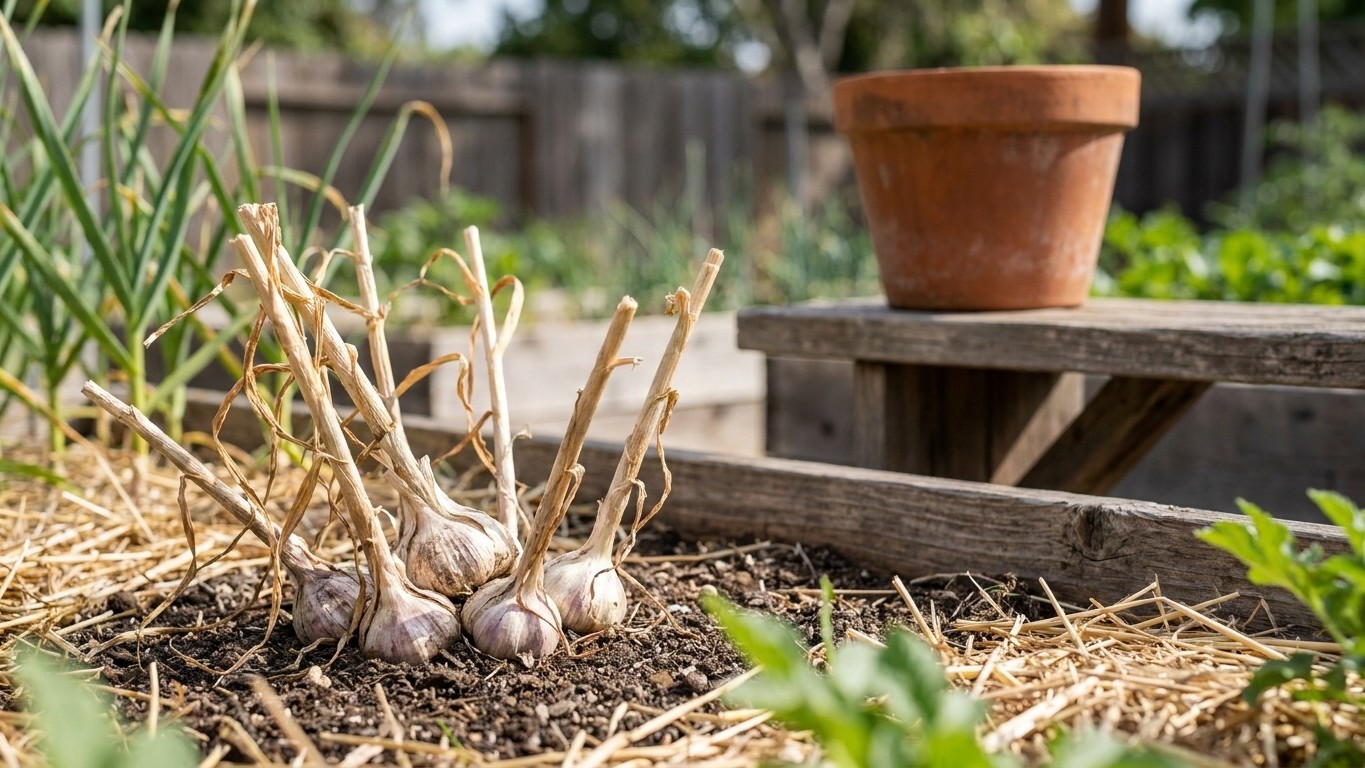

Garlic in Oklahoma comes out of the ground in early summer, once the lower leaves have browned back and the bulb wrappers feel papery rather than green and tight. There’s no fixed calendar date for this because it depends on when the cloves went into the ground the previous fall and how the season played out. What follows is how to read the plant itself, how to cure it in this climate, and how to keep it edible until next planting time.
When garlic is ready to lift in Oklahoma
Garlic planted in autumn spends the cold months building roots, then pushes leaf growth hard once soil warms in spring. That fall planting window matters here because Oklahoma’s first fall frost, measured at the reference weather station used by NOAA, falls between October 29 and November 8. That’s a midpoint drawn from 1991-2020 climate normals, not a guarantee. In roughly half the years on record, the first freeze arrives after that window; in the other half, it arrives before. Gardeners in suburban yards and rural plots, away from the paved surfaces and heat retention of an airport tarmac, often see their first freeze arrive a week or two earlier than the reference figure, and elevation pushes it earlier still. Check your own county’s typical freeze dates rather than treating the regional number as settled fact.
Once cloves are in the ground and winter passes, the harvest signal has nothing to do with frost dates and everything to do with the plant’s foliage. Garlic tells you it’s close to done when the lower third to half of its leaves turn brown and dry while the upper leaves stay green. Pull one test bulb before committing to the whole bed. Slice it in half. A cross-section with plump, well-defined cloves and skins that haven’t started separating from the flesh means the crop is ready or nearly so. If the cloves look small and the wrapper is still thick and green, give it another week and check again.
Timing this wrong in either direction costs you. Lift too early and the cloves are undersized, with wrappers too thin to protect the bulb through curing or storage. Wait too long and the wrappers split, individual cloves separate from the stalk, and the bulb loses its ability to seal itself for months of storage. Oklahoma’s early summer heat accelerates this decline once the plant starts to dry down, so once you see that five-to-six-leaf brown mark, check every few days rather than every week. Lift with a garden fork rather than pulling by the stalk. Dry soil in a hot spell can grip a bulb tightly enough that a hand pull snaps the neck clean off, and a snapped neck won’t cure properly no matter what you do afterward.
Curing it, and where to hang it here
Curing is not the same step as harvest, and skipping it is the single fastest way to lose a garlic crop to rot within weeks. Fresh-pulled garlic is still roughly 70 percent water by weight in its outer layers. Curing pulls that moisture down slowly, hardening the neck and tightening the wrappers into the papery seal that keeps storage garlic from spoiling. Done right, this takes three to four weeks. Rushed, it produces bulbs that look fine on the outside but rot from the neck down once boxed up.
The bulbs need airflow, shade, and low humidity, and Oklahoma’s early summer supplies exactly the wrong combination if you cure outdoors in direct conditions. Direct sun on bare bulbs scalds the cloves and can cook them from the outside in, especially once afternoon temperatures climb. A carport, covered porch, open-sided shed, or garage with the door cracked for airflow all work better than a sunny yard. What matters is shade, moving air, and protection from rain, since damp bulbs mold before they cure.
Bundling versus laying flat
Tie six to ten bulbs by the stalk and hang them upside down, or lay them in a single layer on a screen, wire rack, or slatted surface that lets air pass underneath. Avoid piling bulbs on a solid table or tarp. Trapped moisture underneath a bulb sitting on plastic or plywood is a common cause of soft rot showing up two weeks into what looked like a clean cure.
| Stage | Airflow needed | Light exposure | Typical duration |
|---|---|---|---|
| Curing | Constant, gentle | Full shade | 3 to 4 weeks |
| Storage | Some ventilation | Darkness | Through winter |
Resist the urge to trim roots and stalks and brush off soil right after pulling. Wait until the cure is finished. Cutting into a bulb before it’s dried down opens a path for bacteria and speeds decay instead of slowing it. Once the necks are fully dry and papery, snip the stalks to an inch or two above the bulb, brush off loose dirt with a dry hand or soft brush, and set aside any bulb with soft spots, mold, or a neck that never firmed up. Those go in the kitchen for immediate use, not into storage.
Storing it through a Oklahoma winter
Cured garlic wants three things for the long haul: cool temperatures, low humidity, and darkness, held as steadily as your house allows. A pantry shelf against an interior wall, a closet away from the water heater, or a cellar all beat a kitchen counter near the stove or a garage that swings from freezing to hot depending on the week. Garlic stored somewhere too warm sprouts early. Garlic stored somewhere too humid, like near a sink or in a plastic bag that traps condensation, molds from the inside out even after a good cure.
Mesh bags, paper sacks, cardboard boxes with ventilation holes, or open baskets all work because they let a small amount of air exchange happen without dumping humidity onto the bulbs. Sealed plastic containers and zip-top bags are the most common storage mistake, since they trap the little moisture the bulbs still release and turn that airtight bag into a slow-motion greenhouse for mold.
How long it actually keeps
Expect softneck types, if that’s what you planted, to hold up several months longer in storage than hardneck types, which tend to soften and sprout sooner even under ideal conditions. Check the stored bulbs every few weeks regardless of type. Pull and use any bulb that’s gone soft, started sprouting a green shoot, or developed a moldy patch before it spreads to its neighbors in the same bag or box. One rotting bulb in a mesh bag doesn’t usually take down the rest, but it will if you leave it in contact with them for weeks.
Set aside your best, firmest bulbs from this harvest as seed stock for the next fall planting rather than buying new seed garlic every year. Store that seed stock the same way as your eating garlic, and plan to get it in the ground again as autumn approaches, well before the freeze window your area typically sees.
What goes wrong here
Most garlic failures in Oklahoma trace back to timing rather than disease: pulled too early or too late, cured somewhere too humid, or stored in a sealed container that trapped moisture. But pests do show up in the garden bed before harvest, and a handful are documented for this territory by Oklahoma State University Extension. Spider mites and green peach aphid both build up during hot, dry stretches and can stress a garlic patch enough to shrink the bulbs before you ever get to the curing question. Grasshoppers chew foliage in late spring and summer, which matters because damaged leaves are exactly the signal you’re relying on to judge harvest timing, and a grasshopper-shredded leaf canopy makes that read unreliable.
The rest of the documented list, including blister beetles, Colorado potato beetle, corn earworm, cucumber beetles, harlequin bug, squash bug, and stink bugs and leaffooted bugs, tend to target other vegetable crops more than garlic directly, but they’re worth watching for in a mixed garden bed since garlic is often planted near or in rotation with crops those pests do favor. Oklahoma State University Extension documents this specific set for the territory; if a pest you’re seeing isn’t on that list, treat it as unconfirmed for this area rather than assuming it behaves the same way local guidance describes for these named ones.
Beyond pests, the recurring problem is skipping the test-bulb check before a full harvest, and the second is curing in a spot with too much direct sun or too little airflow. Both are avoidable with a five-minute check before committing the whole bed to the fork.
Common questions
Can I harvest garlic in Oklahoma before the leaves start browning?
You can, but the bulbs will be undersized and the wrappers too thin to protect them through curing, which usually means a shorter storage life and a higher chance of the cloves drying out or shriveling within weeks. Waiting for the lower leaves to brown gives a much more reliable signal than working off a calendar date alone.
What happens if I leave garlic in the ground too long?
The wrappers split, individual cloves separate from the central stalk, and the bulb loses the tight seal that lets it cure and store well. Oklahoma’s early summer heat speeds this decline once the foliage starts dying back, so a bed left unchecked for two extra weeks in hot, dry weather can go from ready to over-mature fast.
Does Oklahoma’s fall frost date affect when I plant, not just when I harvest?
Yes. Garlic is planted in autumn and lifted the following summer, and the fall planting window is usually set relative to the first freeze so roots establish before the ground goes cold. The reference first-fall-frost window for this area, October 29 to November 8, is a regional midpoint from NOAA’s climate normals, not a fixed date, and many rural and suburban gardens see frost a week or two earlier. Check local conditions in your own county through Oklahoma State University Extension rather than relying on the regional figure alone.
Why did my cured garlic still rot in storage?
The most common cause is storing bulbs in a sealed plastic bag or container, which traps residual moisture even after a proper three-to-four-week cure. Switch to mesh bags, paper sacks, or ventilated boxes, and keep the storage spot cool, dark, and dry rather than in a warm kitchen or a humid garage.