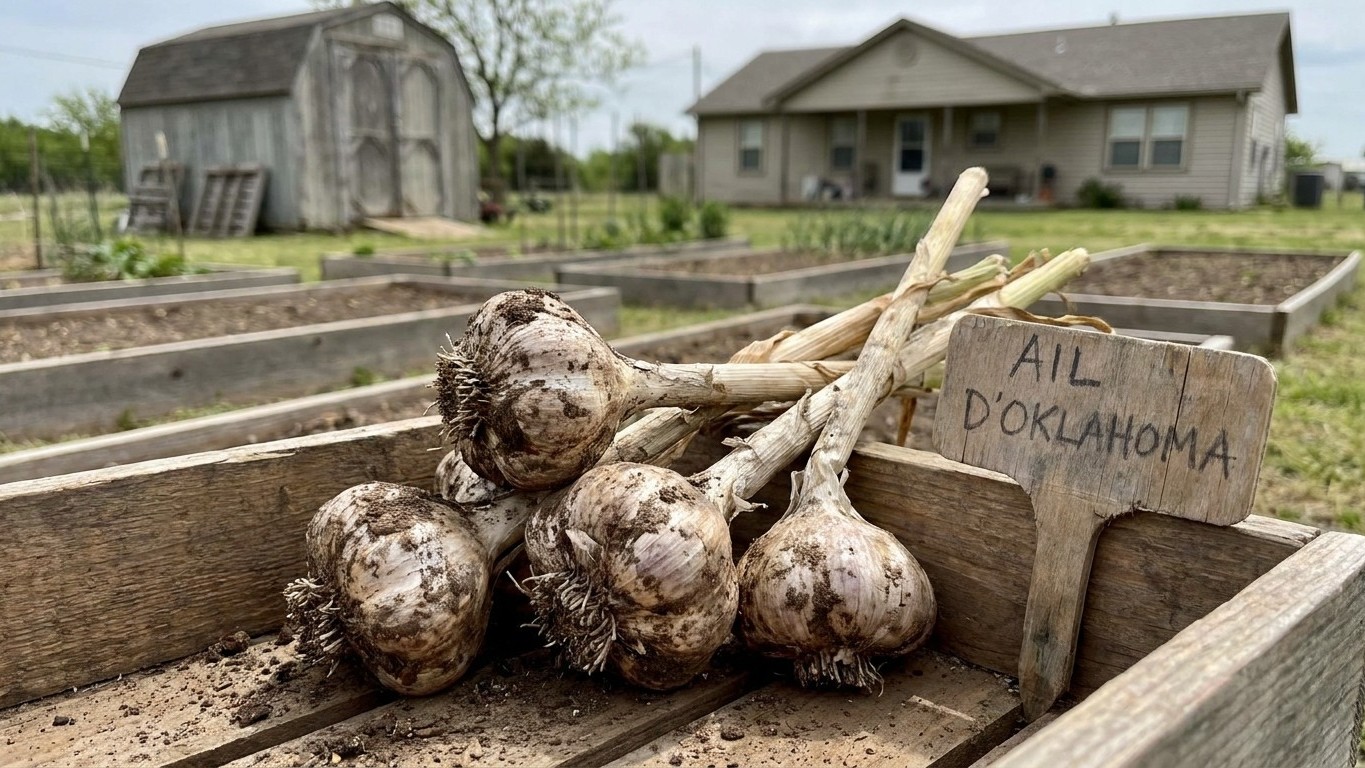

Six to eight weeks below 40°F — that’s the cold garlic actually needs, not “plant it before Thanksgiving and forget it,” which is the line repeated everywhere else. Oklahoma usually clears that bar easily; Arctic fronts push through most winters and the state’s typical cold season runs well past the minimum. But “most winters” isn’t every winter, and the first freeze date tells you nothing about what follows. A mild year, or a warm pocket of the state, can leave a clove short. Plant as if it might fall short anyway.
Will garlic get the cold it needs in Oklahoma

Garlic doesn’t turn into a multi-clove bulb just because you planted it in autumn. The clove has to sit through a genuine cold season first, or what you lift the following summer is a single round bulb, closer to an onion than a head of garlic. University of Georgia Extension’s publication C854 puts the requirement at six to eight weeks of air temperatures below 40°F after planting, and that number, not the calendar, is what your winter needs to clear.
NOAA’s 1991-2020 climate normals for the Oklahoma City station give the first fall freeze as October 29 to November 8. That figure only marks when the first hard cold typically shows up. It says nothing about how many weeks of sub-40°F weather follow, and that count is what actually drives vernalization. Oklahoma sits in the path of Arctic cold fronts most winters, and a typical winter here runs well past the six-to-eight-week minimum across most of the state.
If your winter runs short
The exception is a mild winter, or a garden in the warmest pocket of the state, where the cold arrives late, breaks early, or simply doesn’t hold long enough. You won’t know which kind of winter you’re getting when you plant cloves in October. Plant as if the cold might fall short, and a normal winter costs you nothing. Two moves cover the gap. Refrigerate seed cloves for four to eight weeks before planting, in a mesh or paper bag held at 35 to 40°F, kept away from apples and other fruit that give off ethylene. Or plant a softneck variety instead of a hardneck one: softnecks divide reliably on far less cold, which is exactly why they’re the traditional garlic of mild-winter regions, and it’s worth reviewing Garlic Varieties That Suit Oklahoma Winters before choosing seed stock.
Don’t skip garlic here because a bad winter seems possible. Hedge with refrigeration, or lean on softneck varieties, and plant on schedule either way.
When to put the cloves in
Oklahoma has a reliable fall frost anchor, unlike the mildest parts of the country, so timing works backward from that freeze rather than from an open-ended soil temperature drop. NOAA’s 1991-2020 climate normals put the first freeze at the Oklahoma City station somewhere between October 29 and November 8, a nine-day band representing the years when a hard freeze becomes better than a coin flip, not a single date to circle. For a fuller breakdown of these windows, see this garlic planting dates in Oklahoma guide. Treat both ends of that range as real. Some years the first freeze lands in late October, some years it holds off past the second week of November.
Garlic wants enough time in the ground to grow roots before the soil turns cold, but not so much time that it pushes leaves above ground and wastes energy on top growth a hard freeze will only cut back. That balance generally lands cloves in the ground in the weeks leading up to the first fall frost, which is why the catalogue planting window for the varieties below runs early October to mid October in this territory. It sits ahead of the earliest end of the Oklahoma City freeze range with room to spare for roots to establish.
What shifts the date in your yard
Your own garden may run earlier or later than the Oklahoma City airport station, where these normals are measured. Elevation shifts the date: higher ground in the Panhandle and northwest cools faster than the river valleys of the south-central part of the state. A large reservoir, Lake Texoma or Lake Eufaula among them, moderates the immediate shoreline and can push a local first frost a few days later than a station even a short drive inland. None of that changes the order of operations, only the exact week. Get cloves in while soil is still workable and cooling, ahead of that freeze window.
If cloves arrive after the mid-October window closes, that isn’t a lost season. Garlic tolerates a late start better than an early one, since a clove barely rooted by the first freeze still vernalizes through winter. What it doesn’t recover from is sitting in warm soil with green growth exposed to an early hard freeze after weeks of unwanted top growth.
Which types suit Oklahoma
Hardneck or softneck isn’t a matter of taste here. It’s a matter of winter. Hardneck garlic wants a real cold season to vernalize fully and tends to reward it with bigger cloves and stronger flavor, but it doesn’t store as long once cured. Softneck garlic tolerates a milder winter and keeps for many months longer in storage, which is why it’s the type sold braided in grocery stores. Given the cold Oklahoma winters generally deliver, described above, most of the state can grow hardneck varieties successfully, and the far southern tier, closer to the Red River, is nearer the marginal edge and safer with softneck or a refrigerated hardneck planting.
Varieties for Oklahoma gardens
Among softnecks, Inchelium Red and Lorz Italian are reliable choices, along with Early Red Italian and Italian Late. All four are set out in the same early October to mid October window as the hardnecks. Among hardnecks, German Red, German White, Chesnok Red, Duganski, Georgian Crystal, Georgian Fire, Bavarian Purple and Blue Music cover a range of flavors, along with Fall Festival and Ivan. Hardnecks also send up a scape, a curling flower stalk, that gets cut before it stiffens so the plant’s energy stays in the bulb.
| Variety | Type | Planting window (this territory) | General storage tendency |
|---|---|---|---|
| Inchelium Red | Softneck | Early Oct to mid Oct | Long, among the best keepers |
| Lorz Italian | Softneck | Early Oct to mid Oct | Long |
| Early Red Italian | Softneck | Early Oct to mid Oct | Long |
| Italian Late | Softneck | Early Oct to mid Oct | Long |
| Chesnok Red | Hardneck | Early Oct to mid Oct | Moderate |
| Duganski | Hardneck | Early Oct to mid Oct | Moderate |
| German Red | Hardneck | Early Oct to mid Oct | Moderate |
| German White | Hardneck | Early Oct to mid Oct | Moderate |
| Georgian Crystal | Hardneck | Early Oct to mid Oct | Shorter, use earlier |
| Georgian Fire | Hardneck | Early Oct to mid Oct | Shorter, use earlier |
| Bavarian Purple | Hardneck | Early Oct to mid Oct | Moderate |
| Blue Music | Hardneck | Early Oct to mid Oct | Moderate |
| Fall Festival | Hardneck | Early Oct to mid Oct | Moderate |
| Ivan | Hardneck | Early Oct to mid Oct | Moderate |
Soil and bed preparation
Garlic sits in the same bed through the entire winter and well into summer, so the bed has to be right before you close it up for the season. Drainage comes first. A clove that sits in standing water rots long before any disease organism gets involved, and heavy Oklahoma clay holds water exactly the way garlic can’t tolerate. Raised beds or ridged rows solve this in tight clay soil, and either way the bed should drain visibly within a few hours of a hard rain, not sit puddled overnight.
Working organic matter in before planting
Work compost or well-rotted manure into the bed in the weeks ahead of planting, not the day of. Garlic is a heavy feeder over a long season, and organic matter worked in early has time to start breaking down and improving structure before cloves go in. A soil test ahead of that work tells you where pH and phosphorus actually stand, rather than guessing, and the local extension office covered further down can run one. Loosen the bed a full spade depth, since compacted subsoil below a nicely worked top layer still perches water the same way undisturbed clay does. Skip fresh, un-composted manure right before planting. It’s a common way to push too much nitrogen into fall growth right when you want roots developing, not leaves.
What the climate here favours, and what it does not
UC IPM’s Pest Management Guidelines for Onion and Garlic (UC ANR Publication 3453) publish the temperature ranges four soil-borne diseases need to develop, and those ranges can be checked against how often Oklahoma’s air temperature falls inside them across a growing season that runs from planting in September through harvest in July. The thresholds are published as soil temperatures, and the figures below are monthly air temperature means, so a month landing inside a disease’s range is a tendency toward risk, not a diagnosis, and soil lags air by weeks in both directions.
Four diseases, and where the numbers actually point
| Disease | Pathogen | Months in published range (of the Sept-July season) | Months at published optimum |
|---|---|---|---|
| White rot | Sclerotium cepivorum | 6 (Sept, Oct, Nov, Mar, Apr, May) | 2 |
| Fusarium basal rot | Fusarium oxysporum f. sp. cepae | 6 (Sept, Oct, Apr, May, Jun, Jul) | 1 |
| Pink root | Setophoma terrestris | 2 (Jun, Jul) | 2 |
| Southern blight | Sclerotium rolfsii | 0 | 0 |
White rot and Fusarium basal rot each sit inside their published range for six of the eleven months of the Oklahoma garlic season, spanning the cool planting and harvest months rather than the hottest part of summer. Neither pathogen needs Oklahoma’s temperatures to spike anywhere unusual to find conditions it likes, which is the argument for starting with clean, disease-free seed stock rather than leaning on climate to keep either one out. Pink root’s optimum falls squarely in June and July, the same stretch when bulbs are sizing up and curing begins, worth watching for on plants that seem to be struggling right when they should be finishing strong.
Southern blight never reaches its published optimum in this territory across the growing season measured here. That is not the same as saying it can’t occur. Being outside a disease’s optimum range means it’s less active, not absent, and infected planting stock or contaminated soil carries any of these four pathogens into a garden regardless of what the local climate favors. Buying certified or at least visually clean seed garlic, and rotating away from alliums for a few years if a bed has grown them for a long stretch, does more to keep any of the four out than the local temperature record does.
Getting it through the winter
Mulch is what separates a bed of intact cloves in spring from a bed of frost-heaved ones. Lay a generous, several-inch layer of straw or shredded leaves once the ground has cooled but before a hard freeze sets in, timed to that Oklahoma City freeze window described above and adjusted a few days earlier or later for your own county. The mulch insulates the soil against the freeze-thaw cycles that do the real damage, more than it protects against the cold itself.
Mulch timing and depth
A clove planted shallow is the one heaving pushes partway out of the ground over winter, exposing it to drying wind and cold it wasn’t meant to face directly. Deep, even planting combined with a solid mulch layer is the real defense, since mulch alone can’t fully compensate for a clove barely covered to begin with. Leave the mulch in place through the coldest months. Pull it back gradually in spring as new green shoots push up through it, rather than stripping it all at once, since a late cold snap after an early pull-back can still injure exposed new growth.
In a wet Oklahoma winter, watch the mulch layer for matting. Straw that packs down into a solid, waterlogged mat holds moisture against the soil surface longer than loose mulch does, which works against the drainage priority established at planting time. Fluff or replace a matted layer rather than leaving it to compress all winter.
Harvest and curing here
Lift garlic by reading the plant, not the date on a calendar. When roughly the bottom leaves have browned back and the upper leaves are still green, the bulb has generally finished sizing and it’s time to pull a test plant or two and check the wrapper before committing to a full harvest. Pulling too early costs you unfilled cloves and thin wrappers. Waiting too long past that point risks the bulb splitting open in the ground or the wrappers degrading, which hurts storage life more than the eating quality of that year’s crop.
Reading the leaves
Once pulled, garlic needs to cure before it goes into long storage, and Oklahoma’s early summer humidity works against a fast, even cure. Curing means drying the whole plant, bulb and stalk together, out of direct sun with good airflow moving around it, typically for several weeks rather than a few days. A shaded porch, an open garage, or a barn with the doors cracked for cross-breeze all work better than a closed shed that traps humidity. Bad airflow during a humid stretch is what loses a crop after the harvest itself went fine, since a bulb that cures wet is prone to mold and soft rot in storage even though it looked perfect coming out of the ground. Once the outer wrappers are papery and the necks have fully dried and tightened, trim roots and tops and move the bulbs to a cool, dry, dark spot for the rest of storage.
Local help
County-level planting dates, soil test results, and disease identification are all things a local office can pin down more precisely than any statewide guide. Oklahoma State University Extension, at extension.okstate.edu, connects to county offices across the state that can confirm your local frost timing and run the soil test that decides how much organic matter and lime or sulfur your particular bed actually needs before October planting.
Common questions
Can I Plant Garlic in spring in Oklahoma instead of fall?
Not with any expectation of full-sized bulbs. Garlic planted in spring skips the winter cold that splits a clove into multiple cloves, and what you lift is usually a small, undivided bulb. Fall planting, timed to the frost window described above, is how garlic is grown in this climate.
What if I miss the October planting window entirely?
Get cloves in the ground as soon as you can while soil is still workable, even into November, rather than waiting for spring. A late-planted clove has less time to root before winter but still receives the cold it needs to vernalize. If the ground has already frozen solid, refrigerating the cloves and planting in very early spring is a fallback, though bulbs from that route usually run smaller than a properly fall-planted crop.
Can I plant garlic from the grocery store?
You can, but it carries risk that named seed stock doesn’t. Grocery garlic is often treated with a sprout inhibitor that slows or blocks root development, and it isn’t screened for the soil-borne diseases discussed above, including white rot, which can persist in soil for years once introduced. Seed garlic sold specifically for planting is the safer bet, especially for a bed you intend to replant for years.
Do I need to cut the scapes off my hardneck garlic?
Yes, once the scape curls into a loop, cutting it redirects the plant’s energy into bulb growth instead of the flower stalk. Softneck varieties like Inchelium Red and Lorz Italian don’t produce a scape, so this step only applies to hardnecks such as Chesnok Red, German Red or Duganski.
How do I know if white rot has shown up in my garlic bed?
Look for yellowing, stunted foliage and a white fungal growth studded with small black flecks at the base of the bulb, right around the roots. Those black flecks are resting structures of the fungus that can survive in soil for years after infected plants are removed, which is why avoiding infected seed stock in the first place matters more than any in-season treatment once it appears.